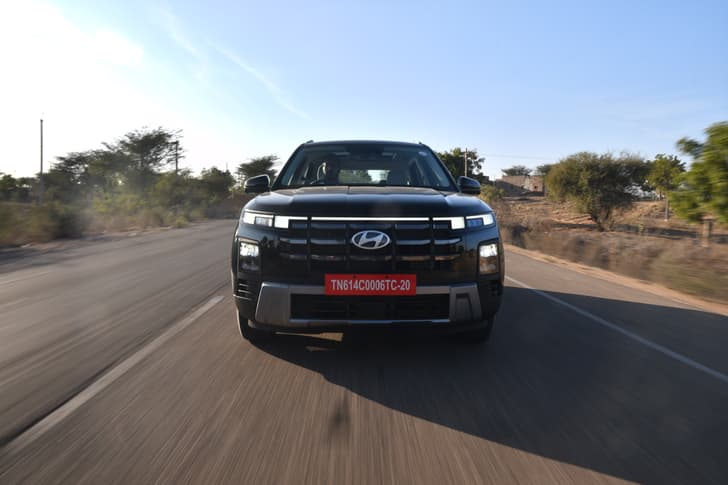
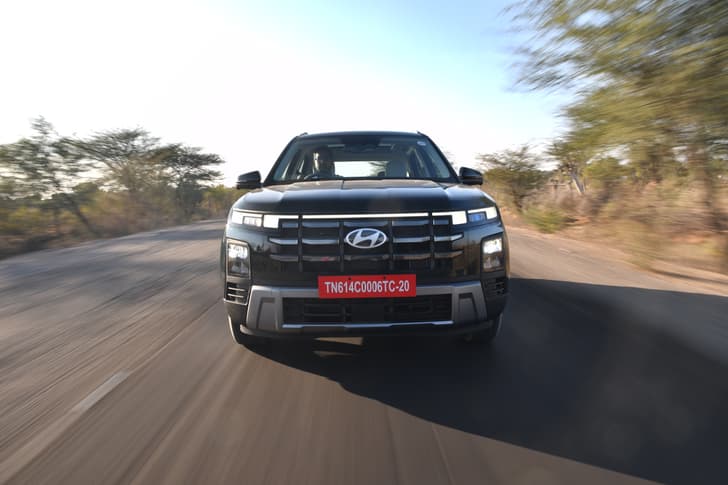
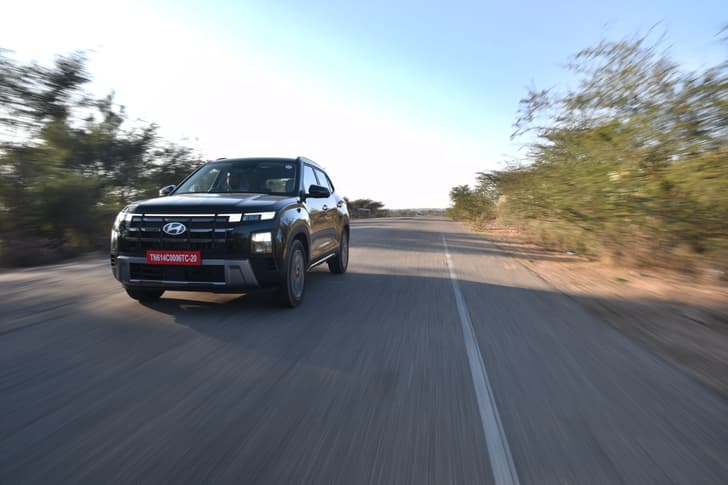
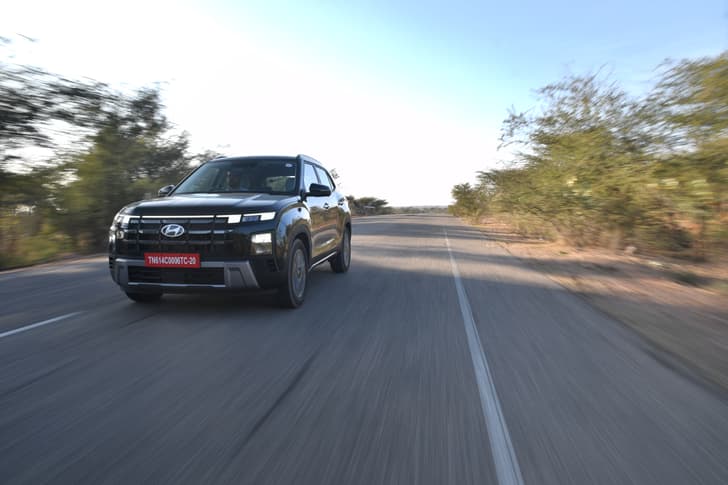
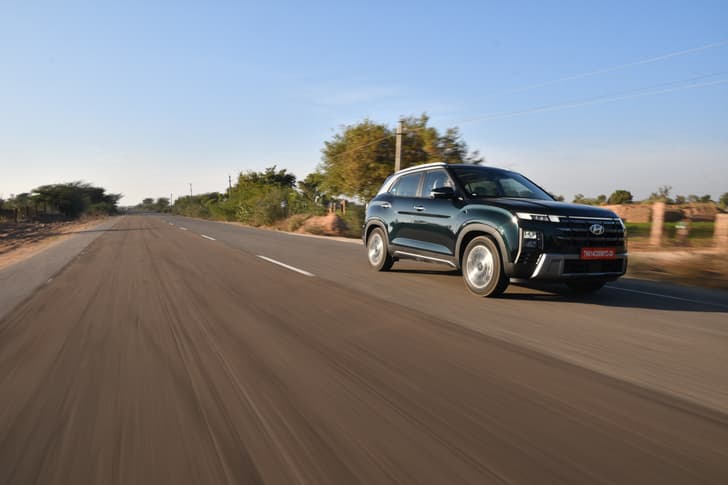
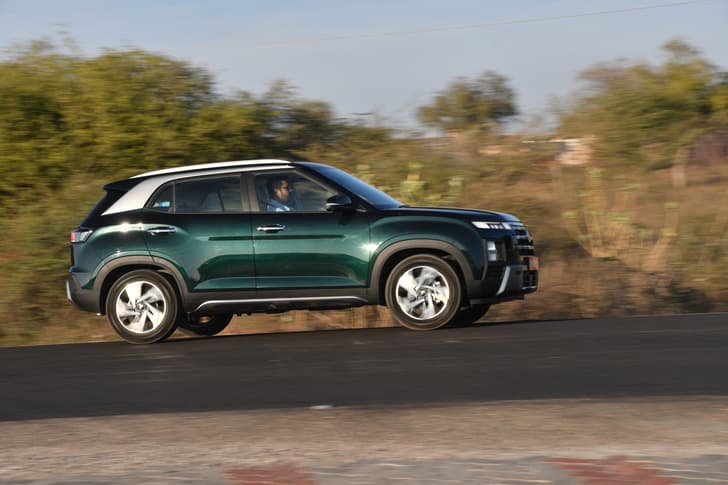
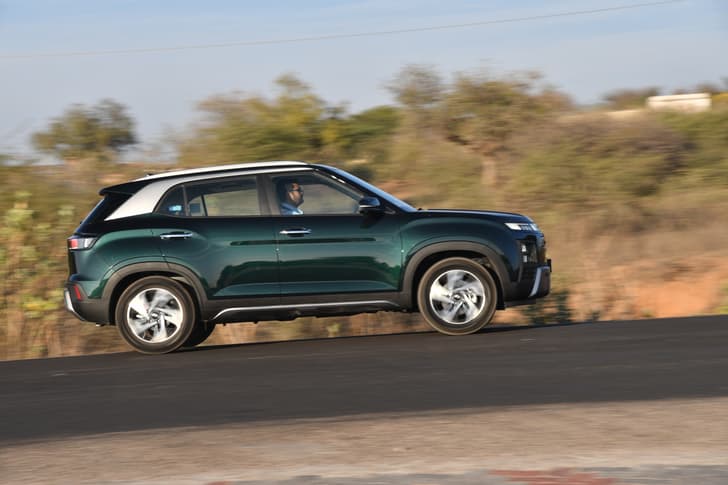
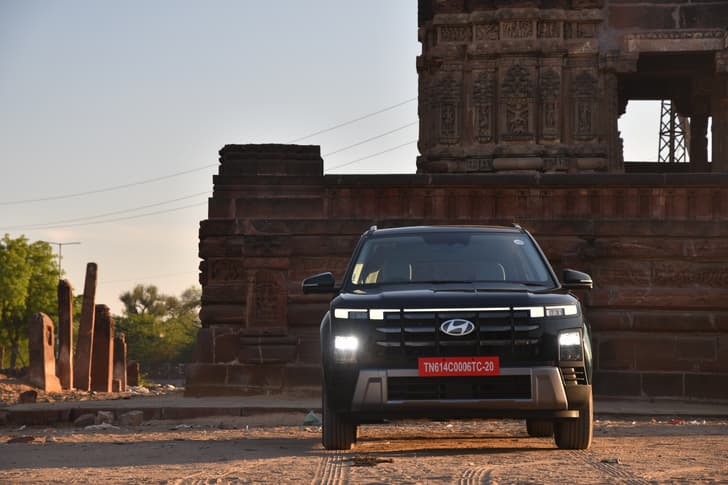
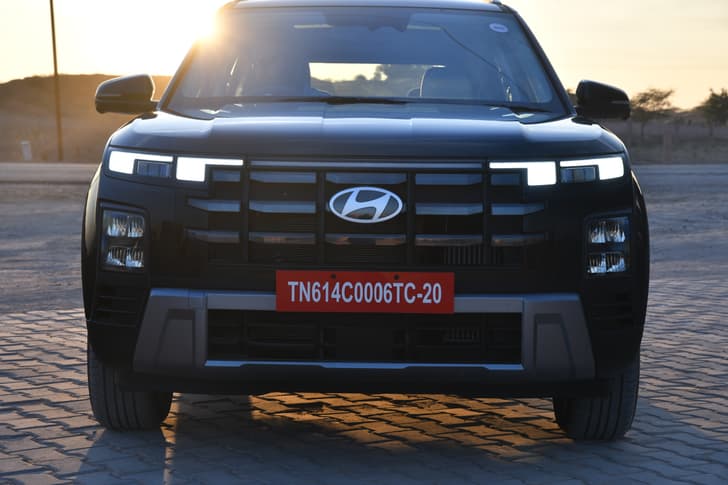
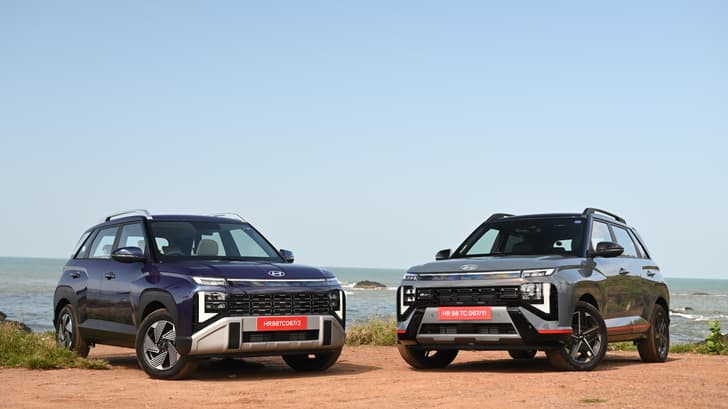
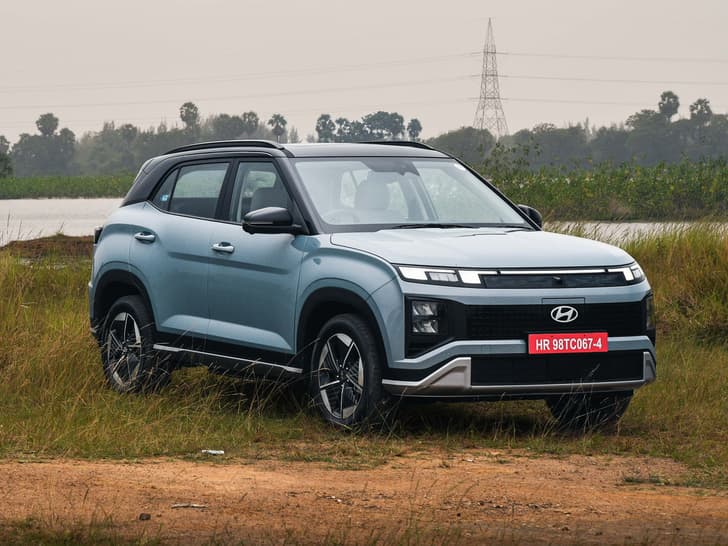
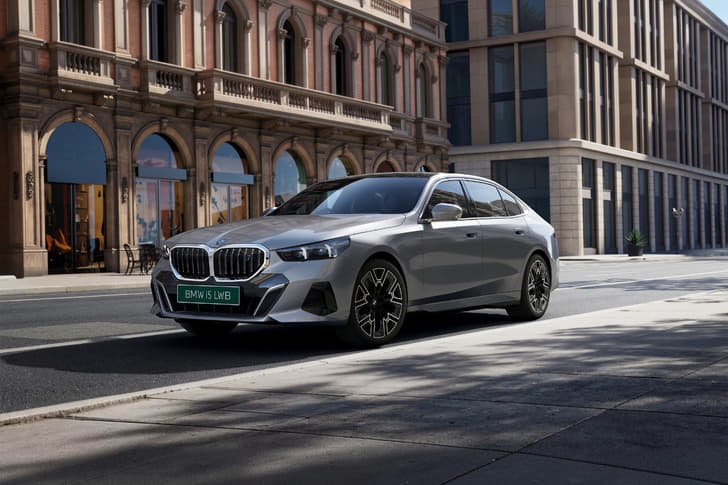
Hyundai Creta Petrol S(O) CVT
Hyundai Creta Petrol S(O) CVT specifications
Engine & Transmission
Fuel Type/ Propulsion | Petrol |
Engine Installation | Front |
Engine Displacement | 1497 cc |
Engine Type | 4 cyls |
Max Engine Power | 115hp at 6300 rpm |
Max Engine Torque | 143.8Nm at 4500 rpm |
Drive Layout | Front-Wheel Drive |
Gearbox Type | CVT Auto |
Lockable Differential/s | No |
Sport Mode for Automatic Gearbox | Yes |
Manual Shifts via Gear Lever on Automatic Gearbox | Yes |
Paddle Shifters for Automatic Gearbox | Yes |
Fuel & Performance
Fuel Tank Capacity | 50 litres |
Official Fuel Economy | 17.7 kmpl |
City Fuel Economy as Tested | 11.17 kmpl |
Highway Fuel Economy as Tested | 15.05 kmpl |
Auto Start/Stop | Yes |
0-100kph | 13.73 s |
20-80kph (in third gear/ kickdown) | 7.68 s |
40-100kph (in fourth gear/ kickdown) | 9.67 s |
Suspension & Steering
Front Brakes | Discs |
Rear Brakes | Discs |
Type of Power Assist | Electric |
Steering Adjust | Tilt and Telescopic |
Steering Adjust type | Manual |
Front Suspension Type | Independent, MacPherson Strut |
Front Springs | Coil Springs |
Rear Suspension Type | Non-independent, Torsion Beam |
Rear Springs | Coil Springs |
Damper Control | No |
Ride Height Adjust | No |
Wheels | Alloys |
Wheel Size | 17-inches |
Front Tyre Size | 215/60 R17 |
Rear Tyre Size | 215/60 R17 |
Spare Wheel | Space-saver |
Dimensions
Length | 4330 mm |
Width | 1790 mm |
Height | 1635 mm |
Wheelbase | 2610 mm |
Kerb Weight | 1282 kg |
Doors | 5 |
Boot Capacity | 433 litres |
Hyundai Creta Petrol S(O) CVT features
Comfort
| Power Windows | Front and Rear |
| Power Windows with One Touch-Down | |
| Power Windows with One Touch-Up | |
| Exterior Mirrors Electric Adjust | |
| Exterior Mirrors Electric Fold | |
| Remote Locking |
Safety
| Airbags | 6 |
| Anti-Lock Brakes (ABS) | |
| Electronic Brakeforce Distribution (EBD) | |
| Brake Assist (BA) | |
| Electronic Parking Brake | |
| Traction Control |
Exterior
| Body Coloured Bumpers | |
| Projector Headlamps | |
| Headlight Type | LED |
| Daytime Running Lights | LED |
| Front Fog Lamps |
Interior
| Speedometer | Digital |
| Tachometer | Digital |
| Trip Meter | |
| Average Fuel Consumption | |
| Average Speed | |
| Distance to Empty |
Entertainment
| Audio System | |
| CD Player | |
| USB Input | |
| AUX Input | |
| Bluetooth Audio Streaming | |
| Bluetooth Telephone Function |
Hyundai Creta variants
Hyundai Creta comparison


Trending Questions on Hyundai Creta - Answered by Autocar Experts
I am using WagonR (CNG). I want to upgrade to an automatic petrol SUV. I am considering Grand Vitara Zeta AT, Victoris ZXI AT and Creta S (O) iVT. Please suggest me good car in terms of comfortable driving and milage. I use car 50% in city and 50% on highway. My annual usage is 5000-6000 km.
The Hyundai Creta IVT is the best pick of the three models on your shortlist. It's got the smoothest gearbox, and engine performance is also significantly better than the Maruti Suzuki Grand Vitara AT and Victoris AT. Fuel economy is decent too, and should not pinch over your 5000-6000km of annual usage.
What also strengthens the Creta's case is that it's more spacious than the Maruti Suzuki models.
However, we'd also recommend checking the Kia Seltos IVT. As you may know, the Seltos and Creta are closely related products. The recently-launched second-gen Seltos is built on the Hyundai Group's latest platform (the Creta continues on the last-gen platform). IIt comes with better tech as well as the promise of better safety. The new Seltos is also roomier than the Creta, making it better suited to family use.
Hi, I want to purchase an SUV with an automatic transmission. There are so many vehicles, and I am confused. My budget is ₹18-20 lakh, and my daily city drive is between 30 and 40 km. Can you suggest the best vehicle with safety, comfort and good service?
I drive around 178 km daily (approximately 46,000 km per year), mostly on highways and expressways. I am trying to decide between CNG and diesel for my next car. My main concern with CNG is long-term engine wear, as I have heard that some CNG engines may require major repairs after 1-1.3 lakh km. Since I plan to keep the car for at least 5+ years, durability is very important to me. My priorities are low NVH (noise, vibration, and harshness), smooth highway cruising, comfort, durability, and reliable long-term ownership. Considering my usage pattern and high annual mileage, which engine option would be better - CNG or diesel? Also, which car would you recommend?
For the kind of usage you describe, around 178km a day and roughly 46,000km a year - a diesel car makes far more sense than a CNG one.
Firstly, diesel is much more widely available on highways and expressways, which is where you’ll be spending most of your time. With such high daily mileage, convenience matters, and diesel fuel stations are easy to find almost anywhere in the country.
Secondly, diesel engines are better suited to long-distance cruising. Their strong low-end and mid-range torque make overtaking easier and allow the car to cruise at highway speeds with less effort. This also typically results in lower engine stress and more relaxed driving. It should suit your priorities of smooth cruising, good NVH and long-term durability.
CNG cars, on the other hand, do have a few compromises. Performance is noticeably weaker than petrol versions, because CNG produces less energy. When the car is fully loaded or when you need quick overtakes on the highway, the lack of power becomes quite evident.
Another practical issue is that the CNG cylinder takes up a large portion of the boot, which can be inconvenient if you are frequently travelling with luggage. From a mechanical perspective, modern factory-fitted CNG engines are much better engineered than earlier conversions.
However, CNG is a dry gaseous fuel and doesn’t have the lubricating properties of liquid fuels, so over very high mileages, there can be slightly higher wear on valves and valve seats. For someone covering well over 40,000km a year, a diesel powertrain is generally the more robust long-term solution.
Since you haven’t mentioned your exact budget, here are a few strong diesel options across segments. In the compact SUV class, the Hyundai Venue diesel is a good choice with a refined and proven 1.5-litre engine. If you want something larger and more comfortable for long highway drives, the Hyundai Creta diesel remains one of the best all-rounders with excellent refinement and efficiency.
And if you are looking for something bigger and more premium, the Mahindra XUV7XO diesel offers strong performance, good highway manners and a very robust engine.
Both Hyundai Motor India and Mahindra & Mahindra have well-proven diesel engines that are known to handle high mileage well when properly maintained. Given your driving pattern and ownership horizon of 5 years or more, diesel is clearly the more suitable and practical choice.
I currently own a Skoda Rapid 1.5-litre turbo diesel and am planning to buy a new car with a budget of up to Rs 20 lakh. Will cars like the Hyundai Creta or Kia Seltos offer the same engine quality, refinement and driving experience as my Rapid? My priority is engine smoothness and efficiency rather than features. Which car or brand would you recommend based purely on engine performance?
The Skoda Rapid 1.5 TDI you are driving uses VW’s EA189 1.5-litre diesel, which is known more for its strong mid-range punch and excellent efficiency than for outright refinement. It has a slightly gruff note and a typical diesel clatter, especially at idle and under hard acceleration.
The 1.5 diesel in the Hyundai Creta and Kia Seltos (Hyundai’s U2 CRDi engine) feels smoother and quieter. That’s largely down to newer-generation injection systems that use multiple injection pulses per combustion cycle, better insulation, and tighter control of combustion noise. The power delivery is also more linear and less “peaky” than the old VW unit, so it feels more refined in everyday driving.
On efficiency, your older BS4 Rapid has an inherent advantage. BS6 engines must meet stricter emission controls (higher EGR rates, DPF systems, different injection strategies), which affect outright fuel economy in real-world use. That said, the latest 1.5 diesels in the Creta and Seltos are still very efficient and won’t feel like a major step down.
If engine smoothness and quietness are your top priorities, the Creta/Seltos 1.5 diesel will feel more polished than your Rapid. If you love that strong, slightly raw mid-range surge and bulletproof efficiency, the old Volkswagen diesel still has a character that’s hard to replicate today.
I am planning to buy a new car and am confused between the 2026 Hyundai Creta EX(O) IVT, Kia Seltos HTK IVT and Honda Elevate V CVT. My usage will be around 50 percent in the city and 50 percent on highways. I also plan to sell the car after 3-4 years, so good resale value and overall value for money are important factors. Which of these cars would you recommend?
Among your three choices, the Hyundai Creta is in high demand in the used market and therefore holds its value the best. The current Kia Seltos is too new to accurately predict its resale value, but going by the resale values of the last generation, we expect it to be only slightly behind the Creta. Interestingly, the Elevate, despite Honda's good reputation, will likely see the most depreciation of the three, but in the V CVT variant you've chosen, it is also the cheapest to buy, and Honda dealers regularly offer sizeable discounts on it.
The Creta is the safest bet if you want the best value for money and strong resale value. It is good to drive, well-equipped, the engine is smooth and refined, and the IVT works seamlessly. However, do take a test drive of the Elevate as well. It offers better acceleration than the Creta, the seats are very comfortable, and the suspension feels more robust. If you can negotiate a good deal, it can represent very good value for money.
I own Maruti S-Cross Diesel 2018 model.I have driven 1 lac km approximately with one major accident till date.We are a family of four.I drive extensively with 60% city and 40% highway.Is it the time for switching to new car or continue with the old car? If yes what is your suggestion for cars within Rs.20 lacs?
1 lakh kilometres is significant mileage and speaks volumes about the durability of the Fiat-sourced MultiJet diesel in your Maruti Suzuki S-Cross. It also reflects Maruti Suzuki’s reputation for reliability. That said, once the odometer crosses 100,000km, you are entering a phase where wear-and-tear components, suspension, clutch, injectors, turbo, etc., start demanding attention.
Also, since the S-Cross is now discontinued and was never a high-volume model, sourcing certain parts in the long term could become more time-consuming or expensive. On balance, this is a reasonable time to consider switching.
Given your positive ownership experience, staying with Maruti makes sense. The Maruti Suzuki Grand Vitara is a strong option. The strong-hybrid variant, around the Rs 20 lakh mark, will deliver very low running costs. It is possibly even better in city use than your current diesel, which suits your 60 per cent urban driving pattern. It should also give you the same easy ownership experience you’re used to.
If you prefer sticking with diesel for highway efficiency and torque, the Hyundai Creta diesel is a very good alternative. It offers a more spacious rear seat than the Grand Vitara and a more usable boot, since the Grand Vitara's hybrid battery slightly eats into luggage space. For a family of four with a mix of city and highway use, both are sensible upgrades within your Rs 20 lakh budget.
I want to buy a car with a budget of ₹16-18 lakh ex-showroom under my employer’s car lease policy. My usage is very light, around 1000 km per month. I currently have a Swift VXi on which I’ve done 30,000 km in 4 years. The car is used mostly in the city with occasional highway trips. I want a petrol manual with a good driving experience like my Swift. I am confused between Kia Seltos, Toyota Hyryder, Skoda Kushaq, and Honda Elevate. Should I consider extending my budget for an XUV 7XO AX7 or should I wait for the Hyundai Creta update (I like the Dark Edition)? Please suggest the most valuable car in this budget with its recommended variant.
If the driving experience is the top priority, the Skoda Kushaq will be the right pick for you. It's got punchy turbo-petrol engines, and handling is very enjoyable. The updated Kushaq launches next month and packs in a few more features, and also stronger air conditioning. While Skoda has not announced prices as yet, you should get a fully-loaded 1.0 TSI with a manual gearbox within your budget.
Of the other options, the Honda Elevate is also worth considering. Engine performance and handling are good, but refinement isn't great for this segment.
The Mahindra XUV 7XO AX7 is great, but it might be too large for your requirements. Also, fuel economy is lower than the alternatives on your list. The Hyundai Creta is a practical pick, and the 1.5 petrol engine and manual gearbox are easygoing, but unexciting.
I am considering the Mahindra XUV 7XO, but I am confused between the diesel and petrol versions. I will be a first-time buyer, and I want to know how the maintenance and running costs compare between the diesel and petrol variants, especially since my usage will be minimal. As a first-time buyer, should I instead choose a lower-cost car? Please advise.
If your usage is minimal, the Mahindra 7XO petrol makes more sense than the diesel. The petrol is smooth, refined and quite perky to drive. Yes, it isn’t the most fuel-efficient and can feel a bit thirsty, but with low running, the higher fuel consumption won’t really pinch. Mahindras are also reasonably priced to maintain, and service costs are generally competitive for the segment.
The diesel would only make sense if you were regularly clocking high kilometres. With limited usage, the higher upfront cost and the nature of modern diesels (which prefer longer runs) don’t really work in your favour.
That said, as a first-time buyer, you should also think about size and ease of driving. The XUV 7XO is a fairly large, powerful SUV, and its size and performance can feel a bit overwhelming initially. A smaller car will be easier to manoeuvre, park and live with day to day and will also be more efficient.
If you like Mahindras, the Mahindra XUV 3XO is worth a look. It’s almost like a baby 7XO - strong performance, good features, but in a more compact and manageable package.
If you want to play it safe, the Hyundai Creta (especially the 1.5 CVT) remains the default choice in this segment. It’s easy to drive, well-rounded, efficient enough, and very user-friendly for a first-time owner.
So yes, the 7XO petrol works if your heart is set on it and usage is low. But do consider whether a smaller SUV might suit you better as your first car.
Hi, I am planning to buy a car for our family, which will be primarily used by my dad and occasionally by me as well. Currently, he drives a Maruti Ciaz diesel. The plan was to go for an SUV with a budget of ₹18-21 lakh. We were thinking of the Hyundai Creta Diesel Automatic or the Maruti Suzuki Grand Vitara Strong Hybrid. Alternatively, we also had the new Kia Seltos and new XUV700 in mind, given their price range. His main priorities are: Smooth driving experience (including smooth suspension) Very good rear seat space (including legroom - as the Ciaz offers very good space) Good luggage space Decent mileage (13-15 km/l in city and 18-20 km/l on highways) Low maintenance and minimal headaches for 5-6 years Considering these, can you guide us on which could be the best option and the specific model we should go for? The expected driving range would be more than 500 km per month.
If you want very good legroom that matches the Honda Ciaz and a smooth driving experience, the Mahindra XUV 7XO 2.2 diesel AT is a good choice. Mahindra has upgraded the rear suspension, and the ride quality and handling have improved significantly.
Rear seat space is excellent, and luggage space is very good, especially with the third row folded down. The trade-off is that the 7XO is a big, heavy SUV. It doesn’t feel as nimble in city traffic and tight parking, and it isn’t very efficient compared to the other options.
If fuel efficiency is a higher priority for you, then the Maruti Suzuki Grand Vitara strong hybrid (or its mechanically similar cousin, the Victoris hybrid) will give you much better economy. It delivers smooth performance, easy city driving and the efficiency figures you’re aiming for.
The Hyundai Creta diesel AT is also a solid, more efficient choice than the 7XO, with a comfortable ride and easy usability in town traffic.
After the Ciaz, you’ll likely feel most at home in the 7XO because of the space and comfort it offers. But if you prefer better efficiency and a slightly smaller, easier-to-live-with package, the Grand Vitara hybrid or the Creta diesel automatic are both good alternatives within your budget.