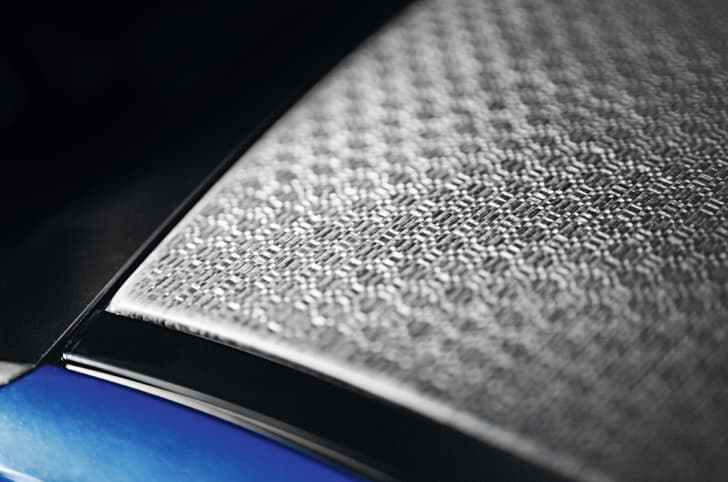
After using a sustainable, natural-fibre composite in motorsport for a number of years, BMW has announced it will be using the flax-based material, developed by Swiss firm Bcomp, on future production models. In testing, the material has proved suitable for a range of uses, including visible A-surface finishes on the interior and exterior.
Several years of R&D have found that composites made from renewable materials are not only able to create attractive surface finishes, but they can also be used for structural components. An example is the roof panel in next-gen cars, where renewable fibre composites can reduce CO2 equivalent by 40 percent during production, and it gives end-of-life benefits.
BMW’s venture capital arm, i Ventures, holds a stake in Bcomp, which was founded in 2011 to make high-performance skis using flax fibres, and Bcomp became an official BMW Motorsport partner in 2022. Its woven fabric, Amplitex, is made from European flax fibres sourced from the plant of the same name. Weaves can vary for different uses and visual effects, and it comes either as fabric or impregnated with thermoplastic resin (prepreg). Structural panels can be reinforced with ‘Powerribs’, a grid-like mesh also made from flax fibres and bonded to the mat.

BMW first used reinforcement parts made from the natural fibre material in its 2019 Formula E cars, followed by the M4 DTM as well as the M4 GT4, replacing carbon fibre-reinforced plastic (CFRP). The M4 GT4 was equipped with parts made from the new materials for the Nürburgring 24 Hours.
Bcomp says that depending on the application, the ‘cradle to gate’ (extraction of raw materials to leaving the factory) CO2 footprint can be up to 85 percent lower compared with conventional composites. Some components can be 50 percent lighter and reduce the use of plastic by 70 percent – thermoplastic Powerribs can meet those weight- and plastic-reduction criteria for interior panels.
Bcomp is also working with a number of other carmakers. Cupra is using its materials in seats, Kia has used it in the interior of the EV3 and EV4 concepts, Polestar in the Polestar 3, Volvo in the Concept Recharge, and Porsche has used it in the 718 Cayman GT4 Clubsport for wings and doors. Along with its announcement, BMW released images of prototype roof panels, a rear diffuser and cabin trim.
Elsewhere, Karuun, a material made from rattan by German firm Out for Space, was used by Nio in its Eve concept back in 2017. It was later used in production in the ET7 and EC7 as a trim material. Karuun Stripe, a rattan veneer, is used in Porsche’s Macan Electric for its Nature Tech Material interior trim options.