


Despite Volvo’s extensive use of super-high-strength steels, Håkan Ivarsson, technical director of Vehicle Line 90, said the SPA cars will be the “lightest in class”. The only significant use of aluminium in the SPA structure is for the front suspension towers, which are glued and riveted to the steel bulkhead and inner wings.
The SPA structure is engineered in five sections, of which four (the front overhang, cabin, rear luggage space and rear overhang) can vary in size. The only fixed section is the engine bay and bulkhead. This is just 593mm long when measured between the centre of the front axle and the point where the driver’s heel rests on the floorpan.
Although the SPA architecture will only accommodate four-cylinder engines, it is compatible with mechanical all-wheel drive, electric rear-axle hybrid drive, plug-in hybrid and pure electric transmissions.
Apple-flavoured interior
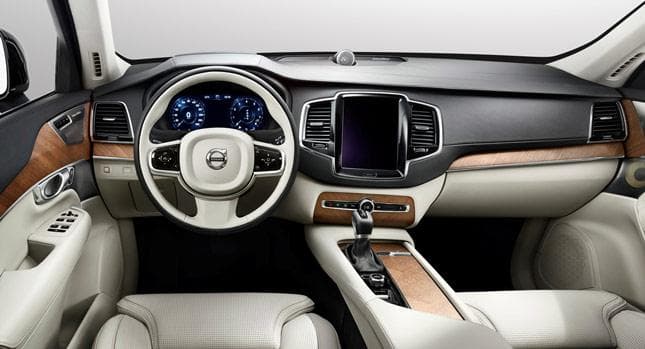
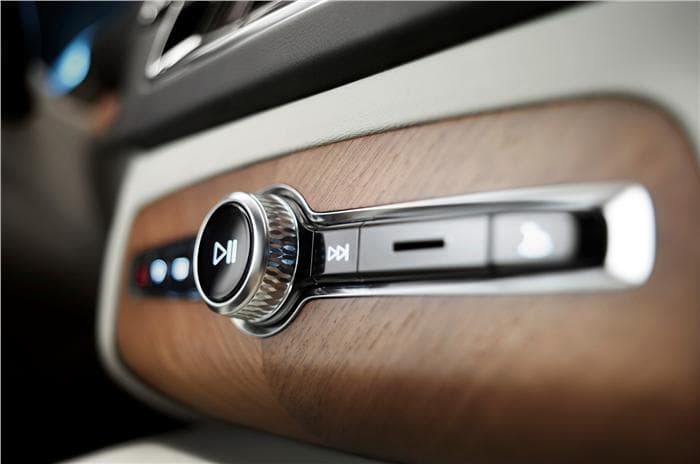
The screen-based dashboard of the new XC90 is dominated by the 9.5-inch, portrait-format touchscreen. It immediately propels Volvo into a lead over its premium rivals, whose button-heavy fascias are in contrast to the XC90’s volume knob and six tiny conventional switches (including the windscreen defrosting and hazard light controls). The touchscreen has been fitted with a filter to stop it from reflecting in the windscreen. It can also be operated by a gloved hand, something that is not possible with most smartphones.
In normal mode, the screen is divided into four sections: navigation, media, phone and weather. If the screen is swiped to the left, it reveals the vehicle settings, such as the climate control. This allows, for example, the cabin temperature to be adjusted on a slider. Swipe the screen to the right and the applications screen, via Apple’s new CarPlay system, is revealed.
New generation of engines
The Volvo Engine Architecture (VEA) was conceived before Ford sold Volvo. Volvo engineers spent so much money modifying Ford engines that it was deemed more cost-effective to build its own from scratch. The 2010 takeover by Geely provided the funds, and the new engines are already fitted to the V40, XC60 and S/V60.
All VEA engines will have four cylinders. There will be four power outputs each for both petrol and diesel versions using, variously, single and twin turbos and a combination of turbocharging and supercharging. Volvo claims fuel economy improvements of between 15 and 35 per cent over their predecessors. The diesel engines get a ground-breaking i-ART injection system that can meter out fuel to each cylinder with extreme accuracy.
 Suraj Viswanathan
 Glenn Noronha
 Dhruv Dhaka
 Dipan Sur
 Uday Singh