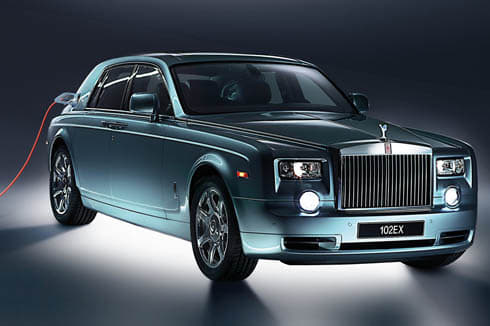
This is the Rolls-Royce 102EX, or Phantom Experimental Electric. It’s a one-off engineering test-bed which sees the standard 6.75-litre V12 engine and automatic gearbox replaced by a huge battery pack and twin-electric motors driving the rear wheels.
Rolls-Royce says the the 102EX will spend the rest of the year on a global tour with the aim of getting feedback from ‘owners, VIPs, media and enthusiasts’.
The 71kWh battery pack weighs 640kg, 90kg more than the combined weight of the conventional engine and transmission.
It takes 20 hours to recharge the huge battery (the largest ever fitted to a car). Using an alternative three-phase electrical supply it takes eight hours for a full charge. The 102EX also features induction charging, using a pad mounted under the floor. Positioning the car over a transmitter, installed in the parking space allows the battery to be recharged across a gap of 150mm.
This giant battery pack drives a pair of electric motors, which are mounted on the rear subframe. The motors drive a single ratio transmission with an integrated differential. Each motor is rated at 145kW but, more importantly, together they also deliver a whopping 878 kgm of torque from standstill. Although the power from the motors is 48kW down on the equivalent from the V12, the torque peak is up 11 percent.
The 102EX’s drivetrain offers advantages during deceleration, or once the driver lifts off the accelerator pedal. It provides 120Nm of regenerative force – energy is reapplied to the motors as the car slows down.
In truth, this electric drivetrain delivers on the Rolls-Royce promise more completely than any internal combustion engine could ever manage. The surge of forward motion is so uncannily seamless and relentless that your first instinct is that the Phantom’s V12 motor is rendered instantly redundant.
There are two big advantages over internal combustion engines, even one as refined as the Phantom’s V12. Firstly, at speed and under hard acceleration, you can really sense the lack of mechanical inhibition – or heavy motor - behind the bulkhead. The second is the unhindered stream of torque because of the power from the electric motors.
The Phantom EX is not much of a back-road animal. The steering of this unique car was rather too light and the exact placement of the wheels on the tarmac wasn’t obvious enough to the driver. However, the ride quality over sudden potholes was slightly better in the 102EX than it was in the standard-issue Phantom that Autocar tried back-to-back with the electric model.
Rolls-Royce used to market their vehicles with the proud line: “at 100kmh all you can hear is the clock ticking” and with the 102EX, this would otherwise be a possibility; were it not for the absence of a louder petrol motor, resulting in tyre noise becoming much more obvious to passengers.
Sorry, but you can’t. And it’d be surprising if the 102EX progressed much further than a very limited production – and would cost an estimated Rs 7.1 crore - even if it were to be given the go-ahead.
The obvious obstacle to the production viability of the 102EX is its mediocre range and lengthy recharging time, unless you happen to have access to an industrial-strength electricity supply. And the battery pack has just a three-year life, given daily use.
However, this is still perhaps the most luxurious way to travel with a clearer conscience.
 Viraaj Bhatnagar
 Dipan Sur
 Dhruv Dhaka