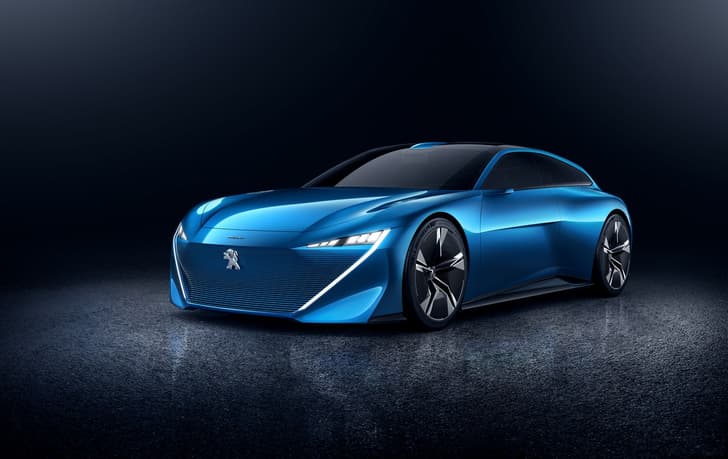
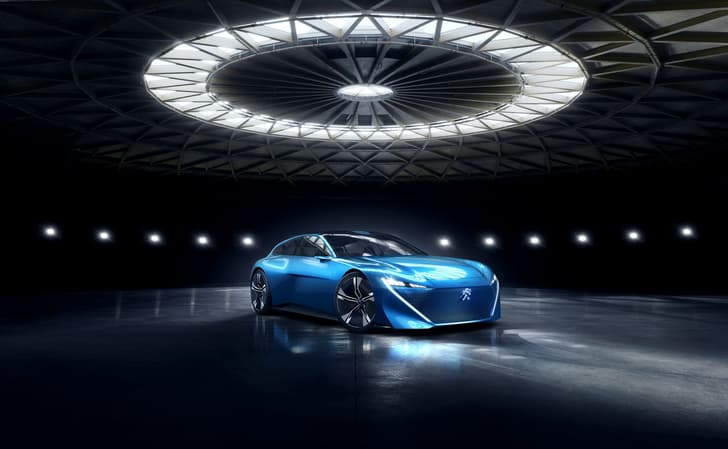
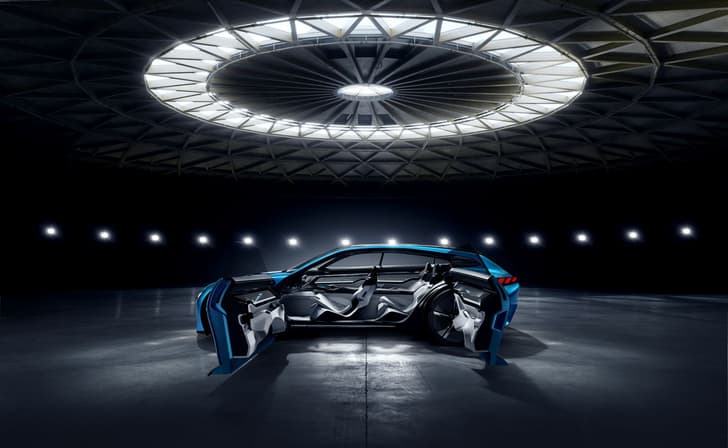
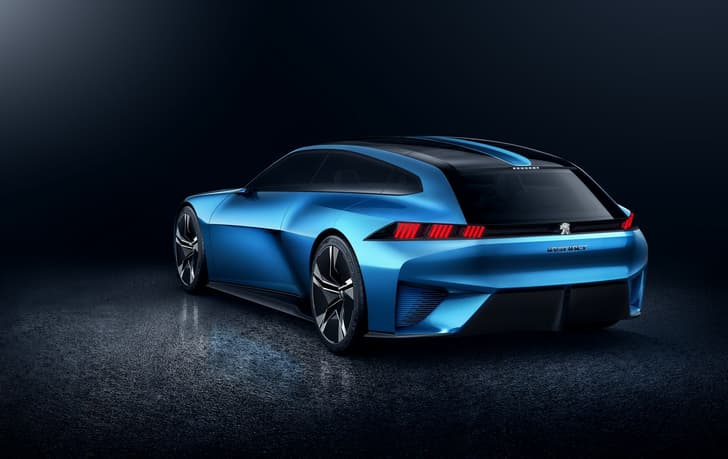
Peugeot has revealed the Instinct shooting brake concept ahead of its public debut at the upcoming Geneva motor show. The concept demonstrates the carmaker’s future autonomous plans for the first time.
Peugeot concept designer Matthias Hossann said that while this model won’t make production, the intention was to create a car “that didn’t look like a UFO” and was genuinely usable as a family vehicle. It has four seats and similar interior space to the 308 hatchback, he added.
Last year, product boss Laurent Blanchent told our sister publication Autocar UK that the carmaker would introduce a greater level of autonomy across its range by 2020, and confirmed that the technology would work in its existing platforms. At a reveal event of the Instinct, Peugeot strategy boss Aude Brille reinforced this, confirming that autonomous versions of its models would not be built on a separate platform.
The Instinct demonstrates technology related to level five autonomy – the highest level of autonomy on a car – meaning it can equal a human driver in every driving scenario. Brille said she expected to see this technology reach Peugeotcars by 2025, a timescale that is in line with the plans of other major carmakers, such as Volkswagen and Mercedes.
The concept is intended to maintain the pleasure of driving, according to Hossann. “You can decide to drive, or you can decide to sleep or read,” he said. With that in mind, the Instinct offers two driving modes for autonomy: Soft, which can be selected if one wants to read in comfort, and Sharp if one wants more of a dynamic journey. There are also two drive modes – Relax and Boost, the latter of which would be the most engaging drive behind the wheel.
Powering the Instinct is a 300hp plug-in hybrid powertrain. Hossann said there was a big focus on efficiency and aerodynamics in the design of the shooting brake. There is also a striking front grille, largely 3D printed, and striking front and rear lights. The front LED lights incorporate a camera into their design that can send information back to the driving assistance systems. This design element is one which, according to Hossann, is most likely to make it to production in the shorter term.
The interior of the concept showcases a future generation of Peugeot’s i-Cockpit interior design. It features a holographic display behind the wheel that shows information such as vehicle speed and battery level, a large screen in the central console and an even larger screen across the front passenger’s dashboard. As with other recent autonomous car concepts such as the Volkswagen ID, the steering wheel can retract. A so-called i-Device next to the central console screen allows the driver to command the car.
The Instinct also demonstrates the possibilities of the Internet of Things. Working with Samsung and its so-called Artik Cloud, the cloud connects to devices used every day by the driver and aggregates data. This information can then be collated to help the user.
 Viraaj Bhatnagar
 Dipan Sur
 Dhruv Dhaka
 Saptarshi Mondal