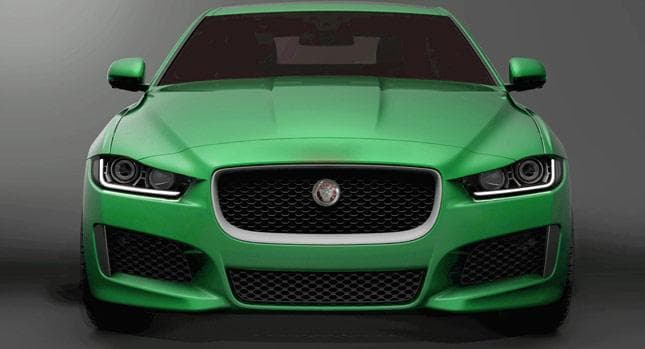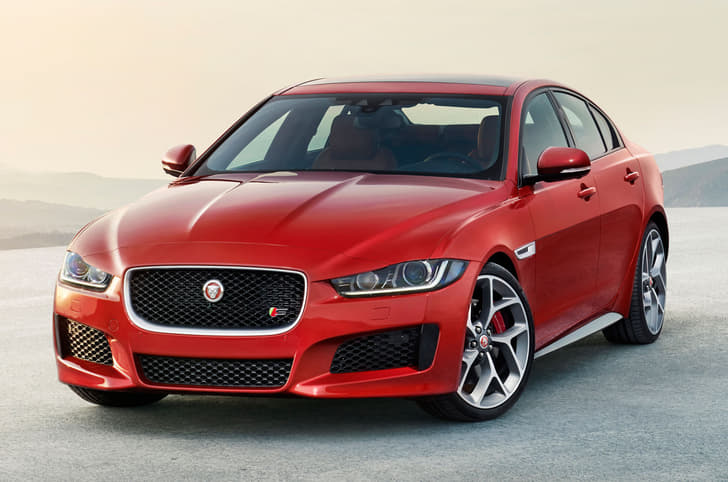
Jaguar has taken the wraps off its new BMW 3-series rival, the XE.
Jaguar will be hoping the XE’s impressive range of technical innovations – including a new chassis, new materials, new body, new assembly works, new engine range and a new engine plant – will help it to take on the 3-series as well as the Mercedes-Benz C-class and Audi A4.
The XE’s success has huge implications for Jaguar’s ability to fulfill its new model plan of the future.
The car does not set out to shock, however. It employs and extends the new-generation Jaguar design style introduced with the XF sedan in 2008 and developed more recently in the F-type sports car range.
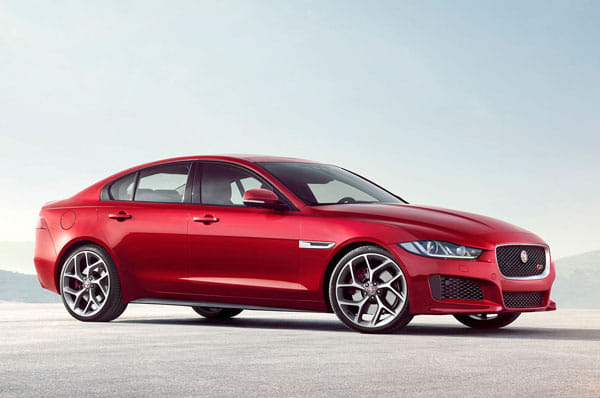
The new Jaguar is an all-aluminium, four-door, rear-drive sedan – slightly bigger than a 3-series but smaller than an A4 – that uses riveting and bonding techniques developed over the past decade that make it Jaguar’s lightest, stiffest sedan yet.
The XE will become Jaguar’s entry-level model. It is tipped to sell well over 100,000 units a year globally, when production hits its stride, and even more when other body styles are launched.
Design
Design boss Ian Callum says that the new Jaguar XE will become “the defining sports sedan for Jaguar”.
His design team’s way of fulfilling that brief, he explains, was to start by giving the car a low driving position, a long, coupé-like roofline like the XF and placing the cabin as far rearward as possible to allow the car a long bonnet and short boot while still providing decent (although admittedly not class-leading) legroom and headroom in the rear.
Callum acknowledges the debt that the XE owes to the XF, which pioneered many facets of Jaguar’s modern design style: the sculpted bonnet with strong ‘power bulge’, the narrow headlights and ‘J-blade’ running lights, the rising waistline and long, confident curve of the coupé roof.
The rear lights he describes as “a horizontal line intersecting a roundel” and they owe something both to the F-type and originally the E-type, just as the rounded window of the rear door carries suggestions of the Jaguar Mark 2.

No one would suggest that this was anything but a Jaguar for 2015, but allusions to the marque’s rich history are clear in many places. Jaguar’s designers are proud of their equal partnership with the XE’s engineers and aerodynamicists.
In its most frugal form, on specially designed 17-inch wheels (as opposed to the 18s, 19s and 20s also available), the car’s drag coefficient is an impressive 0.26. The car’s lowness and shrink-wrapped lines have helped to keep the frontal area low, designers say.

 Viraaj Bhatnagar
 Dipan Sur
 Dhruv Dhaka

 Saptarshi Mondal