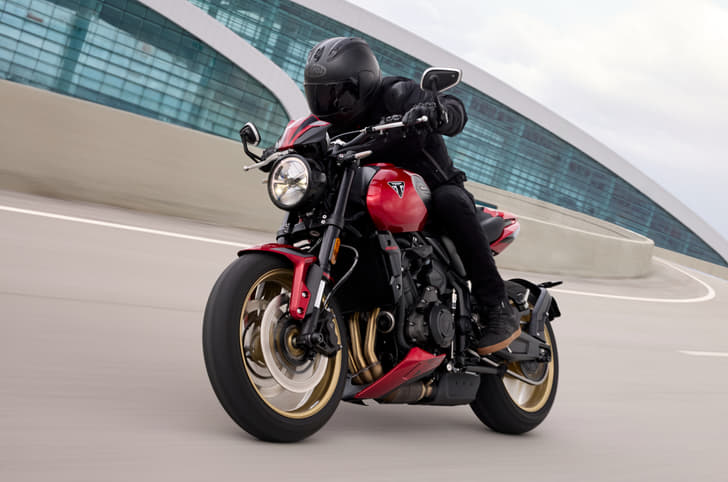
Triumph has unveiled the Trident 800, an all-new middleweight naked roadster that expands its Trident line-up above the 660. While this new model may appear to be a larger-capacity version of the smaller Trident, Triumph says it is substantially re-engineered, with a new engine, revised chassis and more sophisticated electronics.
- Triumph Trident 800 produces 115hp and 84Nm
- It bridges the gap between everyday ease and Street Triple performance
- It is 9kg heavier than the Street Triple R
Triumph Trident 800: What’s new?
The Trident 800 packs the same engine as the Tiger Sport 800
The Trident 800 builds on the 660’s template while promising a more rounded performance package aimed at riders seeking a mix of real-world usability and everyday comfort. Its overall design remains faithful to the Trident identity, featuring a sculpted 14-litre tank, a clean tail section and a round LED headlamp that now gets a small flyscreen and an integrated TFT display.
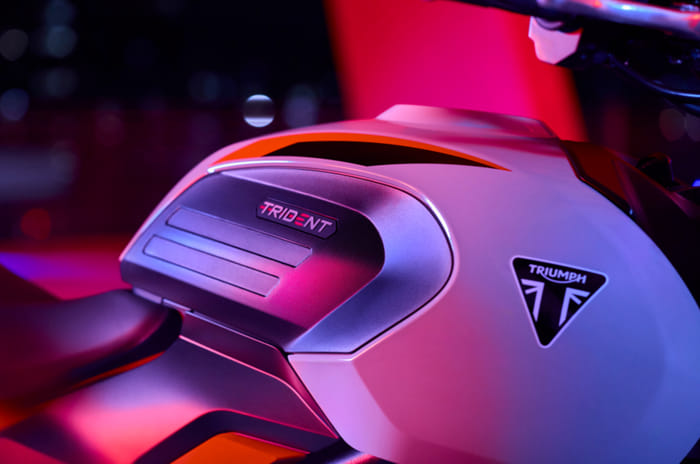
Interestingly, the Trident 800 shares much of its engineering direction with the Tiger Sport 800 that debuted last year, and it sits close to the Street Triple 765 R in Triumph’s line-up, in terms of both performance and positioning.
Trident 800 engine and chassis details:
At its core is an engine derived from the Tiger Sport 800 – a 798cc inline-triple producing 115hp at 10,750rpm and 84Nm at 8,500rpm. Power is down by 5hp, while torque is up by 4Nm compared to the Street Triple R. Triumph claims it delivers roughly 40 percent more power than the Trident 660, with a stronger midrange and a higher-revving top end. The exhaust has also been redesigned, now exiting on the right side rather than beneath the bike.
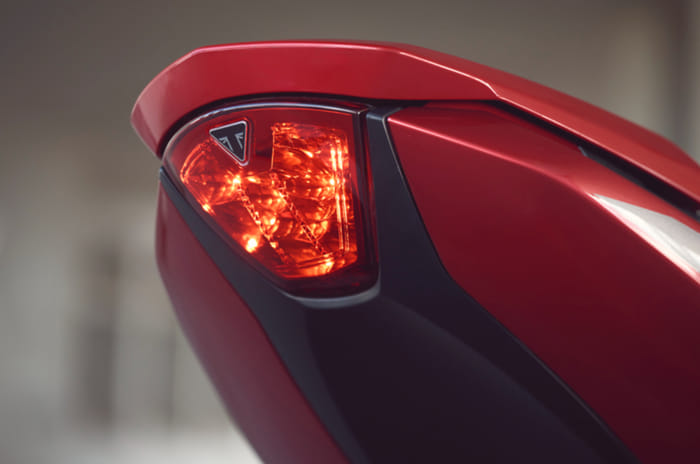
The seat height stands at 810mm, and the rear section has been redesigned with a 2-piece stepped seat. Braking duties are handled by twin 310mm discs with 4-piston radial calipers – a step up from the 660’s setup. It tips the scales at 198kg – 9kg heavier than the Street Triple R, which might be due to the extensive steel usage in its frame compared to the aluminium twin-spar used in the Street Triple. The Trident 800 employs a steel perimeter frame suspended by a Showa 41mm SFF-BP USD fork and a monoshock.
The Trident 800 features a 6-axis IMU that enables lean-sensitive traction control and cornering ABS. There are three riding modes – Road, Sport and Rain – that adjust throttle response and intervention levels, all displayed via a familiar 3.5-inch TFT dash.
Other equipment includes cruise control, Bluetooth connectivity, self-cancelling indicators and an all-LED lighting setup. A colour-matched belly pan is standard, while Triumph’s accessories range includes items such as a titanium Akrapovic silencer and other cosmetic add-ons.
Design and positioning
.jpg?w=700&c=0)
The Trident 800’s design bridges the gap between the Street Triple’s focused performance and the Trident 660’s accessibility. The ergonomics are more relaxed than the Street Triple’s, and the styling, with a round headlamp and compact proportions, gives the bike broader appeal for daily use. The wheel design and colour complement all three paint options – grey with bright red highlights, dark red with grey accents, and black.
The Trident 800 has been priced at GBP 9,195 (approximately Rs 10.72 lakh) in the UK, while the Street Triple R currently costs slightly less at GBP 8,995 (around Rs 10.49 lakh) owing to a temporary discount on that model. At these prices, the Trident 800 could very well overlap with the existing Street Triple R when it comes to India. It now remains to be seen when Triumph India launches it.
 Ved Janve
 Vishal Venugopal
 Dinshaw Magol