
Delhi
Delhi
NR
Nikhil Renuse
•4wHi AutocarIndia, love your entire team. It rocks! {You’ll get the reference :)} I'm looking at buying the Thar Roxx Star Edition, diesel, manual, 4x2, for touring across India. The Roxx stands out for: 1) its ability to go almost anywhere irrespective of road conditions; 2) the 2L diesel engine felt fabulous during the test drive with respect to power and NVH; 3) apart from the body roll due to its body-on-frame construction, the suspension setup impressed me; 4) I have always loved the way the Thars look (found it better than the Jeep Compass in points 2, 3 and 4). Mahindra’s much larger service network compared to Jeep’s also works in favour of the Roxx. I would appreciate your help with two concerns: 1. I couldn’t find an empty stretch of road to test the Roxx at 100-120kmph. Are NVH levels, wind buffeting noise and stability at 100–120 kph a concern? 2. Should I opt for the ADAS version instead? How useful is ADAS with a manual transmission? Is adaptive cruise control actually useful in reducing driver fatigue? Does autonomous emergency braking work in a manual? All questions pertain to real-life traffic conditions on our highways like the Pune-Bangalore highway, which would form a majority of my travel. I’d like your take on anything else I might have missed and need to consider. Thank you, Nikhil.

Autocar India

A manual gearbox does limit how much you can use ADAS, but it doesn’t make it irrelevant. Adaptive cruise control (ACC) can still operate, but only within the usable rev range of the gear you are in. In something like the Mahindra Thar Roxx manual, the system won’t shift gears for you. So if traffic slows and the revs drop too low, you’ll get a prompt to downshift or take over.
In dense, constantly changing traffic, you’ll often end up cancelling it yourself. Where it really helps is on long, relatively open highway stretches, where it can hold speed and distance and reduce the small, continuous effort of modulating the throttle. Yes, it can ease fatigue, but it isn’t as seamless as in an automatic.
Autonomous emergency braking (AEB), forward collision warning, lane keep assist, and other safety functions are largely independent of the gearbox. They rely on sensors and braking, so they will still intervene if the system detects a potential impact. Of course, like all ADAS, they work best with predictable traffic; in the real world, you should treat them as a backup, not something to rely on blindly.
So, should you pick the ADAS version? If you frequently do big highway miles, there is value in the added safety net. Just go in knowing that with a manual, ACC will feel like an assistant you sometimes cooperate with, rather than a system that takes over.
If reducing fatigue is your top priority, there’s nothing to beat an automatic transmission, which makes driving far easier and more convenient than a manual with ADAS features.

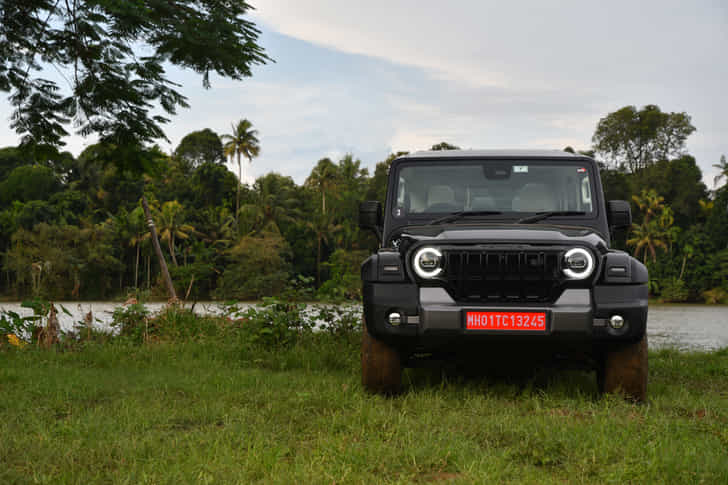
Mahindra Thar Roxx
Explore cars mentioned
Got a suggestion for Nikhil?
Add a Comment
Latest questions people are discussing

Posted on: 17 Feb 2026