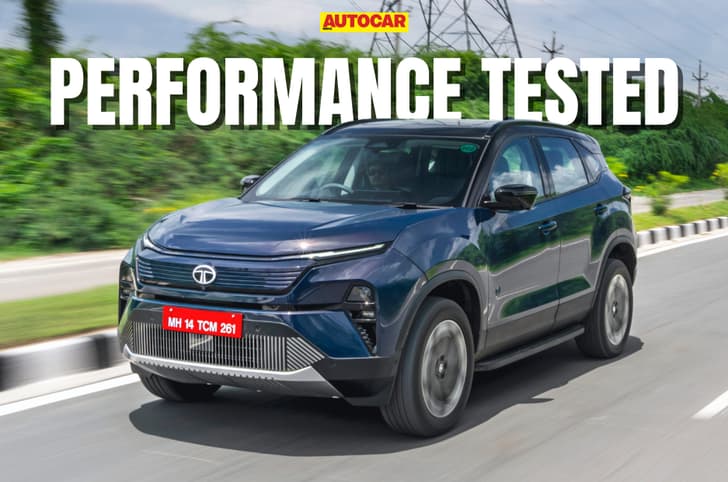
At the launch of the Tata Harrier EV, the brand claimed that the top-spec AWD version – which is powered by a 75kWh battery pack – has a 0-100kph time of 6.3 seconds. We put that claim to the test with our real-world acceleration and braking assessments.
Tata Harrier EV AWD specifications
158hp front motor and 238hp rear motor; combined output is 313hp and 504Nm
Battery 75kWh | Front motor 158hp | Rear motor 238hp |
Total power 313hp | Total torque 504Nm | ARAI range 622km |
Drive AWD | Kerb weight 2335kg |
For the Harrier EV’s AWD setup, Tata opted for a 158hp induction motor on the front axle and a 238hp permanent magnet synchronous motor for the rear. Combined, the peak output figures are 313hp and 504Nm. The Harrier EV AWD gets four drive modes – Eco, City, Sport and Boost. Disc brakes at the front and rear provide stopping power, and there are 4 levels of regenerative braking to choose from while driving, starting with Level 0. It should be noted that even in the highest regen mode (Level 3), the Harrier EV does not come to a halt without brake input.
Tata Harrier EV 0-100kph test results
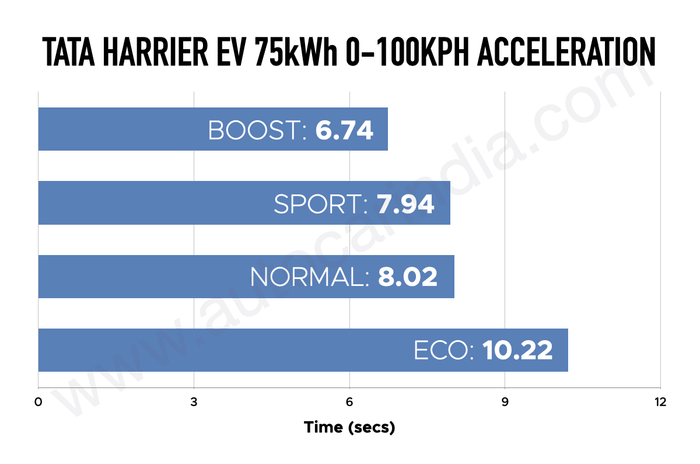
Tested 0-100kph time is 0.44 seconds more than the claimed time
We tested the Harrier EV AWD in all four drive modes, and naturally, Boost posted the quickest times, with 100kph coming up in 6.74 seconds, just 0.44 seconds short of Tata’s claimed time. Still, the sprint time is quick by most standards, especially if one factors in the Harrier EV AWD’s portly 2.3-tonne kerb weight. Interestingly, the acceleration times for Normal and Sport modes are similar, which means that there isn’t much difference between the drive modes at full throttle. However, part-throttle differences between the two modes are noticeable. The table also shows that Eco mode does restrict power significantly, posting a 0-100kph time that is 3.48 seconds slower than the Harrier EV AWD’s fastest time.
Tata Harrier EV rolling acceleration test results
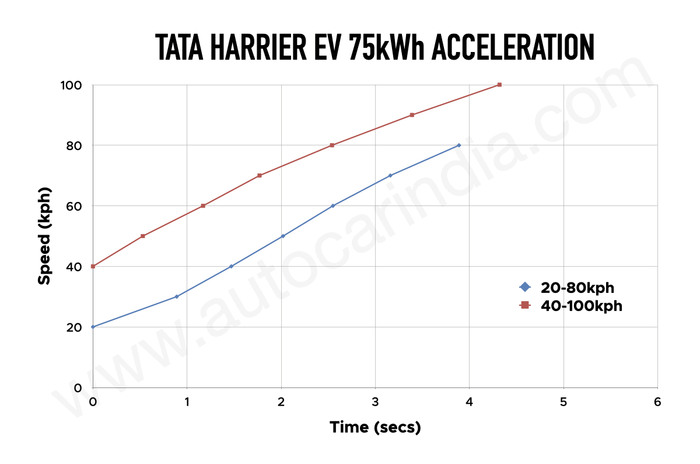
Difference between Sport and Normal drive modes is minimal
In the 20-80kph and 40-100kph rolling acceleration tests, the Harrier EV AWD’s quickest times were 3.89 seconds and 4.32 seconds, respectively. Again, the difference between the Sport and Normal modes is minimal, while Eco mode makes the EV significantly slower.
Tata Harrier EV top speed
Tata claims the Harrier EV AWD’s top speed is 180kph
Tata says the Harrier EV AWD’s top speed is limited to 180kph, and our tests showed that it tops out at 182kph on the speedometer. Adjusting for speedo error, our instruments showed a real-world top speed of 172kph.
Tata Harrier EV braking test results
80-0kph times 2.23s and 34.36m
Despite its size and weight, the Harrier EV AWD comes to a halt fairly quickly, taking 2.23 seconds and 24.36 metres to brake from 80kph to a standstill. In the lowest Level 1 regen mode, the Harrier EV slows down from 80kph to 20kph in 20.78 seconds, while Level 2 and Level 3 take 10.4 seconds and 8.89 seconds, respectively. As mentioned above, even Level 3 regen does not allow for one-pedal driving.
Autocar India’s testing standards
Before we conduct our performance tests, we check and maintain tyre pressure based on the manufacturer’s recommendation and ensure the car is charged to a 100 percent. The car is then tested in a controlled environment with two people on board, and the data is collected via highly accurate GPS-based timing equipment.

 Uday Singh

 Glenn Noronha
 Dipan Sur