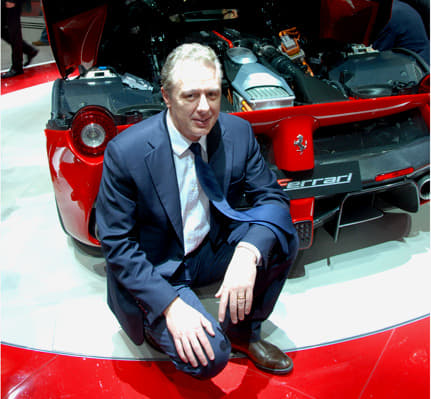
When did work on the LaFerrari actually begin?
We started the project around three years ago. We had a concept before in the development process. But actual work started only three years ago.
What was the objective of the car? Was it meant to be just an Enzo replacement or did you have any specific targets like a particular car, top speed, acceleration or handling?
First and foremost we focused on delivering a car that our customers would enjoy driving. Of course, one has to keep in mind certain targets in terms of technical specifications. But most importantly, our focus was on making a car that would provide a driving experience never felt before in any other car.
The LaFerrari uses a carbonfibre chassis, which you’ve been using for some time, but with this car, you’ve taken it to a whole different level. Could you elaborate?
We added 140kg to the car with the hybrid system. Which means we had to save the same amount of weight to keep it at the same level as the Enzo. In order to do that, the biggest challenge was slimming down the tub (or the frame). And so for this, we used the best technology available to us, the same as is used on our Formula 1 cars. Both the Enzo and this car use carbon fibre, but on this car the grade used is very different. There are three grades in general - T700, T800 and T1000. We’d used T700 on the Enzo while on the LaFerrari, we’ve used the other two. Now while they weigh the same, when using the T800 and T1000, the amount of material required is much less, because it is much stronger.
Was there any objective with the stiffness of the chassis?
The target was the same as on the Enzo but we managed to make it 27 percent stiffer due to its superior design. Today, the stiffness is determined more by crash tests than by handling objectives.
You have a unique arrangement with the fixed seats and moving pedals. Is this a function of reducing weight or is there some other objective?
No, it's not only to reduce weight. It is important from the point of view of safety and weight distribution as well. If you fix the position of the seat, the position of the driver is fixed relative to the windscreen. This means that the trajectory during the crash is defined in a very static way and it does not change. You also have the weight of the driver in exactly the same place, which is good for weight distribution.

 Uday Singh

 Glenn Noronha
 Dipan Sur