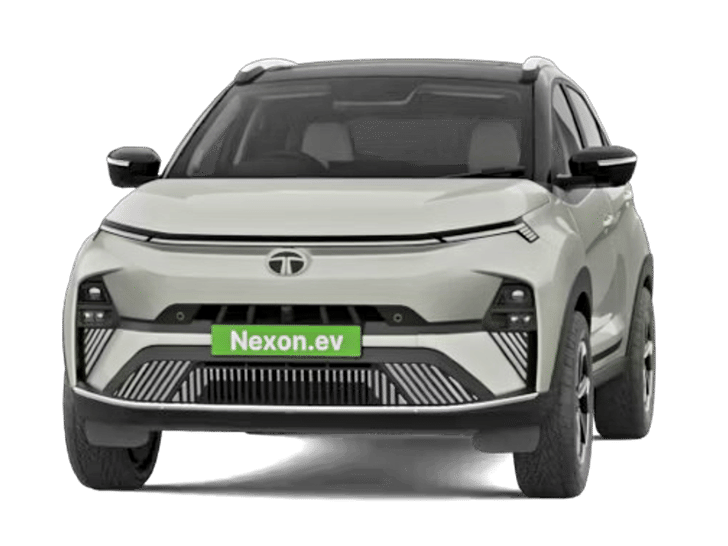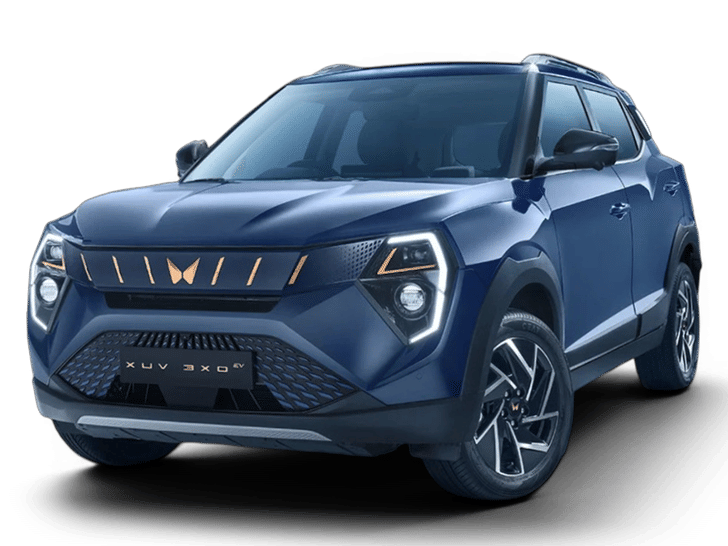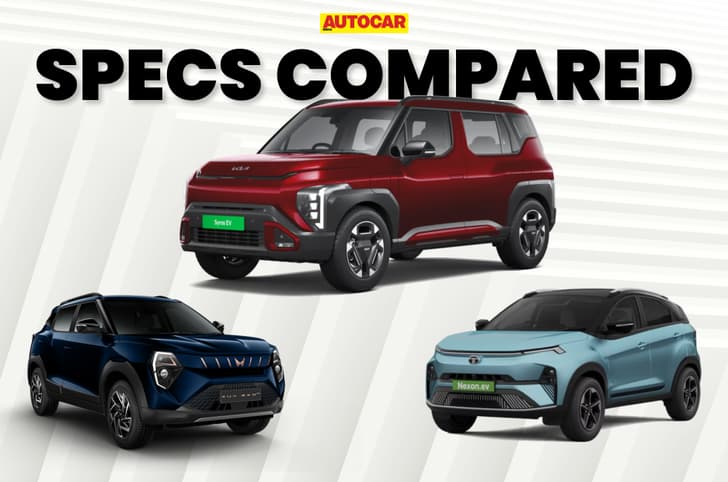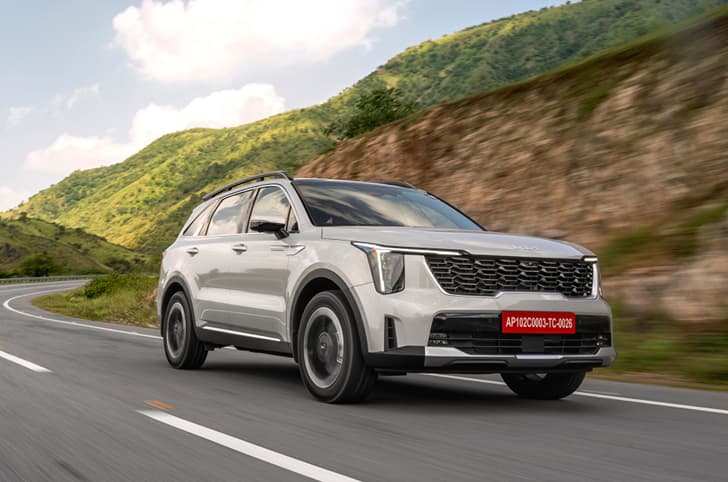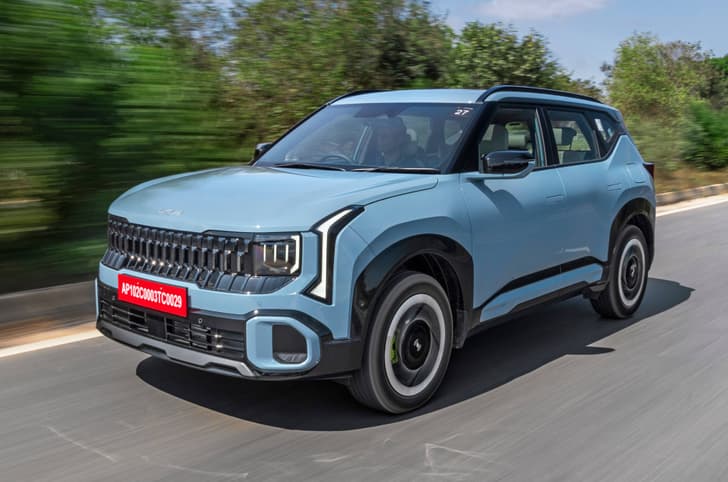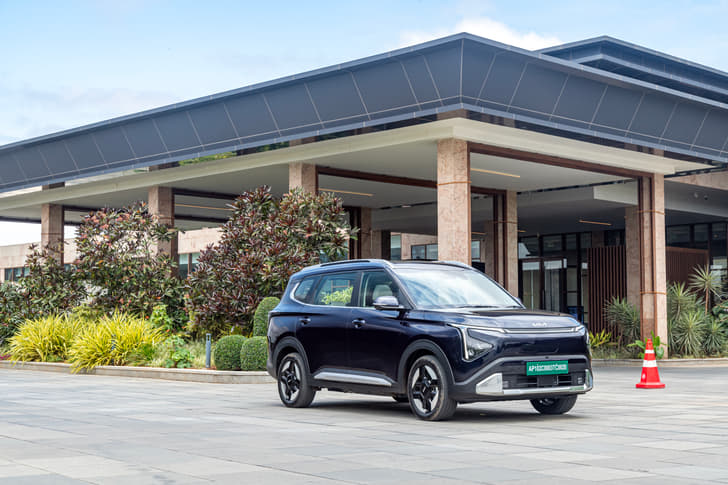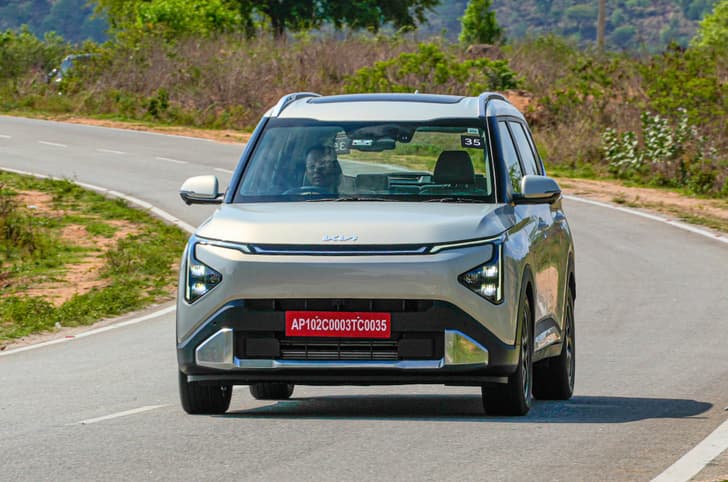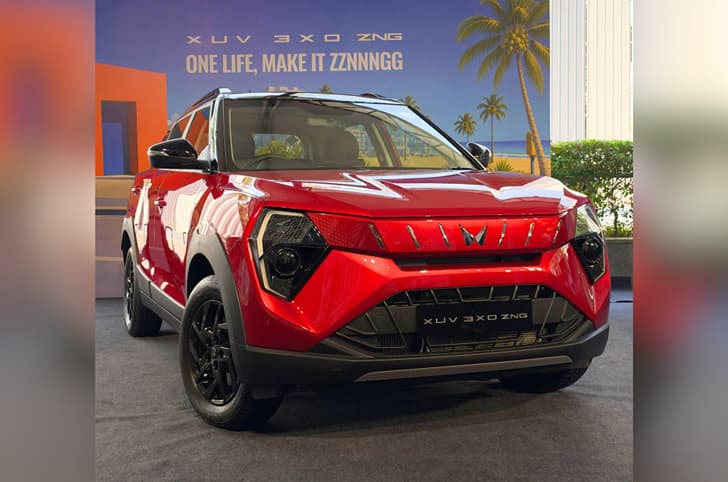

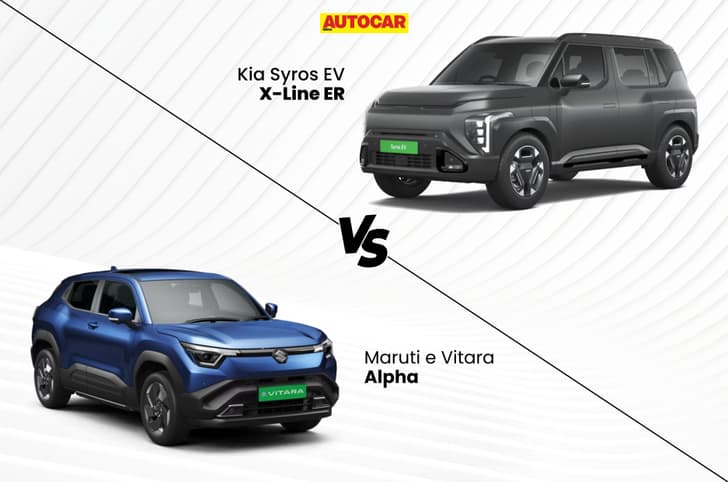
Kia India has officially launched its second mass-market electric car, the Syros EV. While the sub-4m Syros EV directly rivals the Tata Nexon EV and Mahindra XUV 3XO, its pricing overlaps quite a bit with that of the Maruti Suzuki e Vitara, which is from a segment above. In fact, the top-spec trims of both electric SUVs are identically priced. Therefore, we compared the top-spec versions of the Syros EV and e Vitara on paper to determine which electric SUV offers more bang for your buck.
Kia Syros EV vs Maruti Suzuki e Vitara: Top trim dimensions
e Vitara is longer, but Syros EV is wider and taller
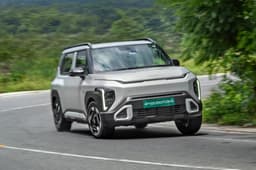
Expectedly, the Syros EV is 280mm shorter overall (150mm shorter wheelbase) than the e Vitara, but interestingly, the Kia compact SUV is 5mm wider and 30mm taller. Neither Kia nor Maruti Suzuki quote precise boot space figures for their respective electric SUVs, but it’s worth noting that the Syros EV comes with a 16-litre frunk, while the e Vitara completely lacks storage space up front. However, the top-spec e Vitara does get larger alloy wheels than the equivalent Syros EV.
Kia Syros EV vs Maruti Suzuki e Vitara: Top trim powertrains
Syros EV is quicker, e Vitara claims higher range and has a bigger battery
The Syros EV’s battery pack is almost 10kWh smaller than that of the e Vitara, but the Kia is only 17km behind in terms of ARAI-rated range. Both electric SUVs are front-wheel drive and have similar power figures, but the Syros EV edges ahead by a significant 62Nm in terms of torque output. This is partly why the Syros EV claims a 0.6sec quicker 0-100kph time than that of the e Vitara.
Kia Syros EV vs Maruti Suzuki e Vitara: Top trim charging speeds
Syros EV supports higher DC wattages
Kia and Maruti Suzuki quote AC charging speeds at different wattages, so the Syros EV and e Vitara can’t be directly compared on this front. However, it is noteworthy that even though the e Vitara has a larger battery than the Syros EV, the former takes roughly the same amount of time for a 10-100 percent charge at 7.4kW as the latter does at 11kW. Coming to DC charging, the Syros EV supports up to 100kW, while the e Vitara tops out at 70kW.
Kia Syros EV vs Maruti Suzuki e Vitara: Top trim exterior features
Syros EV gets puddle lamps, but e Vitara offers much greater choice in colours
Both electric SUVs are quite evenly matched in terms of exterior features, but the Syros EV takes the lead by way of roof rails and door-mounted puddle lamps that project the Kia logo. The Syros EV has flush door handles, too, but some may appreciate the e Vitara’s conventional door handles more. Colours are a square win for the e Vitara, as it offers six monotone options and four dual-tone finishes. The Syros X-Line ER can be had in either Aurora Black Pearl or Matte Graphite, both of which are difficult to maintain. Buyers who want other colours have no option but to consider lower-spec Syros EV variants.
Kia Syros EV vs Maruti Suzuki e Vitara: Top trim interior features
Syros EV beats e Vitara with panoramic sunroof, cooled rear seat bases and more
Even on the inside, the Syros EV’s feature set comes out on top. Over the e Vitara, the Syros EV packs larger infotainment and instrument displays, an additional screen for climate control settings, a panoramic sunroof, rear sunshades and ventilation for the rear seat bases – this feature is not available even in electric SUVs a segment above the Syros EV. The e Vitara’s only advantage over the Syros EV is a greater gamut of electrical adjustment for the driver’s seat.
Kia Syros EV vs Maruti Suzuki e Vitara: Top trim driving features
Syros EV scores big on convenience by way of paddleshifters for regen modes
Both the Syros EV and e Vitara come with three drive modes and adaptive cruise control, but the Kia SUV inches forward thanks to vehicle-to-load (V2L) functionality, which lets you power external devices from the battery pack. The Syros EV also offers paddleshifters to cycle through the regenerative braking levels, while the e Vitara makes do with just a knob on the centre console. However, the e Vitara does offer a Snow terrain mode over the Syros EV.
Kia Syros EV vs Maruti Suzuki e Vitara: Top trim safety features
e Vitara wins thanks to an extra airbag, rain-sensing wipers and a 5-star BNCAP score
Coming to safety, the e Vitara finally scores a win. It’s the only one here to come with seven airbags and rain-sensing wipers, whereas the Syros EV sets itself apart with side parking sensors. The e Vitara also holds a 5-star crash safety rating from Bharat NCAP, while the Syros EV has not been tested yet. It is worth noting, though, that the ICE-powered Syros was awarded 5 stars by Bharat NCAP, so a similar rating for the compact SUV’s electric derivative is very possible.
Kia Syros EV vs Maruti Suzuki e Vitara: Top trim prices
Syros EV for buyers seeking features, e Vitara for those who want a bigger car
As noted previously, there is next to no difference in the pricing of the Syros EV X-Line ER and e Vitara Alpha, which means the final decision comes down to your needs and preferences. If you want as many features as possible, are fine with a dark colour and don’t mind smaller dimensions and funkier styling, the Syros EV X-Line ER is the one to go for. On the other hand, if you want the price you pay to be reflected in the size of the car, more choice in colours, more conventional looks and are happy to forgo some features, you can consider the e Vitara.
It is also worth noting that both the Syros EV and e Vitara can be purchased with a Battery-as-a-Service (BaaS) scheme, which converts the cost of the battery into separate usage-based EMIs, thereby lowering the upfront cost. Kia has yet to reveal the BaaS price of the Syros EV X-Line ER, but the e Vitara Alpha costs Rs 14.49 lakh – Rs 5.5 lakh off the sticker price – with a Rs 4.39/km battery usage fee.
All prices are ex-showroom, India.


 Uday Singh
 Dipan Sur

 Glenn Noronha