


The Renault Duster comes with two turbo-petrol engine options, with its larger 1.3-litre unit not being shared with any other Renault Group model. The Kia Seltos, on the other hand, has the same turbo-petrol mill that’s offered with the Hyundai Creta. Our focus today will be on the top direct injection, turbo-petrol versions of the Duster and Seltos, both of which get a dual-clutch automatic transmission (DCT). So, which of these two midsize SUVs is faster in real-world conditions?
Renault Duster vs Kia Seltos turbo-petrol DCT: Specifications
The Seltos’ higher-capacity engine actually makes less power than the Duster’s unit
Both SUVs come with direct injection, turbocharged four-cylinder petrol engines mated to dual-clutch automatic transmissions. However, the one powering the Seltos has a cubic capacity that’s 149cc higher. Despite this, it’s the Duster’s 1.3-litre powerplant that actually has the higher output, along with boasting a better power-to-weight ratio as well. While the horsepower difference between the two is a mere 3hp in favour of the Renault SUV, the peak torque of the Duster is an appreciable 27Nm more. What is worth noting here is that the Seltos’ peak torque arrives 500rpm earlier in the rev range, providing that initial shove sooner as a result.
Renault Duster vs Kia Seltos turbo-petrol DCT: 0-100kph acceleration test
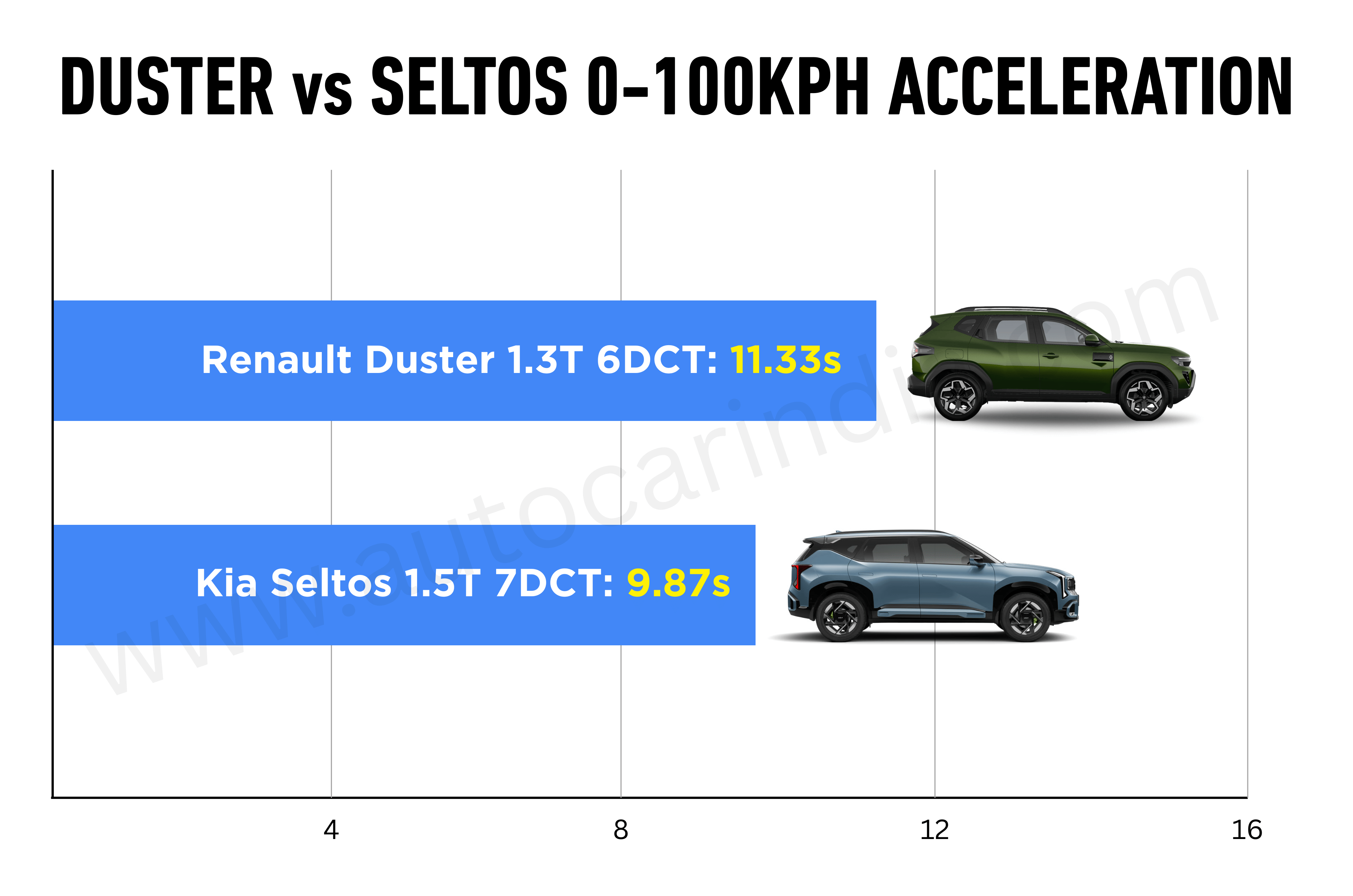
Despite its power disadvantage, the Kia SUV is overall quicker than the Duster
While it makes less power and torque than its Renault counterpart, in our tests, the Seltos 1.5 turbo accelerated from nought to 100kph in just 9.87 seconds. This makes it 1.46 seconds quicker than the Duster 1.3 turbo to the tonne-mark. By the time both cars hit 120kph, the difference between the two drops to 0.66 seconds, still in the Seltos’ favour. The Kia Seltos comes with Eco, Normal and Sport drive modes, whereas the Renault Duster only offers Comfort and Eco modes. However, paddle shifters are available in both models.
The Seltos’ 1.5-litre turbo-petrol engine can be heard in the cabin, but it doesn’t sound coarse and its refinement levels are good. And while its dual-clutch gearbox is quick to shift as speeds rise, it fumbles at lower speeds. The wet-clutch DCT of the Duster is slower between shifts, but it’s nearly as smooth and seamless as a typical torque-converter gearbox. The Duster’s 1.3-litre turbo-petrol engine, however, feels refined and is vibration-free.
Renault Duster vs Kia Seltos turbo-petrol DCT: Rolling acceleration tests
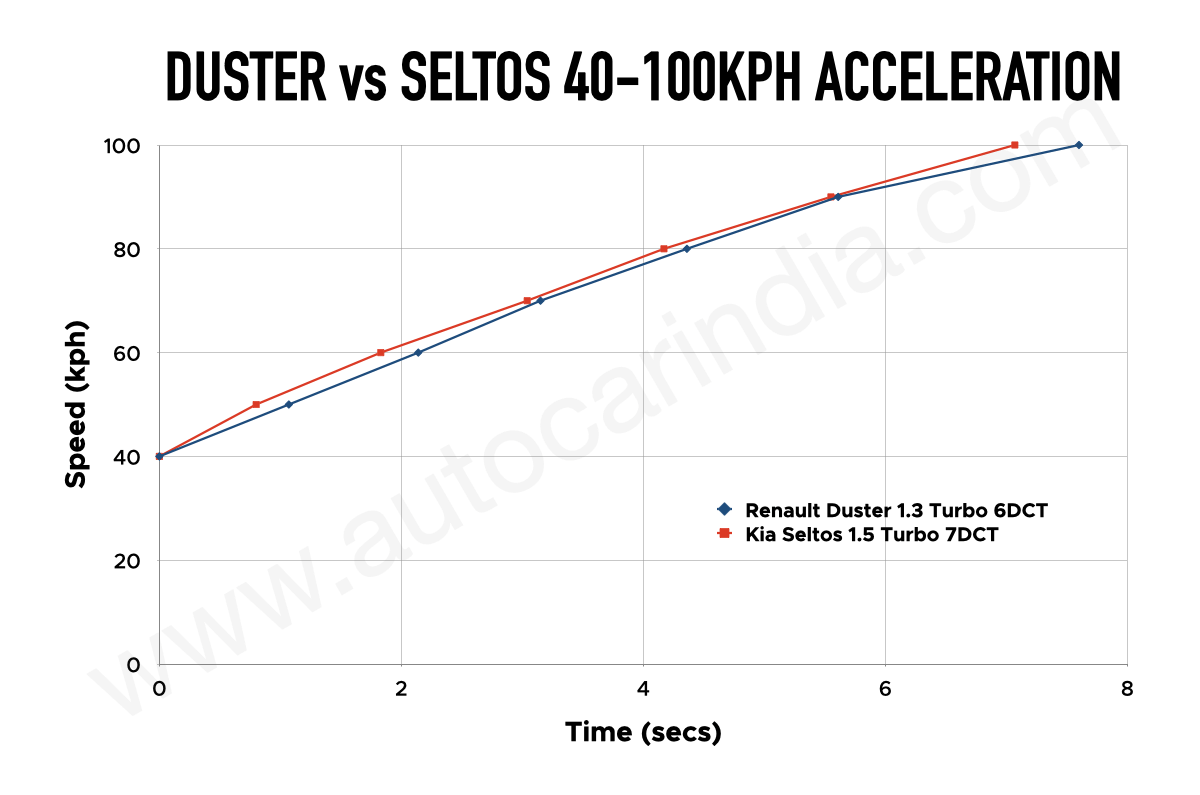
The Seltos outpaced the Duster in our rolling acceleration tests as well
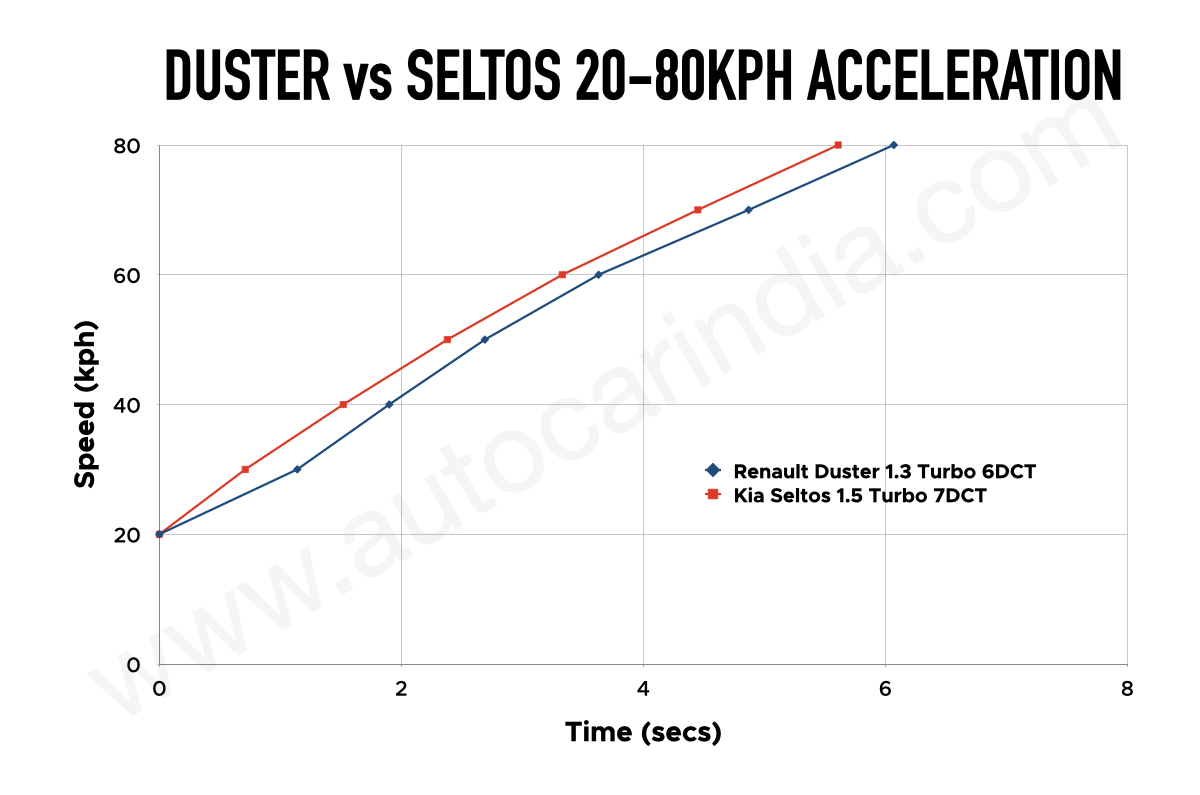
The Seltos 1.5 turbo gets to 80kph from 20kph 0.46 seconds sooner than the Duster 1.3 turbo. This gap widens to 0.53 seconds in favour of the Kia SUV as both models accelerate from 40kph to 100kph.
Renault Duster vs Kia Seltos turbo-petrol DCT: Braking test
The Seltos’ braking performance is better than the Duster’s
Apart from being quicker on the go, the Kia Seltos 1.5 turbo also impresses when dropping its anchors. Despite weighing 104kg more, the Seltos stopped from 80kph in 26.78 metres – that’s 2.28 metres sooner than the Duster 1.3 turbo. However, both models are equipped with disc brakes at all four corners.
Renault Duster vs Kia Seltos turbo-petrol DCT: Prices
The Seltos turbo DCT’s base and top prices are higher than its equivalent Renault Duster
The entry-level turbo-DCT variant of the Kia Seltos is Rs 1.82 lakh more expensive than the equivalent Renault Duster. This price gap shortens to Rs 1.31 lakh at the high end, with the top-spec Duster turbo-DCT remaining more affordable. If outright performance is what you seek, then the Kia Seltos turbo-DCT will be the one for you.
Autocar India’s testing standards
Before we conduct our performance tests, we check and maintain tyre pressures based on the manufacturer’s recommendation and ensure the car has a full tank of fuel. The car is then tested in a controlled environment with two people on board, and the data is collected via highly accurate GPS-based timing equipment.
Prices are ex-showroom, India.



 Uday Singh

 Dipan Sur


 Glenn Noronha