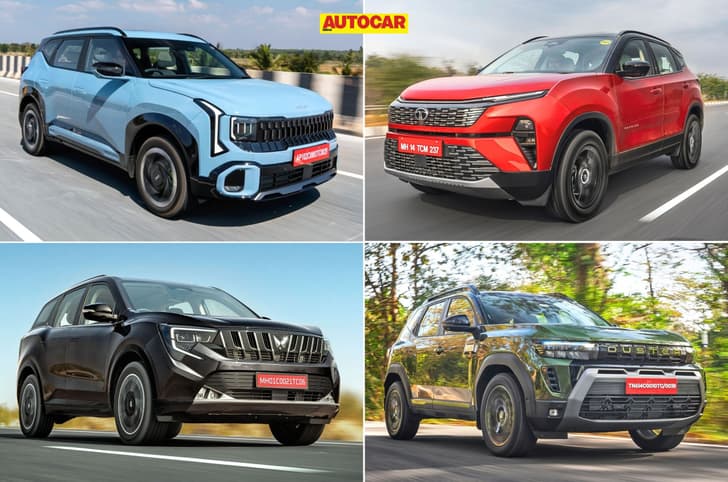

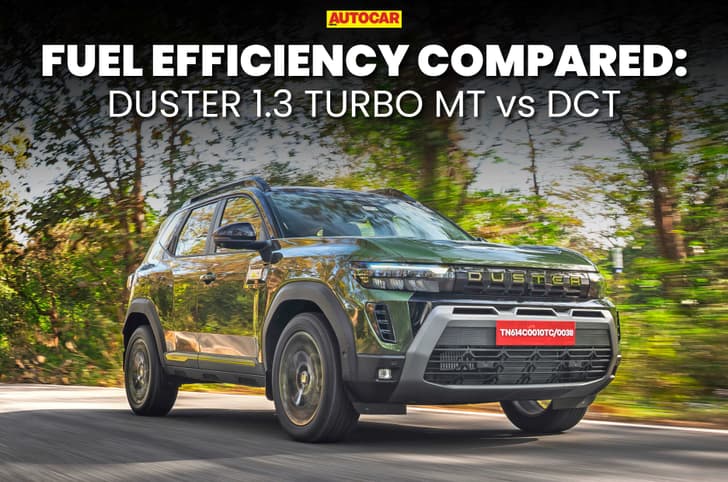
The old Duster was offered with both petrol and diesel engines. With the follow-up model, Renault no longer provides the latter. Instead, the midsize SUV is now available with two turbo-petrol engine options – a 1.0-litre three-cylinder and a 1.3-litre four-cylinder. The larger engine features direct fuel injection, whereas the former does not. Moreover, while the three-pot is only available with a 6-speed manual gearbox, the four-cylinder mill can also be had with a dual-clutch automatic. Let’s now find out which transmission offers better fuel economy.
Explore full specs, features and a price breakdown in our Duster 1.3 turbo MT vs DCT comparison.
Renault Duster turbo MT vs Duster turbo DCT: Specifications and price
Engine output is the same for manual and automatic versions

No matter which transmission you choose, the power and torque values remain identical on paper. There’s also no difference between the two when it comes to the size of the fuel tank. However, the Duster’s 6-speed manual transmission (MT) has been geared tall, which could have been an attempt by Renault to help improve fuel economy as well as reduce driver fatigue in stop-and-go traffic. Like the manual, the 6-speed dual-clutch automatic transmission (DCT) of the Duster also features tall gearing.
When it comes to price, the entry-level Evolution 1.3 MT variant costs Rs 1.5 lakh less than its DCT equivalent. Interestingly, the price difference between the top-spec Iconic 1.3 MT and DCT variants is also Rs 1.5 lakh.
Renault Duster turbo MT vs Duster turbo DCT: Real-world fuel efficiency
The manual is more efficient in the city, while the automatic takes the lead on the highway
The ARAI-rated mileage of the Duster 1.3 MT is 17.75kpl while that of the Duster 1.3 DCT is 18.45kpl. During our tests, the manual transmission returned a combined mileage of 10.64kpl, which is 40.06 percent lower than claimed. Meanwhile, the dual-clutch automatic’s real-world mileage of 10.47kpl was 43.25 percent lower than what Renault quotes.
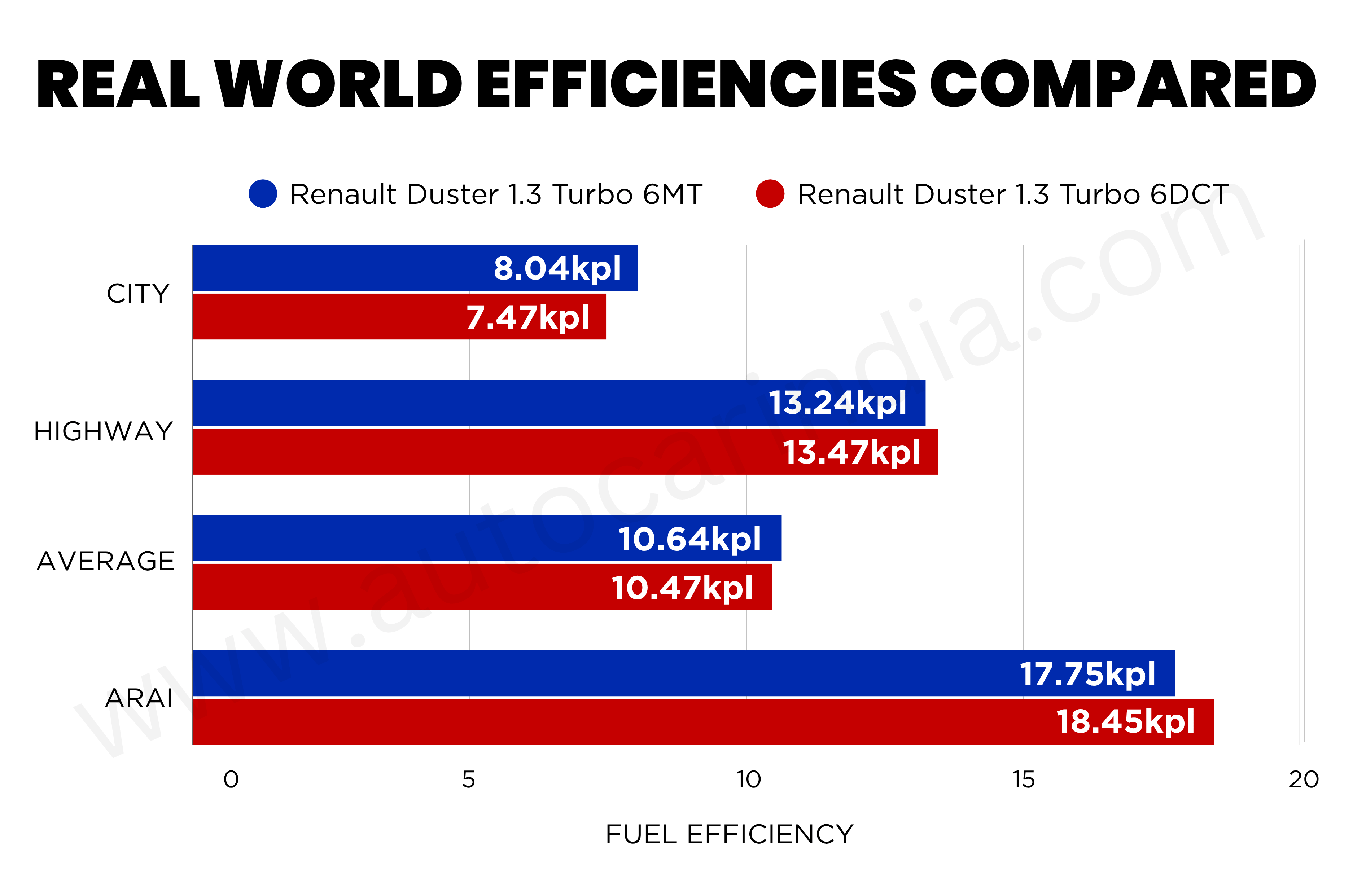
As tested in city conditions, the Duster 1.3 MT returned a 0.57kpl higher mileage than the 1.3 DCT version. However, on the highway, the latter edged past by a margin of 0.23kpl. Over a combined cycle, the Duster 1.3 MT turned out to be ever so slightly more efficient – by just 0.17kpl. Do note that the DCT commands an additional Rs 1.5 lakh over an equivalent MT variant.
Autocar India’s fuel efficiency testing
Before our real-world fuel efficiency tests, we fill our test cars’ tanks to the brim and maintain tyre pressures based on the manufacturer’s recommendations. These cars are driven in fixed city and highway loops in and around Navi Mumbai, and we maintain certain average speeds. Throughout the tests, there is only one person in each car, running the air conditioner and other electricals, such as the audio system, indicators and wipers, when required, just like a regular user would. Periodic driver swaps further neutralise variations in driver patterns. At the end of each cycle, we calculate efficiency by filling the tanks to full again.
Prices are ex-showroom, India.

 Uday Singh
 Glenn Noronha
 Dipan Sur