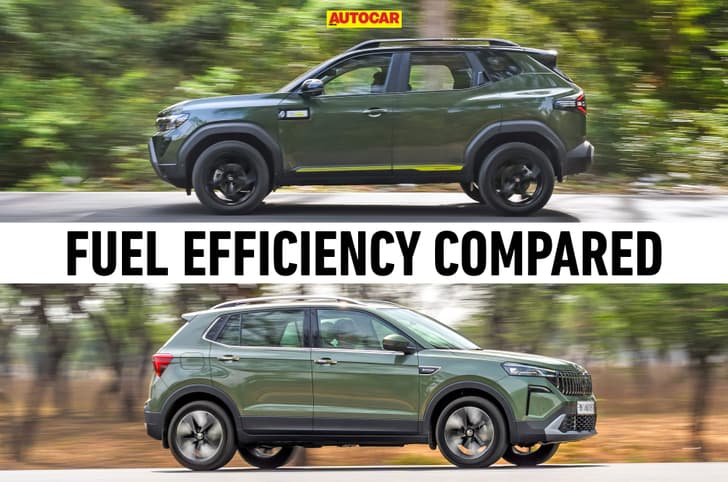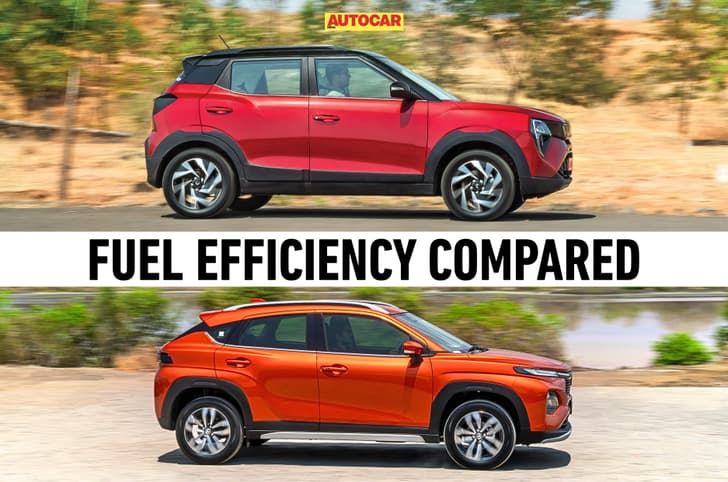
The Mahindra XUV 3XO and Toyota Taisor are among the few compact SUVs on sale offering a combination of a turbo-petrol engine and a torque-converter automatic gearbox. In that guise, the Mahindra offers significantly more power and torque, while the Taisor is a lot lighter. We test both models and compare their real-world mileage to see which will be easier on your pocket.
Mahindra XUV 3XO vs Toyota Taisor turbo-AT: Specifications
XUV 3XO is more powerful, but Taisor is lighter
The XUV 3XO’s 1.2-litre turbo-petrol engine develops 31hp and 82Nm more than the Taisor’s 1.0-litre turbo-petrol unit. On the other hand, the Toyota has a massive 351kg weight advantage over the Mahindra. On paper, the Taisor is 1.9kpl more efficient than the XUV 3XO, but does that hold true in the real world? Let’s find out.
Mahindra XUV 3XO vs Toyota Taisor turbo-AT: Real-world fuel-efficiency results
Taisor is more fuel-efficient in city and highway driving
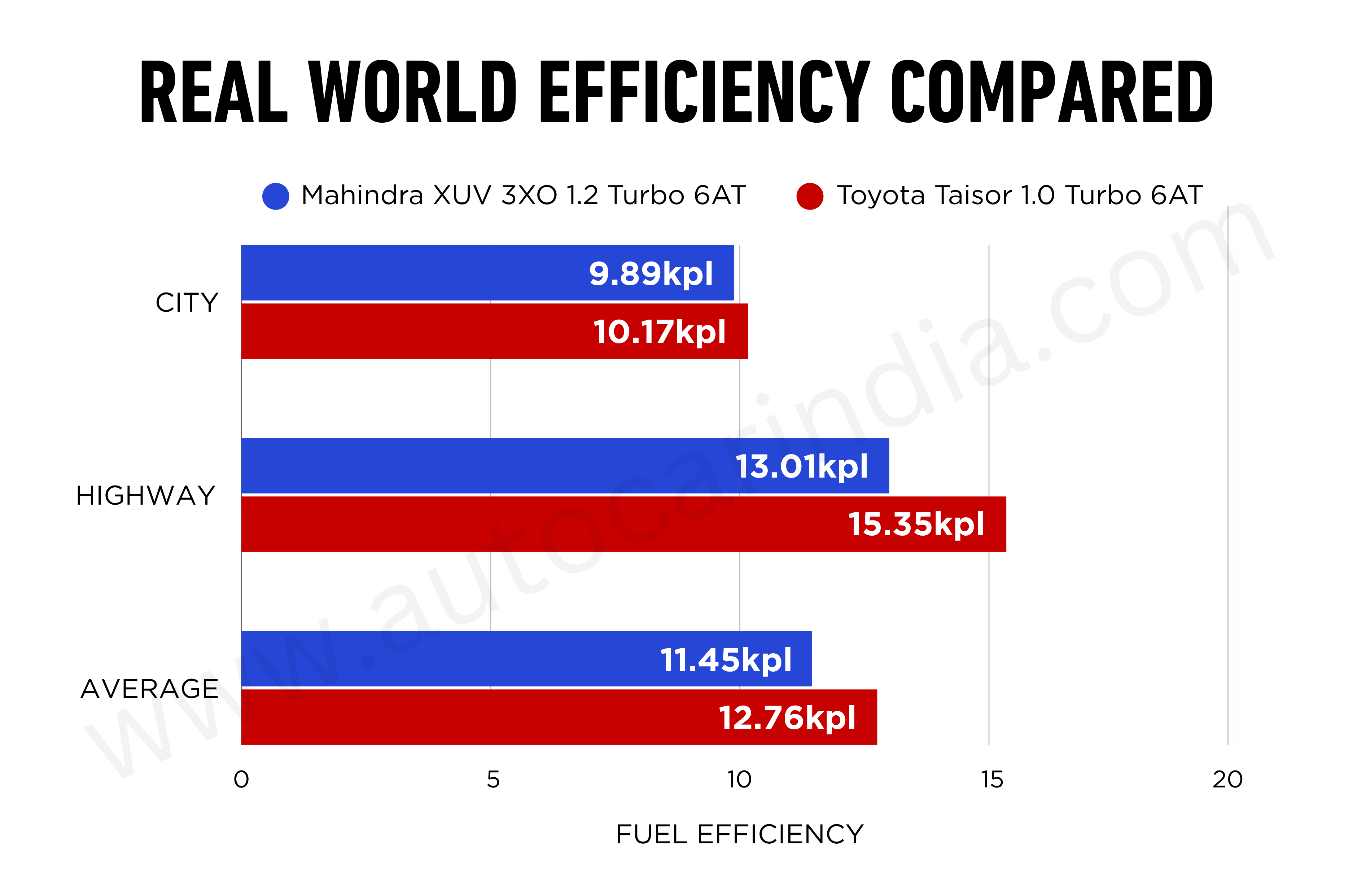
The Taisor was consistently more efficient than the XUV 3XO in our tests, returning 0.28kpl more in the city and widening the gap to 2.34kpl on the highway. Overall, the Taisor’s average worked out to be 1.31kpl more than that of the XUV 3XO.
In the test, the XUV 3XO was driven in Zip mode, its most efficient drive setting. However, being a lot heavier and with a powertrain tuned more for performance, the XUV 3XO was naturally the less efficient of the two. While both feature fuel-saving automatic start/stop technology, the Taisor also gets mild-hybrid technology that further improves economy and provides a torque boost.
The Taisor’s turbo-petrol automatic is available only in the top-end G and V trims, priced from Rs 11.35 lakh to Rs 12.23 lakh. The XUV 3XO, meanwhile, offers its turbo-petrol automatic from the MX2 Pro variant onwards, with prices ranging from Rs 9.94 lakh to Rs 14.89 lakh.
Autocar India’s fuel-efficiency testing
Before our real-world fuel efficiency tests, we fill our test cars’ tanks to the brim and maintain tyre pressures based on the manufacturer’s recommendations. These cars are driven in fixed city and highway loops in and around Navi Mumbai, and we maintain certain average speeds. Throughout the tests, there is only one person in each car, operating the aircon and other electricals, such as the audio system, indicators and wipers, when required, just like a regular user would. Periodic driver swaps further neutralise variations in driver patterns. At the end of each cycle, we calculate efficiency by filling the tanks to full again.

 Uday Singh

 Glenn Noronha
 Dipan Sur