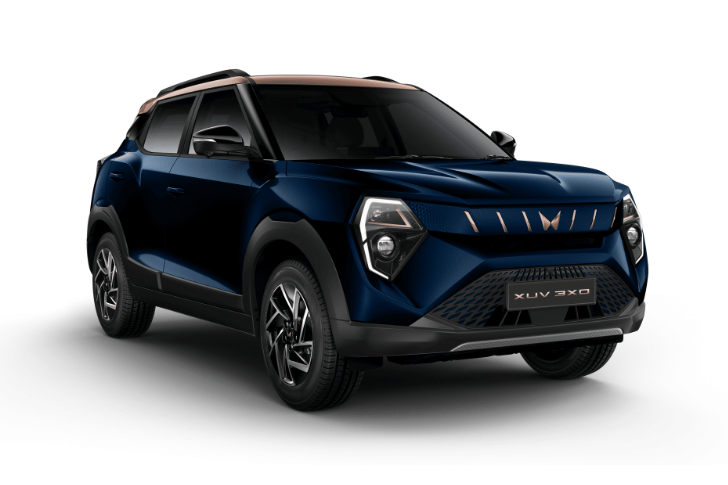


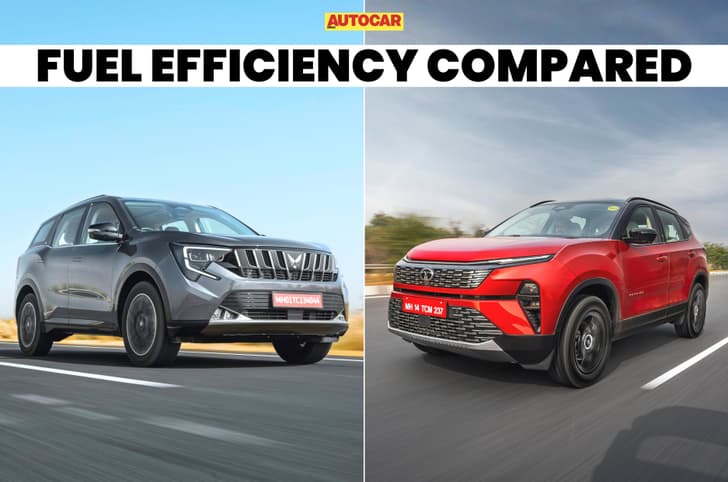
While the petrol-automatic option has only recently been introduced to the Tata Harrier, the Mahindra XUV 7XO has had petrol versions for quite some time now. The 7XO’s turbo-petrol unit is known as the mStallion, and the Harrier’s is called Hyperion. Unlike the 7XO, which is available in 6- and 7-seat layouts, the Harrier turbo-petrol is a 5-seater. In both SUVs, the automatic transmission (AT) is available across all trims except the base. As for fuel economy, which of these petrol-automatic SUVs fares better?
Explore full specs, features and a price breakdown in our XUV 7XO vs Harrier comparison.
Mahindra XUV 7XO vs Tata Harrier turbo-petrol AT: Specifications
The larger-engined XUV 7XO clearly has the upper hand when it comes to output
The petrol engine powering the XUV 7XO is a turbocharged direct-injection unit that produces 33hp and a massive 100Nm more than the engine under the Harrier’s bonnet. Speaking of which, the Tata’s petrol engine also features four cylinders, a turbocharger and direct injection. However, it displaces 499cc less than the 7XO. The Mahindra also has the larger tank.
Mahindra XUV 7XO vs Tata Harrier turbo-petrol AT: Real-world fuel efficiency
The XUV 7XO’s mileage in the city is better than the Harrier’s, but this changes on the highway
During our time testing these two, the XUV 7XO turbo-petrol AT achieved 1.43kpl more in the city than the Harrier turbo-petrol AT. However, on the highway, the latter was more frugal, returning 2.69kpl more than the Mahindra. This is because moderate throttle inputs or overtaking manoeuvres hit the XUV 7XO’s fuel economy hard.
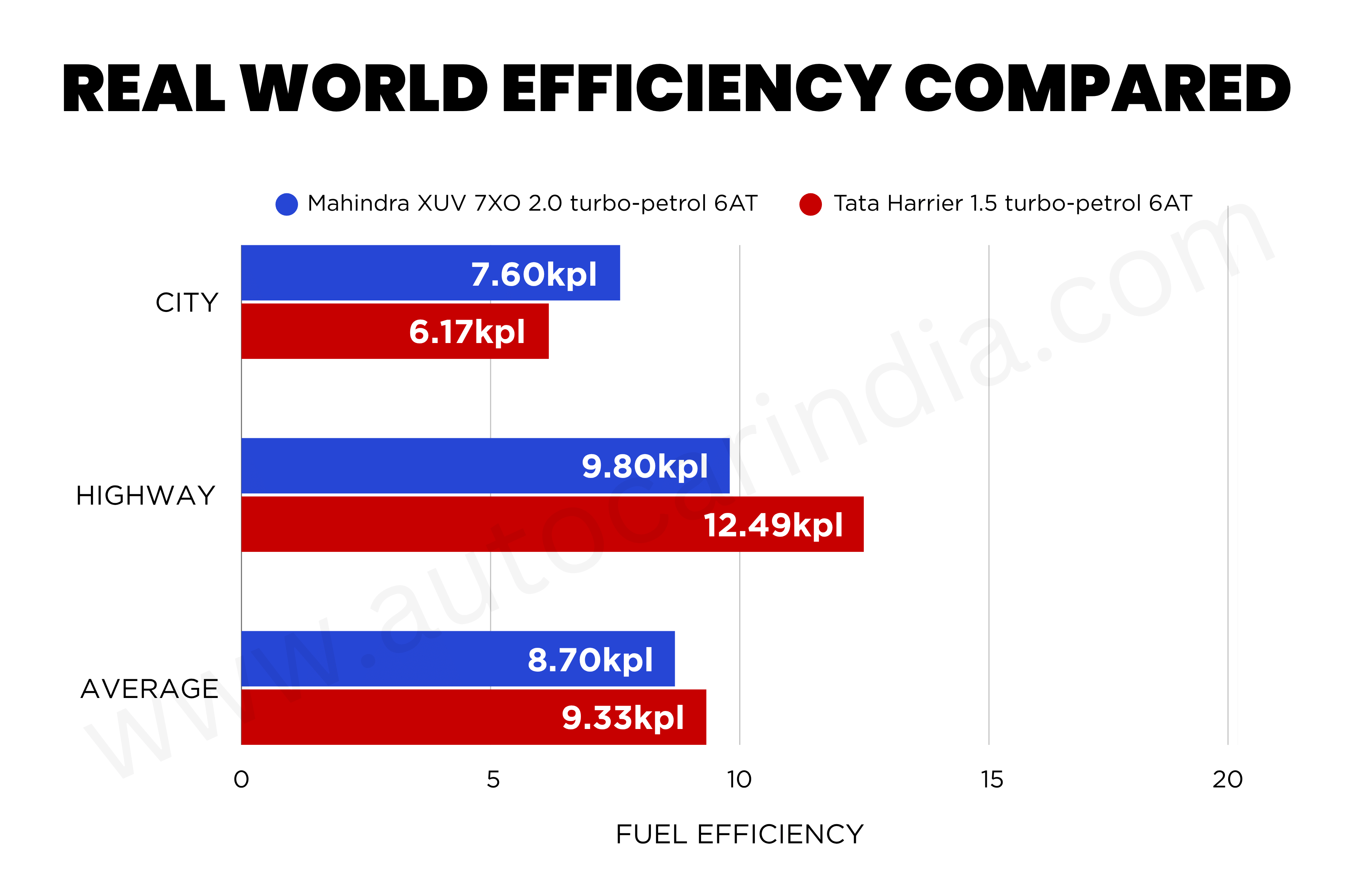
A couple of factors helping the Harrier turbo-petrol AT are its smaller-capacity engine and the inclusion of Eco mode – the latter is absent in the XUV 7XO. However, what the Mahindra SUV does get is an automatic engine stop-start system, which helps explain its higher fuel efficiency in the city. Having said that, the Tata Harrier turbo-petrol AT edges ahead in terms of average mileage by a narrow margin of 0.63kpl.
What community is saying on the XUV 7XO?
Mahindra XUV 7XO vs Tata Harrier turbo-petrol AT: Prices
There are seven trim levels of the Mahindra XUV 7XO turbo-petrol with the automatic gearbox. The most affordable variant here costs Rs 7,000 less than its Tata Harrier turbo-petrol automatic equivalent. Similarly, the fully loaded turbo-petrol AT variant of the XUV 7XO costs Rs 50,000 less than the top-spec Harrier turbo-petrol AT.
Autocar India’s fuel-efficiency testing
Before our real-world fuel efficiency tests, we fill our test cars’ tanks to the brim and maintain tyre pressures based on the manufacturer’s recommendations. These cars are driven in fixed city and highway loops in and around Navi Mumbai, and we maintain certain average speeds. Throughout the tests, there is only one person in each car, running the air conditioner and other electricals, such as the audio system, indicators and wipers, when required, just like a regular user would. Periodic driver swaps further neutralise variations in driver patterns. At the end of each cycle, we calculate efficiency by filling the tanks to full again.
Prices are ex-showroom, India.



 Uday Singh

 Glenn Noronha
 Dipan Sur