

While gearing up to introduce its Altroz premium hatchback on January 22, 2020, Tata is also working on a major update for its entry-level model, the Tiago. The car has already been seen testing on Indian roads; and today, we have images of the upcoming Tiago facelift sans camouflage for the first time, which could indicate an imminent launch soon enough.
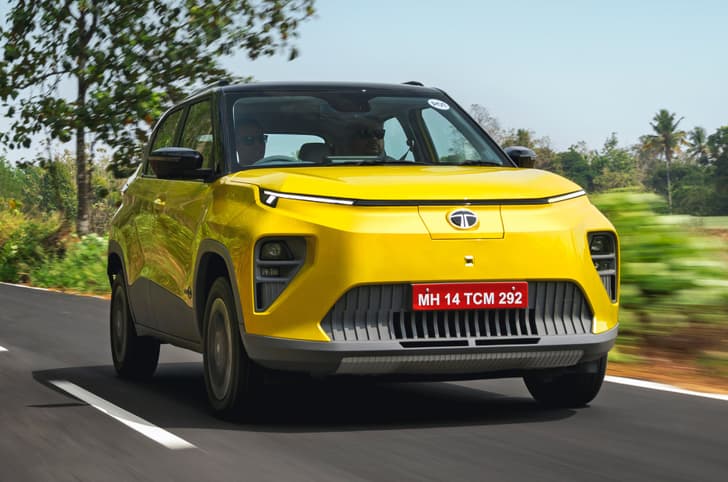
Images of the undisguised model reveal significant changes in the Tiago facelift’s front facia, including slimmer headlamps and a sleeker grille, underlined by Tata’s signature ‘Humanity Line’ in chrome. In order to comply with pedestrian safety norms that come into effect from October this year, the hatch also gets a raised bonnet that gives the front end a sharper profile – a look similar to that of the Altroz. The front bumper has also been completely redesigned, with a large air dam and reshaped fog-lamp housings with horizontal slats.
The rest of the spied model’s side profile remains largely similar to that of the outgoing car, as do the 15-inch dual-tone alloy wheels. A blacked-out roof and contrast-coloured wing mirrors prove that the Tiago will retain its dual-tone paint shade offering too. The rear can be expected to be tweaked with a revised bumper and updated tail-lamp inserts.

With the facelift, the company will also spruce-up the cabin with minor styling tweaks that include new seat-upholstery fabric. The current Tiago comes equipped with a digital instrument cluster, a 7.0-inch touchscreen with Android Auto and Apple CarPlay support, an automatic air conditioner, drive modes and projector headlamps; and the same can be expected of the updated model. Safety kit will continue to include dual airbags, ABS, EBD, rear parking sensors, a seat-belt reminder and a high-speed alert system as standard.
Mechanically, the current-gen 1.2-litre petrol engine will be updated to meet the new and stringent BS6 emission norms. Transmission duties will continue to be handled by a 5-speed manual and AMT automatic gearbox options. However, as a result of Tata deciding to axe small diesels from its line-up, the current-gen Tiago’s 70hp, 1.05-litre diesel engine will be a major omission from its portfolio. However, there are talks of a CNG variant being introduced.
The petrol Tiago carries a sticker price of Rs 4.39-6.37 lakh (ex-showroom, Delhi) for the time being and the facelift can be expected to command a slight premium over the current model. When launched, the refreshed Tiago will battle it out with the Maruti Suzuki WagonR and Celerio, as well as the Hyundai Santro and the Datsun Go, in our market.


 Viraaj Bhatnagar
 Dipan Sur
 Dhruv Dhaka