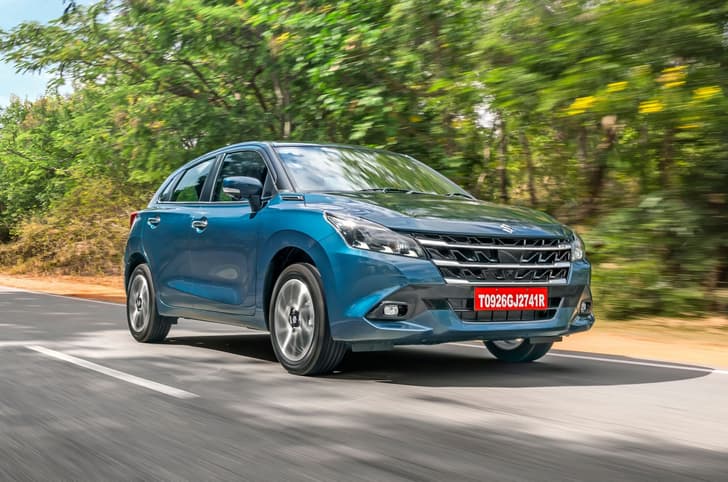



One of the harshest things for a car’s climate control system is dealing with high ambient temperatures and humidity on a regular basis. This is true for many locations across the country, where summer daytime temperatures can easily climb past 40deg C. During our time testing the climate control systems of the Renault Duster and Volkswagen Taigun in May, the ambient temperature on site was a sweltering 42.2deg C. So, how did these midsize SUVs cope? Let’s find out. However, do note that the Volkswagen Taigun's AC test results are applicable to the Skoda Kushaq as well.
Explore full specs, features and a price breakdown in our Duster vs Taigun comparison.
Autocar India’s testing methodology
In preparation for the test, each car is parked under direct sunlight for two hours with its engine switched off and windows rolled up. Sunroof shades are kept closed, but rear window shades are rolled away. Once a car is ‘soaked’, a two-member team enters the vehicle quickly to minimise heat loss – our job is to simulate a worst-case scenario. Each car is equipped with sophisticated test gear provided by Zen Microsystems. Five thermocouple sensors read ambient temperature, cabin temperature, vent temperature (capturing how cold the air is), front-seat temperature (measured near the driver’s ear) and rear-seat temperature (measured at the rear centre armrest).
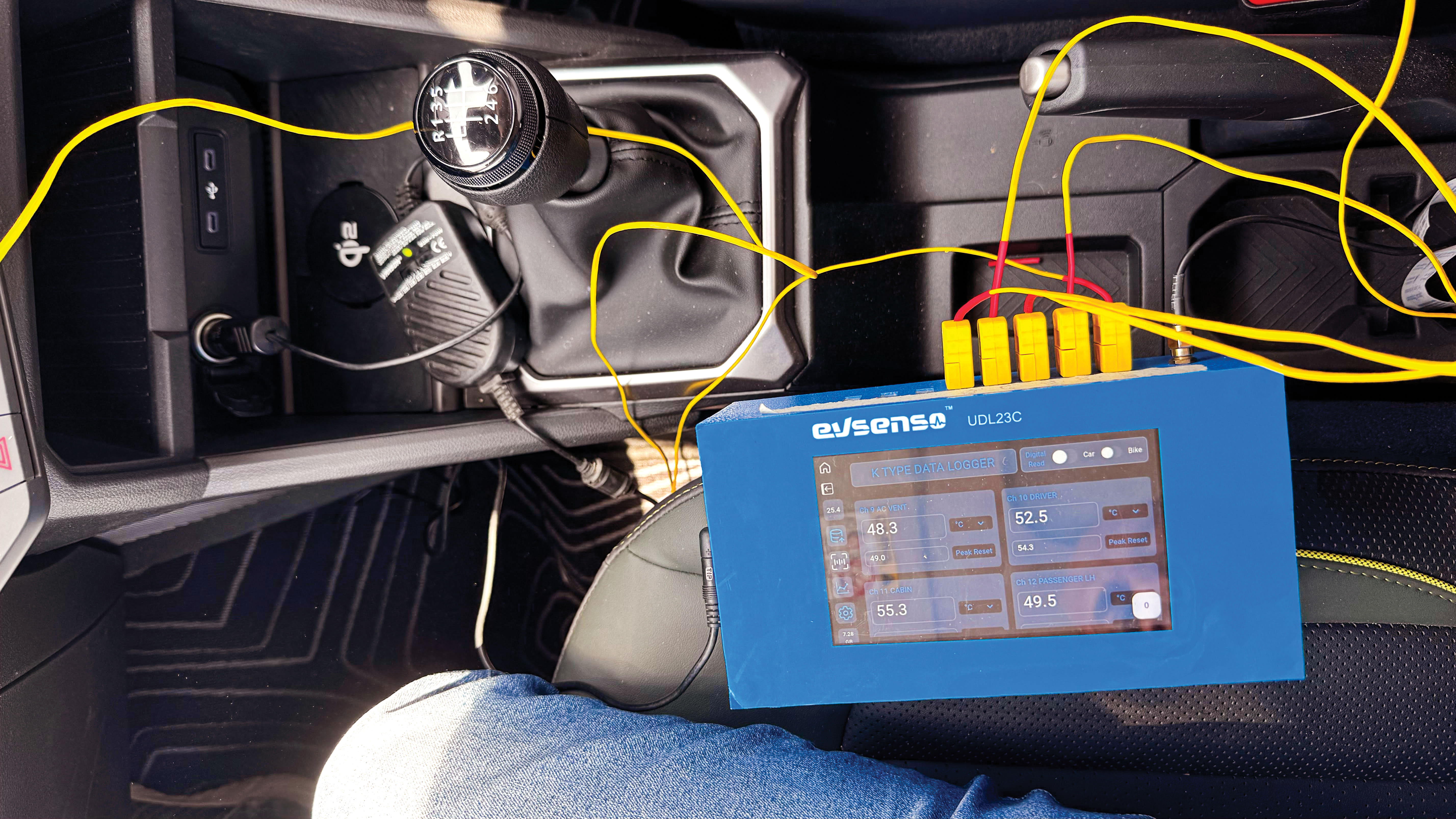
Front vents are directed at the driver’s face, while rear vents are aimed at the occupant seated in the centre. As the car is switched on, climate control is set to recirculation mode, maximum blower speed and the lowest possible temperature. Temperature readings are recorded after a minute of idling and then at five-minute intervals (up to 15 minutes) while driving on a fixed route at 50-60kph. A final reading is taken after another minute of idling.
A key disclaimer: Ambient temperatures and humidity have a big bearing on cooling performance. Hence, our results are from vehicles tested on the same day, and these may vary for you based on your location and ambient conditions.
Renault Duster vs VW Taigun AC test
1. Renault Duster front and rear AC performance
At the onset, the temperature at the front of the Renault Duster’s cabin was 51.2deg C. This fell by 5.7deg C in a minute after starting the car’s dual-zone climate control system. After driving around for 5 minutes, the drop in temperature at the front of the cabin was a marked 18deg C since the start of the AC performance test. The front cabin temperature at the end of 15 minutes of driving dropped by 20.7deg C before climbing by 4deg C towards the end of our test.
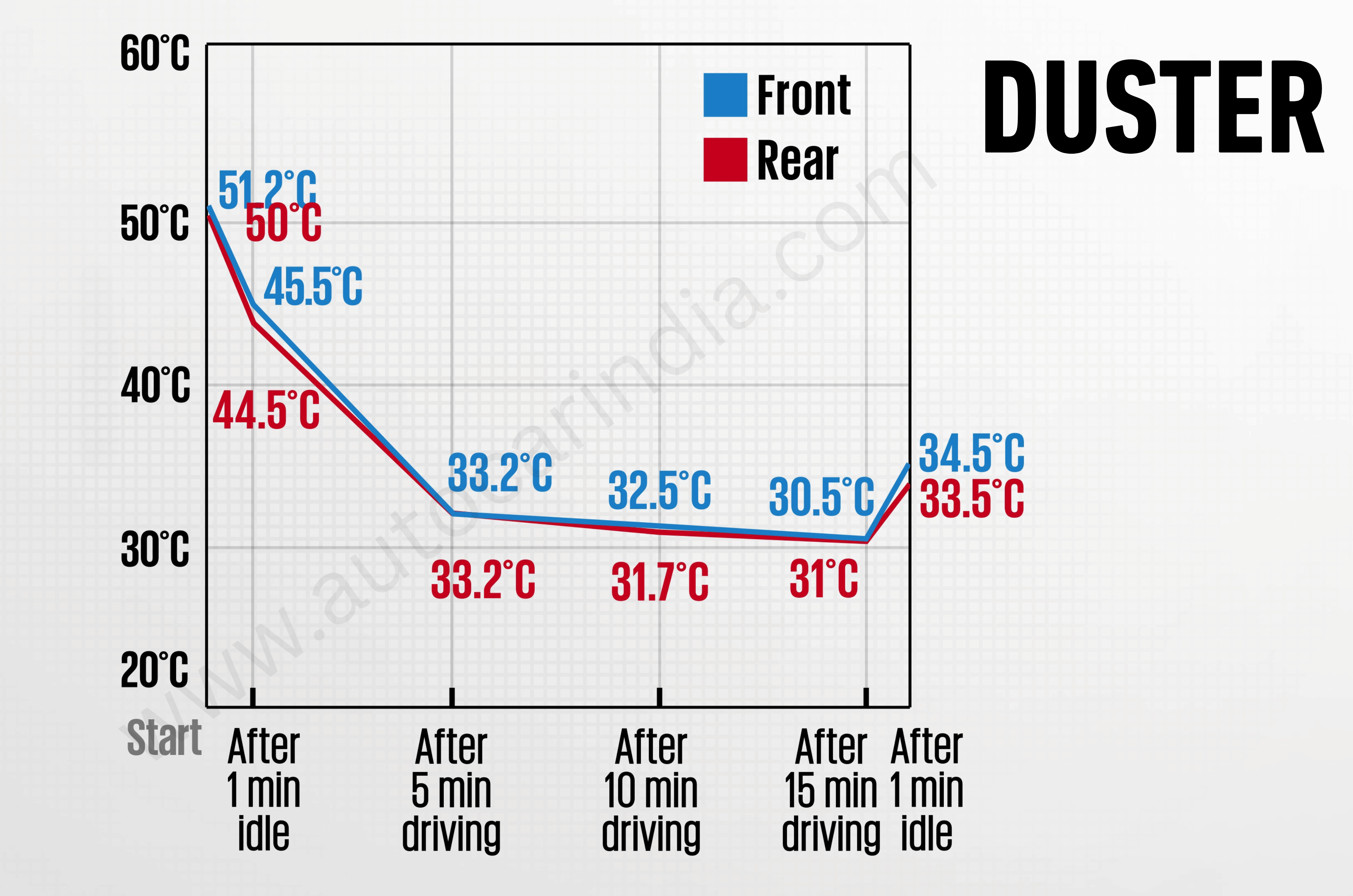
The highest recorded temperature at the rear of the Duster was 1.2deg C lower than that at the front. It dipped by 5.5deg C in the first minute of idling, with the climate control system set to its coldest setting. At the end of 5 minutes of driving, the rear cabin temperature was identical to that measured up front. It was comparable to the front after 15 minutes of driving, too, separated by just 0.5deg C. By the end of this AC stress test, the rear of the Duster’s cabin witnessed a drop of 16.5deg C.
2. Volkswagen Taigun front and rear AC performance
After turning on its automatic climate control system to its coldest setting, the VW Taigun’s front cabin temperature fell by a steep 13.3deg C. It dropped by another 10.5deg C within 5 minutes of driving, going as low as 26.7deg C, signifying a drop of 27.3deg C since the start of this test. During the final minute of idling with the AC still at its coldest setting, the Taigun’s cabin temperature up front rose by 3.8deg C, but the overall drop in temperature since the start of this test was a marked 23.5deg C.
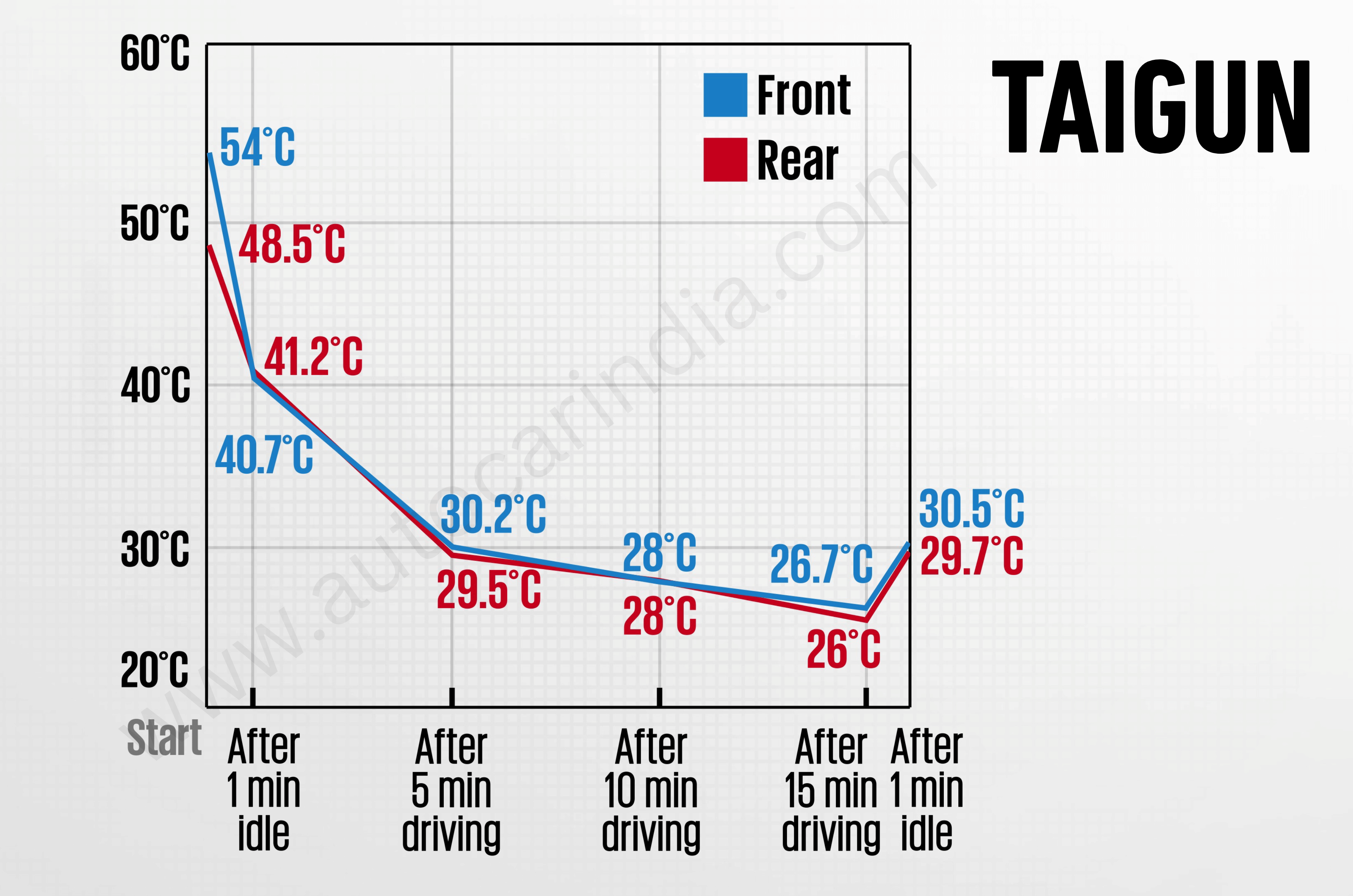
Unlike at the front, the rear cabin temperature of the VW Taigun remained below 50deg C from the onset of this AC stress test. It measured a drop of 7.3deg C during the first minute, thereafter dropping another 11.7deg C over 5 minutes of driving. The lowest temperature recorded at the rear of the Taigun was 26deg C, a drop of 22.5deg C over a span of 16 minutes. Apart from a single instance, the rear of the Taigun’s cabin remained cooler than the front during this AC performance test.
*Front seat temperature is measured near the driver’s ear; rear seat temperature is measured at the centre armrest.



 Uday Singh

 Glenn Noronha
 Dipan Sur