

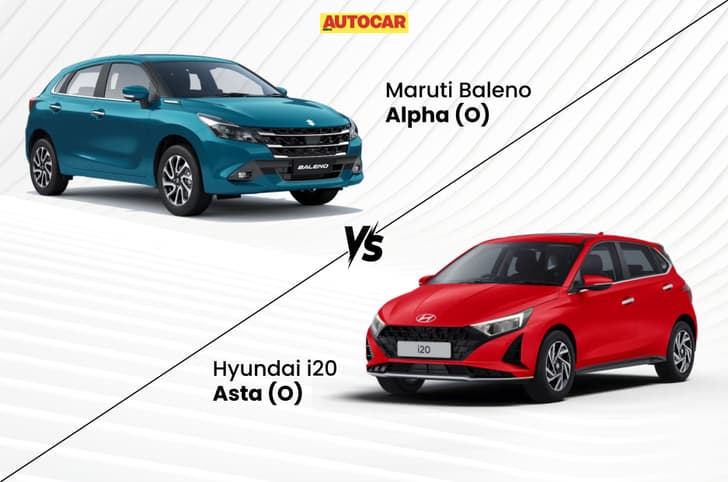
For over a decade, the Maruti Suzuki Baleno and the Hyundai i20 have continuously locked horns in the premium hatchback space. Earlier this year, Hyundai updated the i20 with a rejigged lineup, while Maruti introduced a comprehensive facelift to the Baleno recently. If you’re in the market for a top-of-the-line premium hatchback, we’ve compared the Baleno and i20 on paper to determine the better value pick. In this comparison, we’ve chosen the top Alpha(O) and Asta(O) trims of the Baleno and i20, respectively.
For full specs, features, and a price breakdown in our Baleno vs i20 comparison.
Maruti Suzuki Baleno vs Hyundai i20: Dimensions
Baleno is smaller than the i20 in several dimensions

Overall, the i20 is longer, wider, and has a longer wheelbase than the Baleno. The latter, meanwhile, is taller and comes with a slightly larger boot capacity.
Maruti Suzuki Baleno vs Hyundai i20: Powertrain options
i20 produces slightly more power
In top-spec guise, the Baleno and i20 are powered solely by a 1.2-litre naturally aspirated petrol engine. The difference comes with the number of cylinders, where the former’s mill is a 3-cylinder unit but the latter gets 4 cylinders. Power output on both engines is an identical 83 hp, but the i20 in CVT guise develops 5hp more. Also, the i20 delivers slightly higher torque figures. A 5-speed manual gearbox is standard on both hatchbacks, but the Baleno offers a 5-speed AMT while the i20 offers a CVT gearbox.
Maruti Suzuki Baleno vs Hyundai i20: Exterior features
The Baleno and i20 come fairly equipped on the outside, with LED light setups, power folding ORVMs and 16-inch dual-tone alloy wheels. However, fog lamps are found on the former, whereas the latter gets puddle lamps with a welcome function. Both models offer monotone colour choices, but the i20 also offers dual-tone and matte-finish paint options
Maruti Suzuki Baleno vs Hyundai i20: Interior features
Baleno gets segment-only features like ventilated seats and head-up display
Inside, the i20 comes with a larger screen, a single-pane sunroof, more speakers, and ambient lighting over the Baleno. On the other hand, only the latter comes with a head-up display and front seat ventilation.
Maruti Suzuki Baleno vs Hyundai i20: Driving tech
Baleno gets adaptive cruise control; i20 the only one with drive modes
When it comes to driving-related features, only the i20 gets drive modes. Cruise control is available on both hatchbacks, but the Baleno comes with adaptive cruise control, whereas the i20 features regular cruise control.
Maruti Suzuki Baleno vs Hyundai i20: Safety features
Level 2 ADAS found exclusively on the Baleno
Though the Baleno and i20 are yet to be tested by BNCAP, it's worth noting that the former’s pre-facelift version scored a 4-star rating in crash safety tests. Meanwhile, both premium hatchbacks come well-equipped with basic safety features, airbags, TPMS, parking sensors, auto-dimming IRVM, and hill-hold assist. However, only the Baleno comes equipped with a level 2 ADAS suite and gets a dedicated headrest and three-point seatbelt for the centre rear passenger over the i20. But the latter comes with a factory-fitted dashcam over the former.
Maruti Suzuki Baleno vs Hyundai i20: Price and verdict
In petrol manual guise, the i20 is Rs 36,000 cheaper than the Baleno by Rs 36,000. If an automatic transmission is a priority, the former will cost you an extra Rs 44,000 compared to the latter. When choosing between the two, the i20 is the clear recommendation. In its petrol-manual version, it’s more affordable while packing features like a sunroof, a premium Bose audio system, ambient lighting, and a factory-fitted dashcam.
While the Baleno counters with a head-up display, Level 2 ADAS, and ventilated seats, these convenience features aren't absolute dealbreakers. Furthermore, even though the automatic i20 carries a higher price tag than the Baleno, that premium is fully justified by the more refined experience of its CVT gearbox.



 Uday Singh

 Dipan Sur