
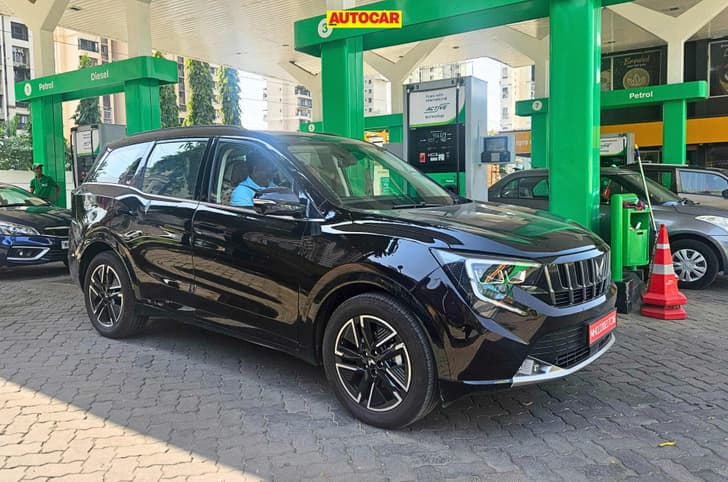
Along with a comprehensive midlife refresh, Mahindra’s flagship SUV now gets a new name. The XUV700 is now called the XUV 7XO. The powertrain options, however, remain unchanged: a 2.0-litre turbo-petrol and a 2.2-litre diesel, both offered with 6-speed manual and automatic gearboxes. While the XUV 7XO is primarily front-wheel drive, the diesel also gets the option of all-wheel drive.
We’ve finally got our hands on the turbo-petrol automatic variant and put it through our real-world fuel efficiency tests. The results, frankly, are unsurprising.
- Turbo-petrol engine gets auto stop-start function
- No drive modes are on offer with this engine option
Mahindra XUV 7XO turbo-petrol AT real-world mileage test
What community is saying on the XUV 7XO?
XUV 7XO turbo-petrol AT has an average fuel efficiency of 8.70kpl
The XUV 7XO turbo-petrol is powered by a 203hp/380Nm 2.0-litre engine paired with a 6-speed torque converter automatic. Mahindra hasn’t revealed official fuel efficiency figures yet. Unlike the diesel version, the petrol does not get selectable drive modes – there’s just a single default setting.


In our city tests, this 1.8-tonne SUV returned 7.6kpl. To help reduce fuel consumption while idling, the XUV 7XO features an automatic engine stop-start system. However, unlike most such systems, it does not restart the engine if the cabin temperature rises significantly beyond the set climate control level. The engine only fires back up when the driver releases the brake pedal, at which point the air-con compressor resumes operation. In peak summer, this behaviour could push owners to switch the system off, as cabin temperatures can rise quickly.
On the highway, the XUV 7XO delivered 9.8kpl. At 100kph in sixth gear, the engine spins at a relaxed 1,600rpm, but the powertrain’s aggressive response and the gearbox’s eagerness to downshift do little to aid efficiency. With a very light throttle and steady speeds, the MID will occasionally show double-digit figures, but even moderate throttle inputs or overtaking manoeuvres see the fuel economy readout drop sharply.
With an overall average of just 8.7kpl, the XUV 7XO’s 60-litre fuel tank translates to a real-world range of roughly 520km.
Autocar India’s fuel efficiency testing
Before our real-world fuel efficiency tests, we fill our test cars’ tanks to the brim and maintain tyre pressures based on the manufacturer’s recommendation. These cars are driven in fixed city and highway loops in and around Navi Mumbai, and we maintain certain average speeds. Throughout the tests, we run the aircon at 22 degrees in full-auto mode, and other electricals, such as the audio system, indicators and wipers, when required, just like a regular user would. Periodic driver swaps further neutralise variations in driver patterns. At the end of each cycle, we calculate efficiency by filling the tanks to full again.




 Uday Singh


 Suraj Viswanathan

 Dipan Sur