



The Mahindra XUV 3XO is the manufacturer’s most affordable SUV in India, and it is offered with three engine options: two turbo-petrols and a diesel. In the compact SUV segment, one of its key rivals is the Kia Syros, which, too, is available in turbo-petrol and diesel guises. So, how fuel-efficient are the XUV 3XO and Syros in real-world conditions? We compare their turbo-petrol automatic versions to find out.
Explore full specs, features, and a price breakdown in our XUV 3XO vs Syros comparison.
XUV 3XO vs Syros turbo-petrol AT: Specifications and price
What community is saying on the XUV 3XO?
The XUV 3XO gets a bigger engine that produces more power and torque
Both the XUV 3XO and Syros offer a 3-cylinder TGDi turbo-petrol engine, but the Mahindra mill has a higher displacement and produces 11hp and 58Nm more. The 3XO is also 0.52kpl more frugal than the Syros as per the claimed ARAI mileage figures. A key difference is that the XUV 3XO’s turbo-petrol engine is paired with a 6-speed torque-converter gearbox, while the Syros gets a 7-speed dual-clutch automatic unit.
XUV 3XO vs Syros turbo-petrol AT: Real-world fuel efficiency
The XUV 3XO outshines the Syros in all real-world mileage aspects
The Mahindra XUV 3XO was slightly more fuel-efficient than the Kia Syros in our real-world fuel efficiency tests – by 1.59kpl in the city and by 1.51kpl on the highway – resulting in a 1.55kpl higher overall mileage.
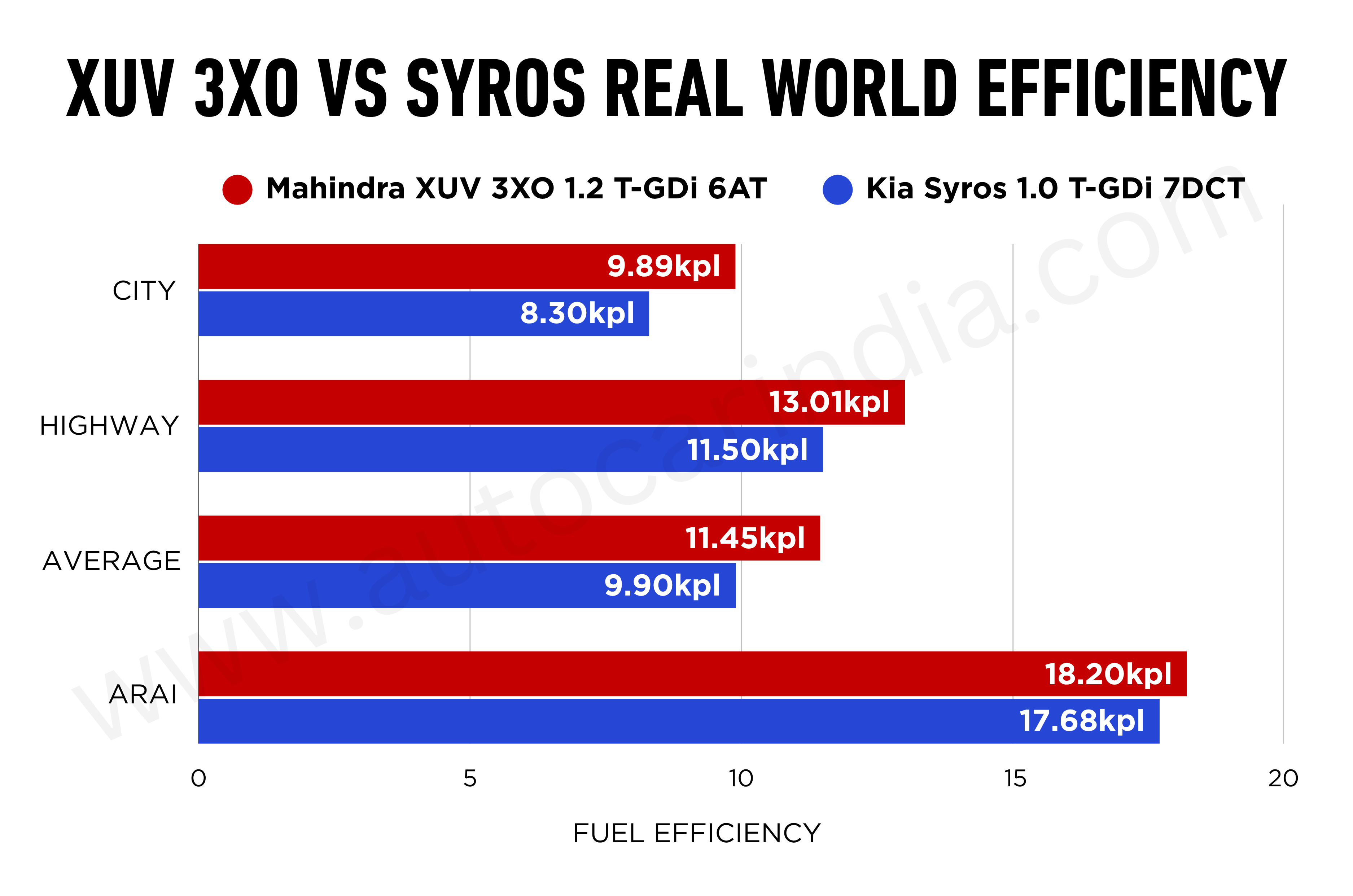
Even though the Syros has a 3-litre bigger fuel tank, the 3XO can travel 35.4km further on a full tank of fuel owing to its higher fuel efficiency.
The XUV 3XO is more affordable than the Syros in its top end
The Syros’s turbo-petrol DCT costs Rs 92,000 less than the XUV 3XO turbo-petrol automatic. But at the top end, the Mahindra is Rs 74,000 more affordable.
Autocar India’s fuel efficiency testing
Before our real-world fuel efficiency tests, we fill our test cars’ tanks to the brim and maintain tyre pressures based on the manufacturer’s recommendations. These cars are driven in fixed city and highway loops in and around Navi Mumbai, and we maintain a set of average speeds. Throughout the tests, there is only one person in each car, running the air conditioner and other electricals, such as the audio system, indicators and wipers, when required, just like a regular user would. Periodic driver swaps further neutralise variations in driver patterns. At the end of each cycle, we calculate efficiency by refilling the tanks to full.
Prices are ex-showroom, India.



 Uday Singh

 Glenn Noronha