
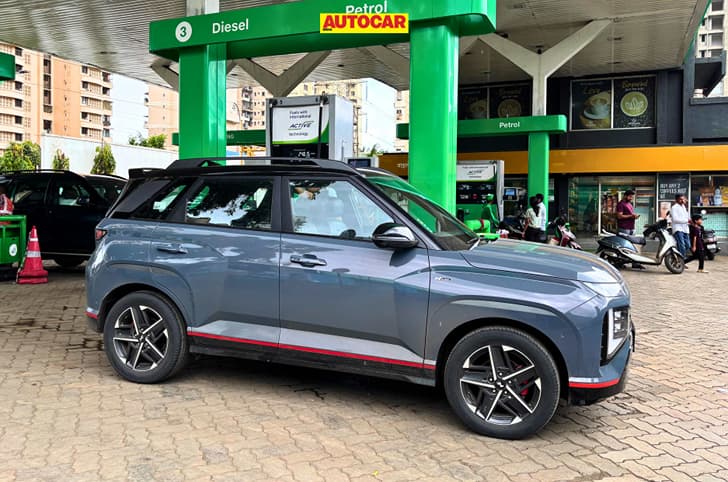
The second-generation Hyundai Venue is larger, better equipped and a lot more appealing than its predecessor. It is available with a 1.0-litre turbo-petrol with a 6-speed manual and 7-speed dual-clutch automatic, 1.2-litre petrol with a 5-speed manual, and a 1.5-litre diesel with a 6-speed manual and automatic transmission. Hyundai also sells the sportier-looking N Line version, which is only available with the turbo-petrol engine, and is priced between Rs 10.66-15-66 lakh.
We put the Hyundai Venue N Line turbo-petrol automatic through our efficiency tests to see how it performs in the real world.
- Gets an auto engine stop-start feature
- Its claimed fuel efficiency is 20kpl
- As tested, it weighs 1,258kg
Hyundai Venue turbo-automatic mileage explained
Powering the Venue N Line is a 120hp/172Nm 1.0-litre direct-injection three-cylinder turbo-petrol engine, paired to a seven-speed dual-clutch transmission (DCT). It gets three driving modes – Eco, Normal and Sport, and for our tests, we used ECO mode in the city and on highways.

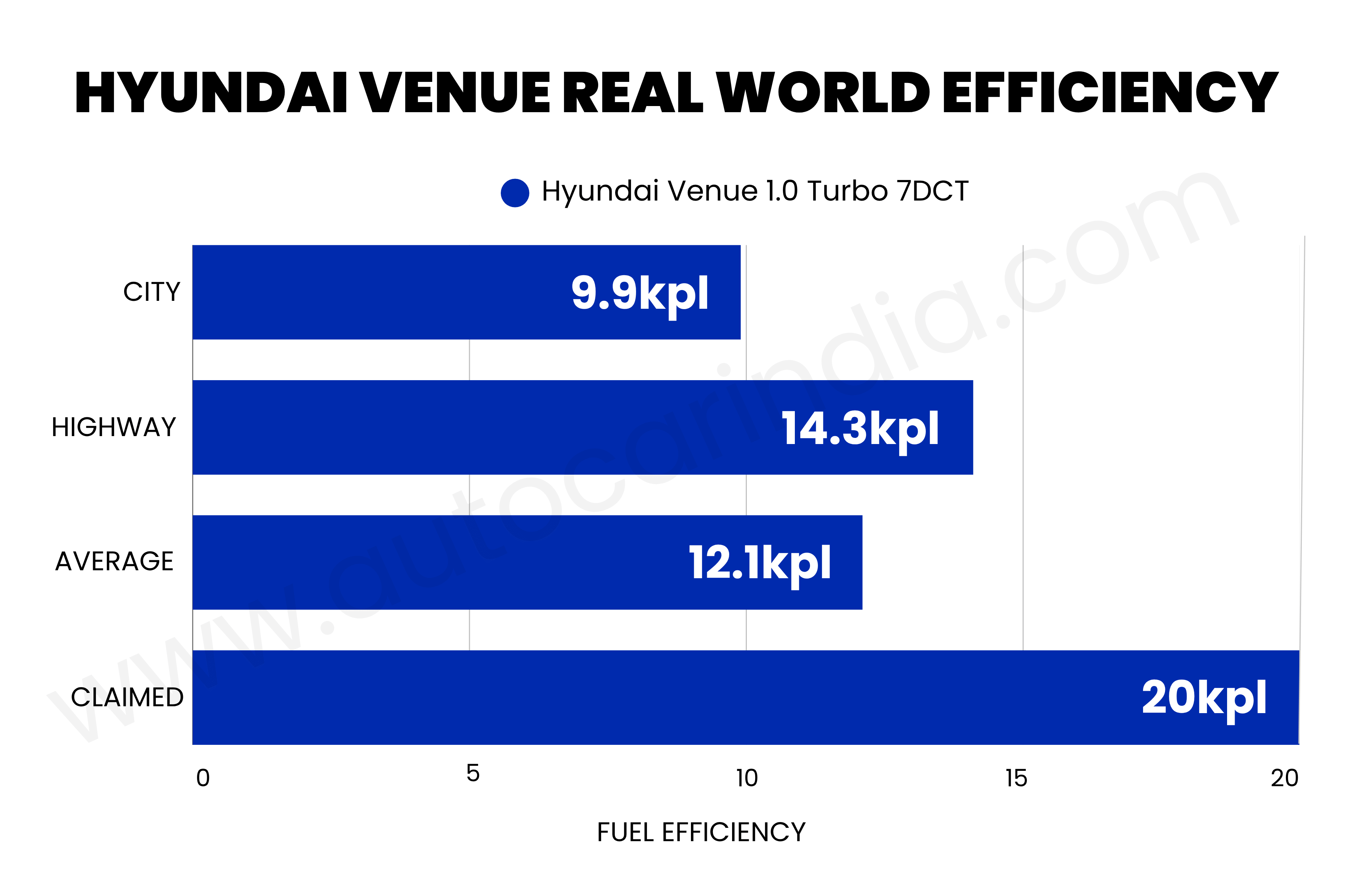
In the city, the Venue N Line delivered 9.9kpl, whereas on the highway it returned 14.3kpl. This results in an overall average fuel efficiency of 12.1kpl which translates to a range of 545km with the 45-litre petrol tank.
Earlier this year, we also tested the new Venue with the 1.2-litre naturally aspirated petrol engine which returned 10.7kpl and 14.9kpl in the city and on the highway, respectively. The impressive bit is that the fuel efficiency of the Venue N Line is quite close to the naturally aspirated engine, despite the turbo-petrol producing extra 37hp power and 57Nm torque, and being much quicker.
What helps the Venue N Line with its city efficiency is the presence of an automatic stop-start system, which is missing on the Venue with the naturally aspirated engine. On the highway, the tall 7th gear allows the N Line to cruise at 100kph with the engine spinning at 2200rpm. In comparison, the regular Venue with the 5-speed gearbox cruises at 100kph with the engine running at a much higher 3200rpm, impacting its efficiency.
Autocar India’s fuel efficiency testing
Before our real-world fuel efficiency tests, we fill our test cars’ tanks to the brim and maintain tyre pressures based on the manufacturer’s recommendation. These cars are driven in fixed city and highway loops in and around Navi Mumbai, and we maintain certain average speeds. Throughout the tests, there is only one person in each car, running the aircon at 22deg C in full-auto mode, and other electricals, such as the audio system, indicators, and wipers, when required, just like a regular user would. Periodic driver swaps further neutralise variations in driver patterns. At the end of each cycle, we calculate efficiency by filling the tanks to full again.


 Uday Singh


 Dipan Sur


 Dhruv Dhaka

 Viraaj Bhatnagar