
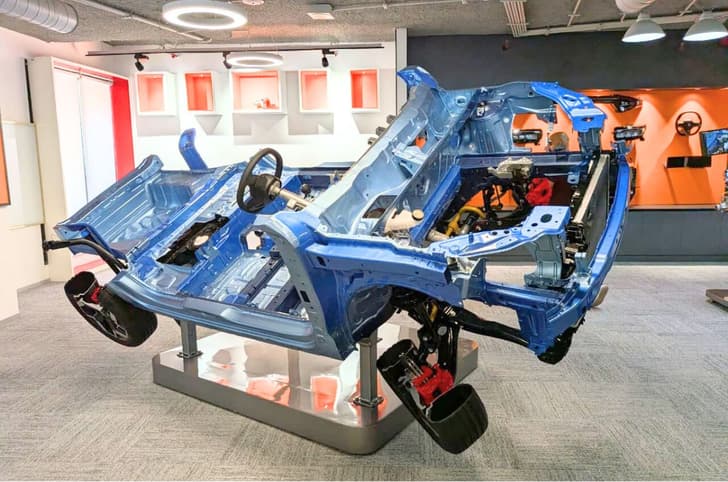
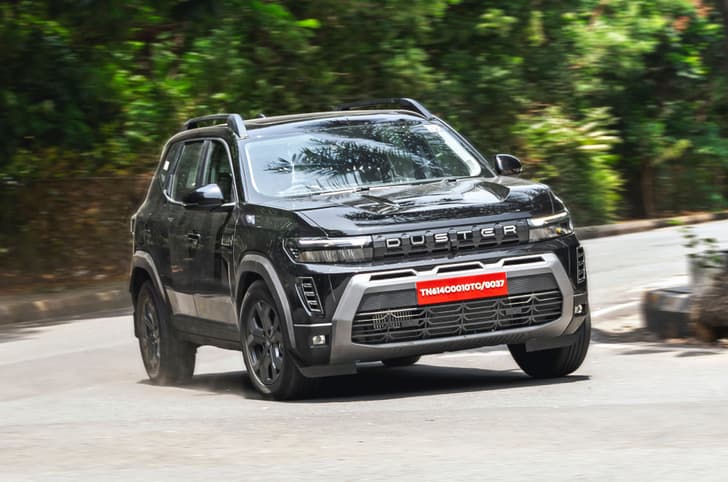
When Renault unveiled the Duster for India, it said the SUV is underpinned by the Renault Global Modular Platform (RGMP), despite being nearly identical to the European model, which is based on the Common Module Family – B (CMFB) platform. To be clear, the two platforms are not completely unique but are, in fact, quite similar. So, what are the differences that have merited the two platforms to have distinct names?
- RGMP gets new E&E architecture co-developed by Renault and Google
- Sub-4m cars are easier to build without compromises on RGMP
- RGMP is compatible with EV, hybrid and CNG powertrains
New E&E
The RGMP takes much of its hardware from the CMFB platform. However, Renault has re-gutted its entire electrical and electronics (E&E) architecture. In place of the earlier system, there’s now a new E&E architecture called SWEET400 (SoftWare Electric and Electronic Technology) that’s co-developed with Google. “The E&E here is more advanced and capable of hosting many of the latest technologies,” says Francisco Hidalgo, VP Sales & Marketing, Renault India, speaking to Autocar India at a tech presentation.
One example of this is the Google Automotive System itself, which goes beyond the infotainment screen and integrates the entire dashboard and other core vehicle functions like HVAC, locking, driver profiles and drive modes. Signing in with your Google ID, for instance, not only brings in your playlists and maps data but also sets up the car to your presets, including preferred drive modes, temperature, and even ADAS settings. So, in essence, while RGMP has its bones from the CMFB platform, its nervous system is all new.
Going small
The bones, too, have had some level of change. Dr Vikraman V, chief of Renault Engineering at Renault Group India, says, “This platform has been engineered to build sub-4-metre cars comfortably, which was not the case with CMFB”. Indeed, the CMFB platform was created to underpin larger cars, and it sits above the CMFA platform, on which Renault has a whole host of sub-4-metre products like the Kiger and Triber.
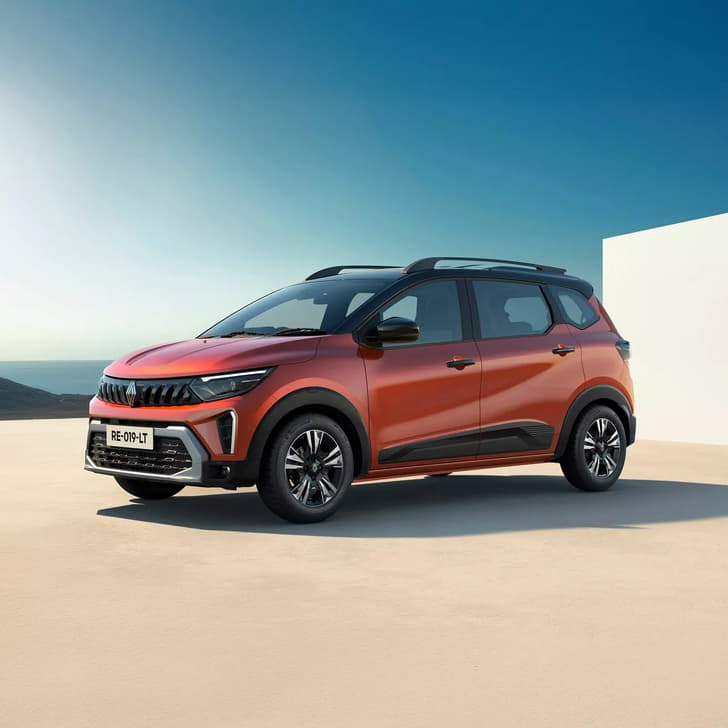
Of course, CMFB has spawned smaller cars too, like the Clio, for instance. But it sits slightly over the 4-metre mark. So, while it could have been altered for a smaller vehicle, Renault says it didn’t want to resort to hacks like truncating the boot. What it wants are well-proportioned sub-4-metre cars. The production vehicle of the upcoming Renault Bridger – which will be a sub-4-metre SUV – is expected to be underpinned by RGMP.
Electrification
The other difference between the two platforms is in regard to electrification. CMFB was never designed to be electrified. In fact, in 2020, Renault announced a plan to electrify it and called the platform CMF-EV. Along the way, though, it was rebranded as AmpR.
The RGMP follows a similar approach. With many elements re-engineered, Renault says it will enable the platform to easily take on full electrification – as well as other powertrain systems like hybrids and CNG – without any compromise on packaging.
Why the distinct names?
With these differences in mind, Renault has chosen to use new names for the two platforms; RGMP and CMFB, no doubt in part for marketing purposes. However, as is seen, the two platforms do bear some notable differences, as, in fact, do the two Dusters that they underpin.
The Indian Duster differs in terms of higher material quality and equipment levels, and, interestingly, it even has a taller passenger cell. That is on account of our love for sunroofs. With the Indian car getting a large panoramic sunroof, Renault had to raise the roof to accommodate the mechanism while still maintaining sufficient headroom. The Indian Duster’s passenger cabin is thus about 40mm taller than its European counterpart, and with an increase in ground clearance too, the India-spec model stands about 50mm taller.



 Uday Singh
 Glenn Noronha
 Dipan Sur