


Hyundai offers the Venue N Line with a turbocharged direct-injection petrol engine and a dual-clutch transmission (DCT). And while there are two turbo-petrol engines available with the Mahindra XUV 3XO, it’s the one with direct injection that we’ll be looking at. Regardless, the type of automatic transmission on offer remains the same Aisin-sourced torque converter. The question now is, which SUV offers superior performance out in the real world?
Hyundai Venue N Line DCT vs Mahindra XUV 3XO AT: Specifications
The XUV 3XO offers more power but is also much heavier than the Venue
Both engines here are direct-injection three-cylinder units. However, the XUV 3XO’s mill is larger by 199cc and delivers an additional 11hp and 58Nm. The Mahindra also achieves its peak power output lower down the rev range, though its 153kg heavier kerb weight means that its power-to-weight ratio is lower than that of the Venue N Line. Where the XUV 3XO fares better is in terms of its torque-to-weight ratio, with its higher torque figure making a marked difference.
Hyundai Venue N Line DCT vs Mahindra XUV 3XO AT: 0-100kph acceleration test
Outright acceleration from a standstill sees the XUV 3XO leaving the Venue N Line behind
The punchier engine of the XUV 3XO is one reason behind its quicker times off the line. The other is its torque-converter automatic gearbox, which allows the driver to mash the throttle pedal while standing on the brakes. It’s also smoother around town at slower speeds, especially in bumper-to-bumper traffic conditions. The Venue N Line’s dual-clutch transmission is reasonably quick to shift as speeds rise, but it can feel jerky at crawling speeds or while downshifting.
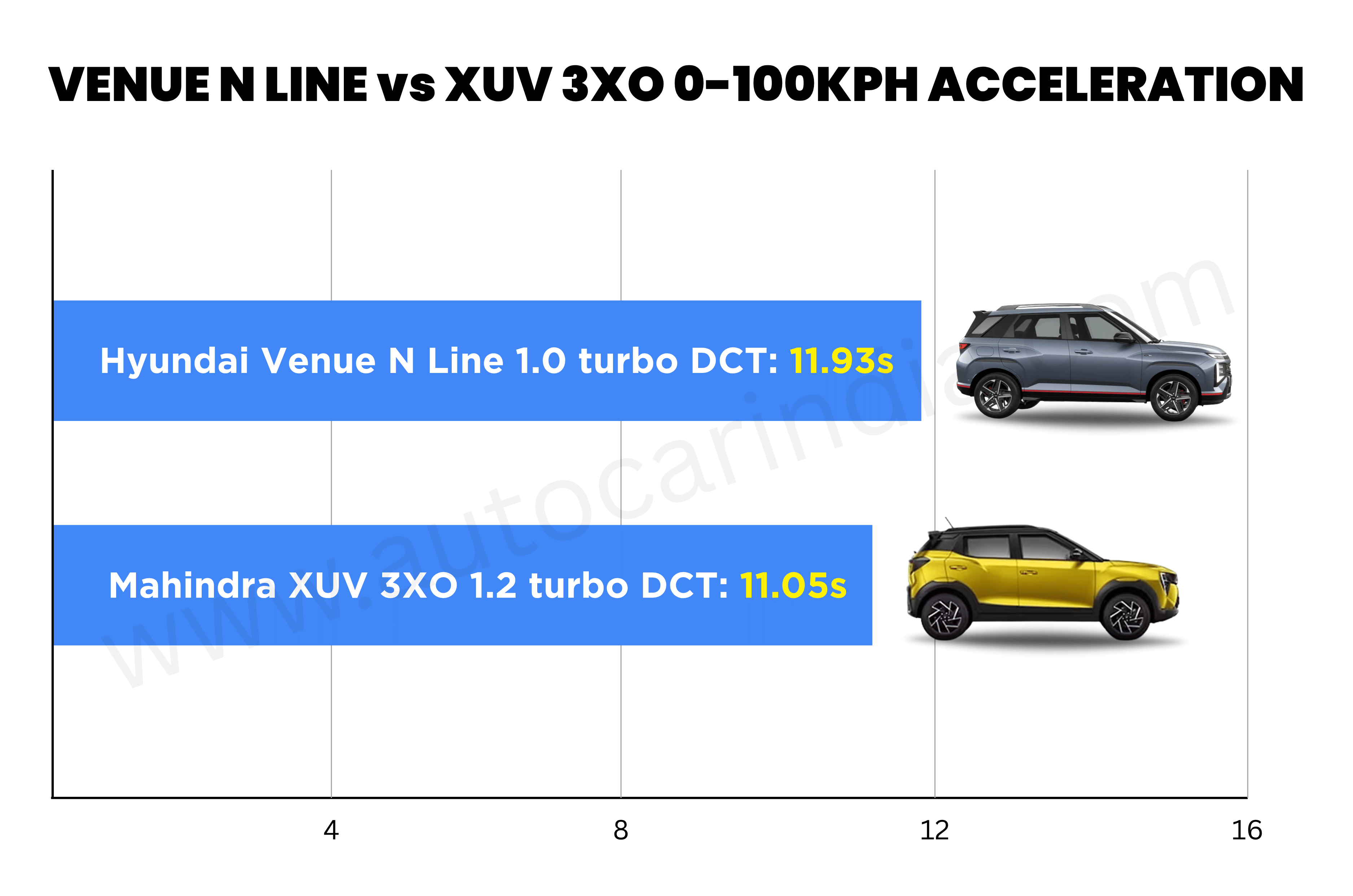
The Venue N Line’s DCT also doesn’t allow aggressive launches, which, along with its engine’s lower output, dulls outright performance. Both cars come with drive modes, but it’s the Venue N Line that features multiple traction modes and steering-mounted shifters to manually change the gears. The latter feels more intuitive and sporty when compared to the gear-lever-controlled shift function of the XUV 3XO.
Hyundai Venue N Line DCT vs Mahindra XUV 3XO AT: Rolling acceleration tests
The Venue is marginally quicker between 20-80kph; 40-100kph is where the XUV 3XO takes the lead
Between 20-80kph, the Venue N Line’s sharper throttle response means that it closes this 60kph gap 0.17 seconds quicker than the XUV 3XO. However, the additional grunt offered by the Mahindra’s engine allows it to accelerate harder at higher speeds. This is evident in its 40-100kph rolling acceleration time of 8.11 seconds – that’s 0.24 seconds faster than the Venue N Line.
Hyundai Venue N Line DCT vs Mahindra XUV 3XO AT: Braking test
It’s the heavier XUV 3XO that remains calmer under heavy braking
The Hyundai Venue N Line is yet to be put through the Autocar braking test. However, what we can confirm is that it had no trouble dropping its anchors. Where the heavier XUV 3XO really stood out is in the manner it shed speed upon slamming the brakes, remaining calmer than the Venue N Line. Both models feature disc brakes all around and similar tyre sizes.
Hyundai Venue N Line DCT vs Mahindra XUV 3XO AT: Prices
The XUV 3XO is pricier at the bottom end but better value at the top end for performance-oriented buyers
The entry-level Mahindra XUV 3XO with the direct-injection turbo-petrol engine and automatic gearbox costs Rs 1.71 lakh more than the equivalent Hyundai Venue N Line DCT. At the top end, it’s the Venue N Line that’s dearer by Rs 46,000. For those who want to satiate their performance appetite, the Mahindra XUV 3XO will be the more rewarding pick of the two.
Autocar India’s testing standards
Before we conduct our performance tests, we check and maintain tyre pressures based on the manufacturer’s recommendation and ensure the car has a full tank of fuel. The car is then tested in a controlled environment with two people on board, and the data is collected via highly accurate GPS-based timing equipment.
Prices are ex-showroom, India.



 Uday Singh

 Glenn Noronha
 Dipan Sur