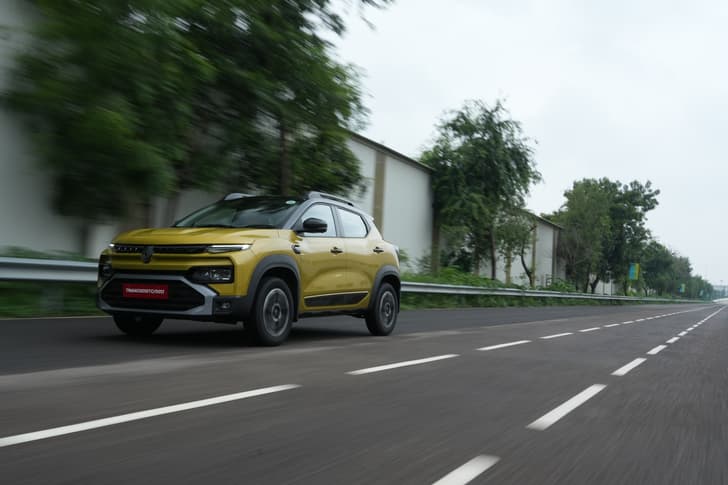

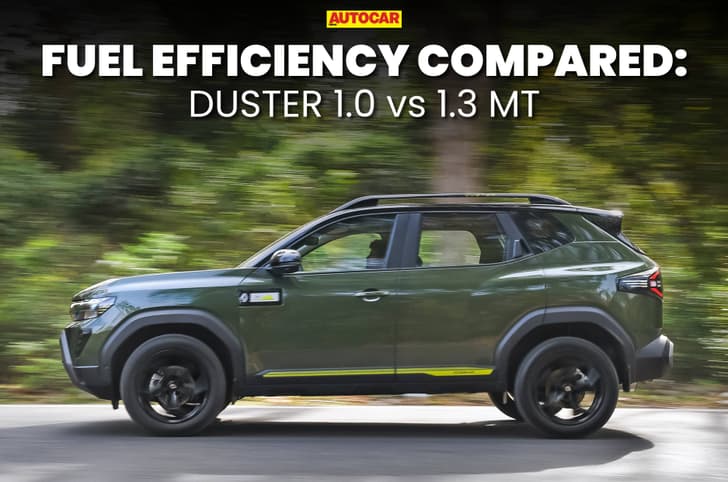
Earlier this year, Renault revived the Duster to mark its re-entry into the midsize SUV space. It is available with 1.0-litre and 1.3-litre turbo-petrol engine options. We’ve extensively tested and compared the real-world mileage figures of both in manual transmission guise to determine the gap in their efficiency.
Renault Duster 1.0 vs 1.3 MT: Specifications

The Duster’s 1.0-litre turbo-petrol engine is essentially the same unit that powers the Kiger. It develops an identical 100hp, but torque is slightly bumped up to 166Nm (from 160Nm). This engine is the least powerful turbo-petrol unit in the segment. In contrast, the 163hp, 280Nm 1.3-litre turbo-petrol engine is the most powerful in the segment. A 6-speed manual gearbox is standard on both engines, with a 6-speed DCT option available on the 1.3-litre mill. The variants with the smaller 1.0-litre engine have a 56kg lighter kerb weight. Both versions get an identical 50-litre fuel tank.
Renault Duster 1.0 vs 1.3 MT: Real-world fuel efficiency
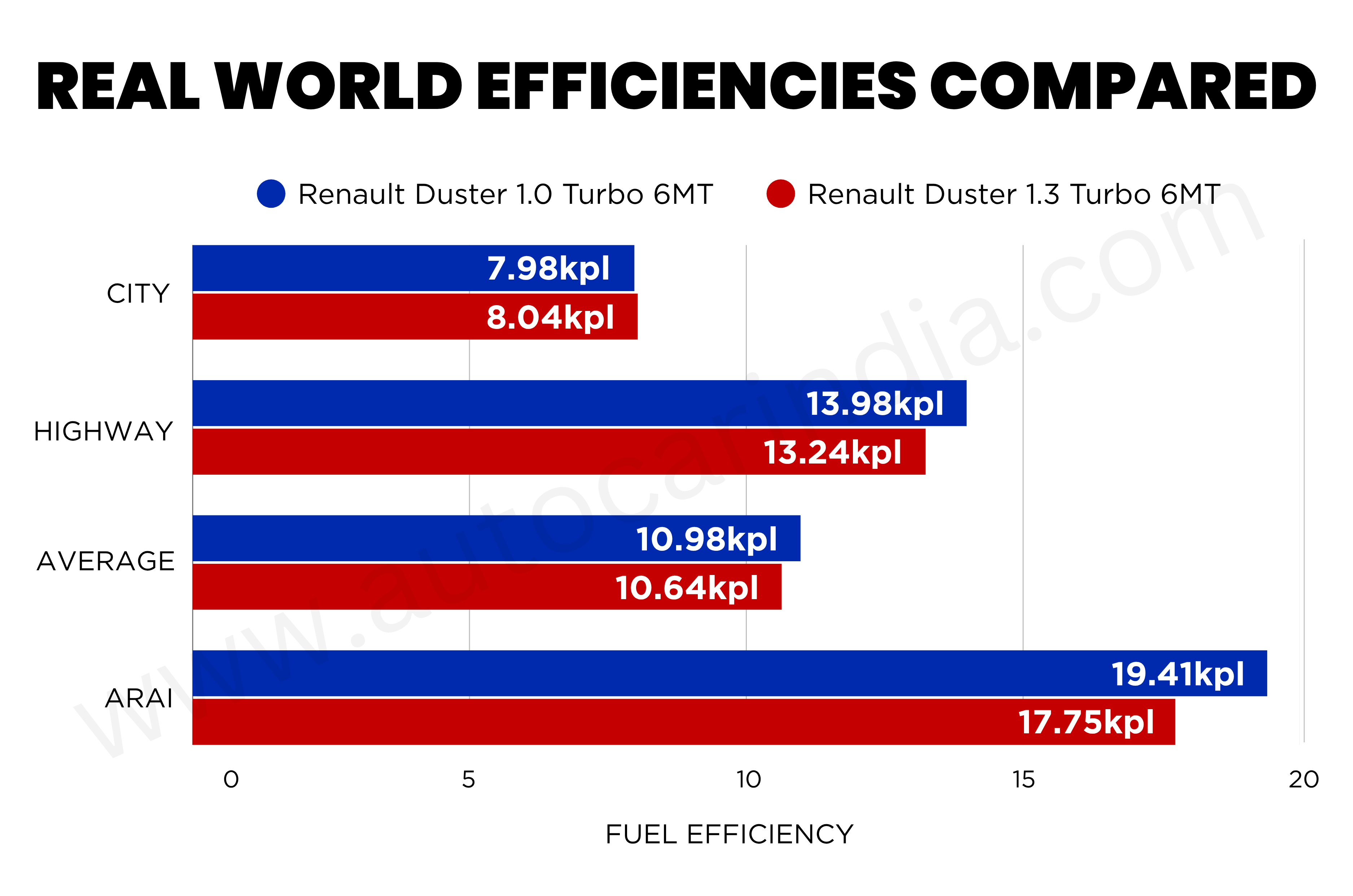
While both engines come with an Eco driving mode and an auto start/stop function, the 1.3-litre mill was more frugal in the city, albeit by a mere 0.06kpl. This is because of its ability to shift less frequently due to taller gearing. In our testing of the 1.0-litre unit, high temperatures forced the AC to work harder and auto start/stop only worked briefly, affecting mileage in the city. On the highway, however, the 1.0-litre unit was more efficient by 0.74kpl. Overall, too, the Duster 1.0’s average fuel efficiency was slightly higher at 10.98kpl compared to the 1.3’s 10.64kpl. The 0.34kpl gap in real-world average figures is much lower than the 1.66kpl difference between their respective ARAI-claimed figures.
What community is saying on the Duster?
Renault Duster 1.0 vs 1.3 MT: Price
The Duster with the 1.0-litre engine is more affordable since it is offered from the base to mid-level trims. Meanwhile, the 1.3-litre engine is available from the one-above-the-base trim, which makes it comparatively pricier. Going for the 1.3 over the 1.0 within the same trim will set you back by up to Rs 1.3 lakh.
Autocar India’s fuel-efficiency testing
Before our real-world fuel-efficiency tests, we fill our test cars’ tanks to the brim and maintain tyre pressures based on the manufacturer’s recommendations. These cars are driven in fixed city and highway loops in and around Navi Mumbai, and we maintain certain average speeds. Throughout the tests, there is only one person in each car, operating the air conditioner and other electricals, such as the audio system, indicators and wipers, when required, just like a regular user would. Periodic driver swaps further neutralise variations in driver patterns. At the end of each cycle, we calculate efficiency by filling the tanks to full again.
All prices are ex-showroom, India.


 Uday Singh

 Dipan Sur