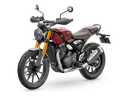
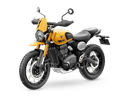
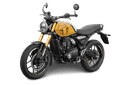
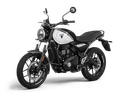

Bajaj found itself at a crossroads when the government introduced the GST 2.0 regime, which benefited bikes that fell within the 350cc threshold by levying a lower 18 percent tax on them while putting bikes above this displacement category in a higher 40 percent tax bracket.
Triumph’s entire small-capacity line-up, which was intended to bring in new customers to the hallowed British brand, sat above the 350cc threshold, attracting the higher tax rate. So Bajaj decided to shoulder the tax burden till it could come out with a lower-displacement engine.
Now, the brand has launched its entire line-up with the smaller displacement mill, and here are all the mechanical and price differences between the ‘new’ 350cc engine and the outgoing 398cc engine on paper.
Triumph 350cc vs 400cc mechanical differences
Bajaj has kept the bore intact and shortened the stroke
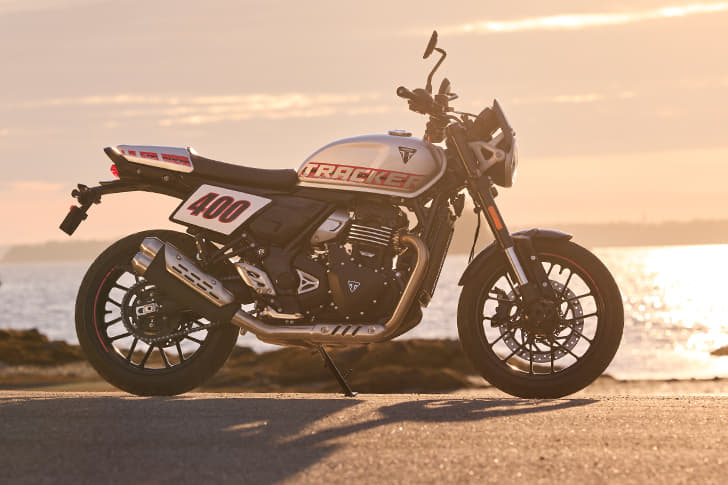
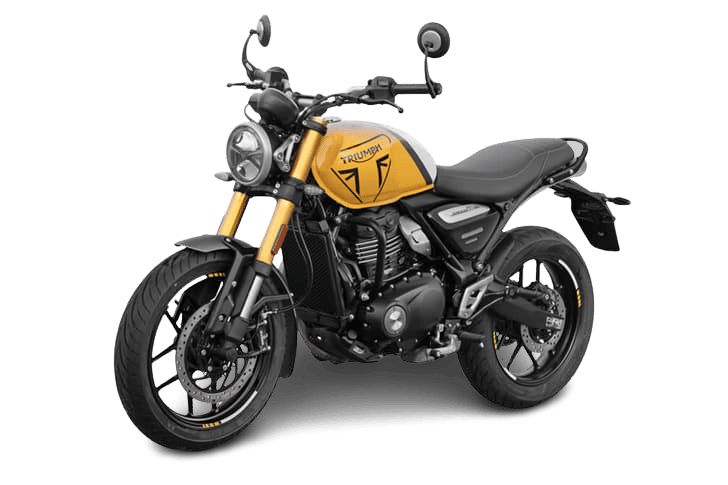
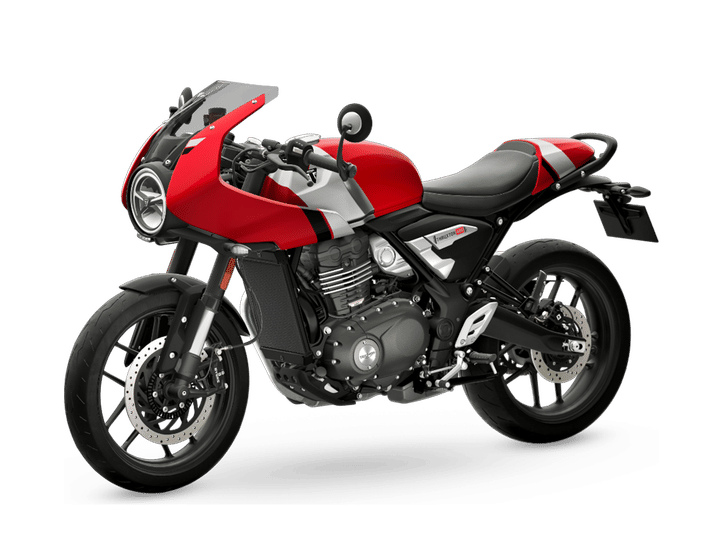
The spec sheets of the 350cc and 400cc engines, when assessed side by side, reveal that Bajaj has kept the bore intact and shortened the stroke, helping the new unit achieve 349cc displacement. Other smaller changes include a new crankshaft, connecting rod as well as new cams although the valves and the rest of the head design are the same. This has also resulted in the engine making its peak power 500-1,000rpm higher up in the rev range for the Speed and Scrambler models. Meanwhile, the Thruxton and Tracker, at 8,750rpm, produce their peak power 250rpm lower in the rev band compared to their outgoing models. The downsized Triumph models also miss out on an immobilizer.
Triumph 350cc vs 400cc power and torque differences
Torque takes a bigger hit with this downsized engine
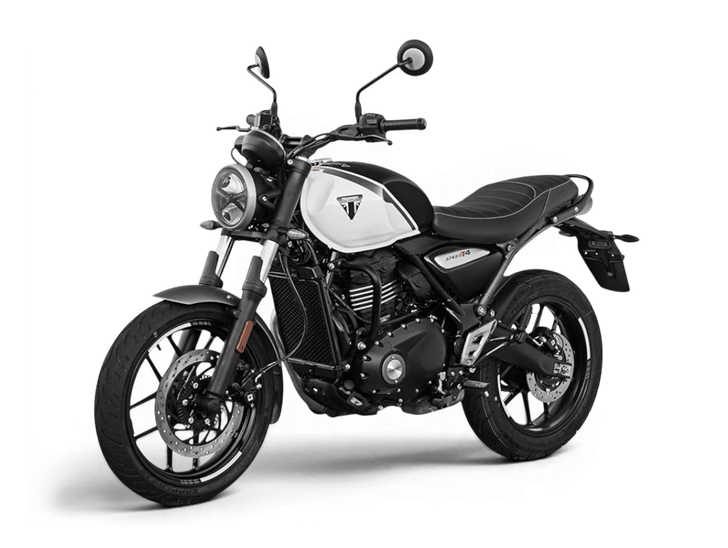
Downsizing often translates into a drop in peak power, and the story isn’t any different here. These new downsized models witness a peak power drop of 2-3hp. For reference, while the earlier 398cc engine was capable of 40-42hp in its full-fat state, the power figures now stand at 37hp-40hp (barring the Speed T4), depending on the model. However, torque takes a bigger hit, with this new engine losing over 5Nm compared to the outgoing one. The Speed T4 comes with a different state of tune, and its revised power now stands at 29hp and 31Nm, down 2hp and 5Nm, respectively.
What community is saying on the Scrambler 400 X?
Triumph 350cc vs 400cc power-to-weight ratio differences
The updated lineup sees a marginal drop in power-to-weight ratios
While all models still weigh the same, the power-to-weight ratios have gone down with reduced power – from 172hp/tonne to 161hp/tonne for the Speed T4, from 223hp/tonne to 206hp/tonne for the Speed 400 and from 216hp/tonne to 200hp/tonne for the Scrambler 400 X. The more off-road-focused Scrambler 400 XC sees its ratio fall from 210hp/tonne to 194hp/tonne. Meanwhile, the Thruxton 400 records a comparatively smaller dip, going from 229hp/tonne to 218hp/tonne.
Triumph 350cc vs 400cc price difference
At Rs 1.95 lakh, the Speed T4 remains the entry point into the line-up
The reason for downsizing the 398cc TR-series engine is so that the bikes are taxed at the lower 18 percent rate. The prices have dropped by up to Rs 11,000, varying by model. At Rs 1.95 lakh, the Speed T4 remains the entry point into the line-up, and its price is the same as that of the outgoing model. The Scrambler 400 X reaps the most benefits with a price cut of Rs 11,000. Despite the new engine, Bajaj has decided not to tinker with the nomenclature and continues with the ‘400’ suffix.
All prices are ex-showroom, Delhi.
 Vishal Venugopal
 Stephen Raj Antony