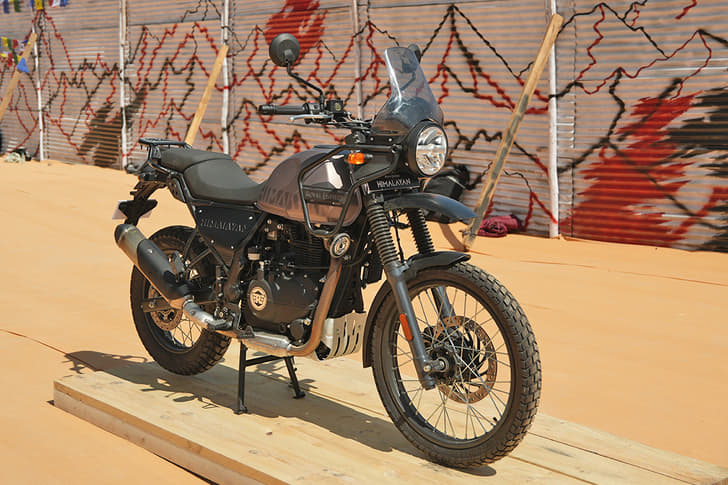


From the moment the RE 650 twins broke cover in 2018, there was always a dream of a Himalayan 650. RE even looked into it at the time but discovered that the bike would have been underpowered and too heavy. That seemed to be the end of the story then, but as it turns out, the Himalayan twin project stayed alive in the background. Bringing it to life ended up requiring a brand-new chassis as well as a bigger engine.
Royal Enfield Himalayan 750 weight, seating position – 8/10
Like most of RE’s new launches over the last decade, the Himalayan 750 was a poorly kept secret. The biggest question I had since first learning of its existence was how heavy it would be. After all, the Classic/Bullet/Super Meteor 650 all weigh above 240 kilos. With that frame of reference, the Himalayan’s 224kg kerb weight is impressive, although still about 8 kilos heavier than a Honda Transalp 750. The engine and new chassis both contribute towards this achievement.

The engine uses magnesium for the side cases and top cam cover. It also has slimmer proportions with pared-back side covers and more compact air-cooling fins. RE tells us that despite being almost 100cc bigger, it weighs roughly the same as the existing 650, which is around 70 kilos. The new chassis also contributes to this via its use of high-strength steel. More importantly, it has enabled a lower seat height.

Weight as a number is far less important than how a bike feels in person. While this bike is nearly 30 kilos heavier than the Himalayan 450, a number of shorter riders I spoke to said that they found the 750 easier to manage at parking speeds. That was largely down to the 815mm seat height, as well as how the seat narrows near the fuel tank. It's not only easier for short riders to get their feet down but the weight balance of the 750 also feels lower down than on the 450.

While there is no adjustable seat height on the 750, RE will sell a lower seat and higher seat option, both making a difference of 20mm. Taller riders will appreciate having the higher seat in place, and will perhaps want something even higher than that. Although, I must say that even the standard seat is superbly comfortable and that the wide handlebar puts the upper body in a neutral position.
Royal Enfield Himalayan 750 engine and performance – 9/10
RE tells us that the 743cc engine was created by increasing the bore and that the engine is 90 percent new. The essential changes include a move to ride-by-wire throttle, a redesigned oil-cooling system, a new air intake design, plated cylinder bores, a new high-power alternator and revised gearing from gears 3-6. The engine also uses a single-throttle body design (the 650s use twin throttle bodies), to help achieve that slender waist and low seat.

Power and torque have both risen, but not dramatically, with peak power now being 55hp and torque going up to 63Nm. On the move, there were two big changes that I felt when compared to the 650. The first is that this engine produces a deeper, more brappy soundtrack that I found more enjoyable. The bigger change is that there’s a noticeable shift in the power delivery.
The 650 engine enjoys being revved and rewards being taken to its 7,100rpm limiter. The 750 shares the same redline, but now prioritises a strong mid-range. The pull from 3,000-6,000rpm is far stronger than the 650 and the engine feels quite flat above 6,000rpm. Once you learn to ride a gear higher at all times, this torquey character is an enjoyable match for an ADV.

The new gearing is mostly quite good, but we noticed a bit of a gap between 2nd and 3rd. Where it works well is in giving the bike a more relaxed feel on the highway and a 120kph cruise feels very calm at just under 5,000rpm. The accelerator response is also beautifully smooth at low revs and the engine is quite tractable at city speeds.
What community is saying on the Himalayan 750?
Royal Enfield Himalayan 750 handling, suspension – 8/10
With a 19-inch front wheel, the Himalayan 750 assumes a more road oriented positioning, although you can have it with cross-spoked wheels in certain colour schemes. The handling is controlled, responsive and absolutely predictable. You’re aware that you’re on a large motorcycle, but the weight never feels unjustifiable or excessive. Turning into a corner doesn’t take much effort and the bike goes from fully upright to fully leaned over in a very linear and trustworthy manner.

The footpegs don’t scrape the road even at quite high lean angles and the tyres offer plenty of grip. Interestingly, many of us found the blocky pattern Vredestein tyres on the spoked wheels had better grip and feedback than the Ceats on the alloys. Braking is the one area where you can become aware of the bike’s weight and inertia. The twin disc set up gets the job done well, but like on all RE’s, the initial bite is a little dull and the lever needs a firm pull for strong braking.
Suspension comfort was an interesting area because this bike felt noticeably firmer than the 450. It was still quite comfortable and not harsh in any way, but definitely not as plush as on the 450. The Showa suspension is fully adjustable and RE officials told us that it had been set up for dynamic on-road handling on the fabulous winding roads in Sicily, so we’ll wait to reserve judgement once we ride the bike in India and get to play with the settings.

While it is more road oriented than the 450, the 750 is still game for some off-road fun. There’s decent suspension travel (190mm/175mm) and 205mm of ground clearance. The standing up ergos are good and the torquey engine ensures you can get good drive, or easily spin up the rear tyre if you like that sort of thing. I didn’t find the weight to be a problem and it was actually the relative firmness of the suspension that urged me not to push as hard as I would have on the 450. Again, this is something that can change with a different suspension set-up. The initial impression is that it isn’t built for off road, but you’ll still have fun and trails don’t need to be avoided.
Royal Enfield Himalayan 750 features and technoloy – 9/10
We’ve already seen plenty of how the Himalayan looks, so I won’t go into much detail. Royal Enfield has stuck with an easily identifiable design theme and the bike looks very well finished up close - a new benchmark for quality and finish for the company. While the round LED looks familiar, we’re told it's a new gen headlamp with stronger intensity and wider spread on both high and low beams.

The 4-inch round TFT is the same as the 450, but with some added features. Thankfully, RE has updated the five way toggle button on the left and the new one is more precise to use. However, there’s still room for improvement in the UI and we found it quite tricky to change the settings within the riding modes.
That’s right, this bike now has riding modes - 5 of them, in fact. It's also packed with numerous other features including cruise control, TPMS and lean sensitive ABS and traction control. Heated grips are available as an accessory. There’s even an inbuilt 4G sim that offers EV-like features including geo-fencing and vehicle tracking.

There weren’t many negatives to report, at least nothing significant. I think there are too many riding modes because there isn’t a huge change between them and that can be simplified. I also noticed that the ambient temperature display seemed quite inaccurate, but apart from that, the only feature I missed was a quick-shifter. That would have really elevated the riding experience and hopefully RE will offer one some time soon.
The Himalayan 750 will be launched at the end of November at the MotoVerse festival and we hope to see an exciting price, but the pressure of 40 percent GST means it's unlikely to be a spectacular one. Nevertheless, hopefully RE can price it below Rs 5 lakh where it would make for a fantastic premium, yet attainable adventure tourer.

 Azaman Chothia

 Dinshaw Magol