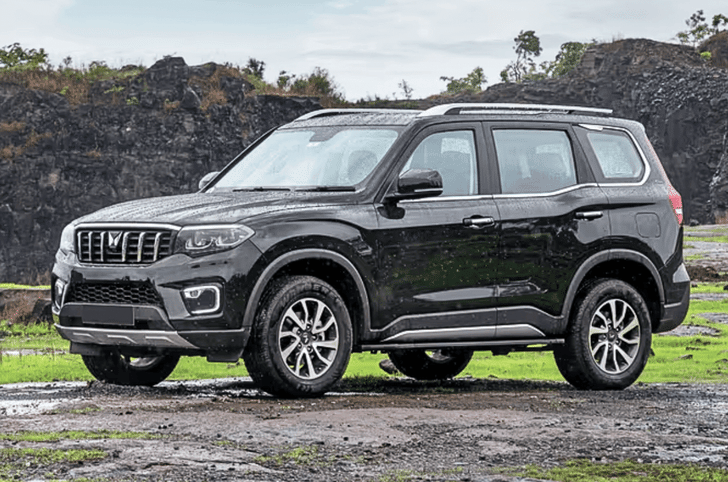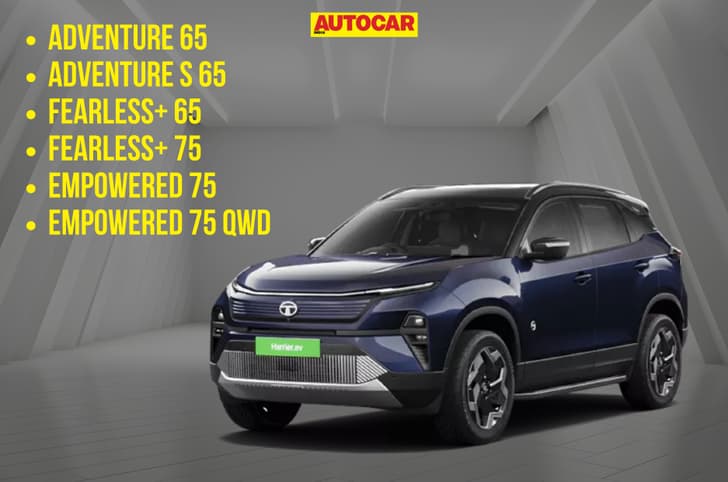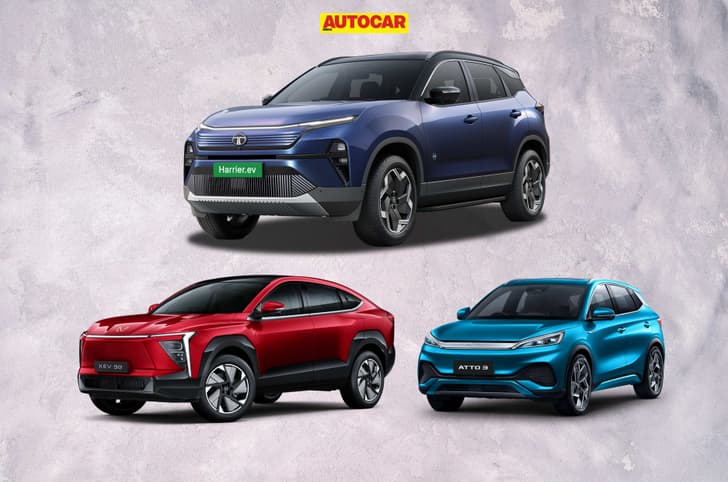
The Tata Harrier EV is the Indian carmaker’s most powerful and tech-rich electric car so far. It’s been attracting a lot of attention since it debuted early last month, and bookings have now commenced. To that end, let’s pit the Harrier EV against its direct rivals – the BYD Atto 3 and Mahindra XEV 9e – on paper and see how Tata’s latest and greatest fares against them.
Tata Harrier EV vs rivals battery and range
Harrier EV’s base 65kWh battery is bigger than Atto 3’s largest battery option
Entry-level variants of the Harrier EV have a big advantage over the XEV 9e and Atto 3, as the Tata SUV offers a larger 65kWh battery pack mated to a single rear-mounted electric motor. In fact, the Harrier EV’s smaller battery option outsizes even the Atto 3’s top-spec 60.48kWh unit.
In this 65kWh configuration, the Harrier EV produces 238hp – 7hp and 34hp over the XEV 9e and Atto 3, respectively – and 315Nm; 5Nm more than the BYD, but 65Nm lower than the Mahindra. When it comes to higher-spec variants, though, things are completely in the Harrier EV’s favour.
Harrier EV is the only SUV here to offer AWD
The Harrier EV can also be had with a 75kWh battery, which may be slightly smaller than the top-end XEV 9e Pack Three’s 79kWh unit, but the Tata SUV’s range-topping Empowered 75 QWD variant adds another electric motor on the front axle, giving it all-wheel drive capability – a segment-first feature. AWD has ensured the Harrier EV gets a slew of off-road-centric features, such as low-speed cruise control, six terrain modes (Normal, Rock Crawl, Mud Ruts, Snow/Grass, Sand, and Custom), a 540-degree camera that projects a view of what’s underneath the car, and more.
Moreover, the extra motor bumps up the Harrier EV’s grunt to a segment-beating 313hp and up to 504Nm – 27hp and 124Nm over the RWD-only XEV 9e. Meanwhile, the Atto 3 is offered with a 60.48kWh battery in pricier variants, but it features the same FWD setup and powertrain output as the lower variants. Should you prefer a greater range over sheer off-road capability, the Harrier EV’s 75kWh battery can be opted with the standard RWD layout as well.
XEV 9e has the longest range, but Harrier EV isn’t that far behind
Speaking of ARAI-certified range, the Harrier EV’s 75kWh RWD variants can travel up to 627km on a single charge, which is over 100km more than that of the 60.5kWh Atto 3, but 29km short of the 79kWh XEV 9e. Meanwhile, the lower-spec 65kWh Harrier EV manages a claimed range of up to 538km – 70km farther than the Atto 3, but 4km less than the XEV 9e.
Tata Harrier EV vs rivals charging speeds
The Harrier EV’s battery can be recharged from 10-100 percent in up to 10.7 hours using a 7.2kW AC fast charger, with 20-80 percent taking just 25 minutes using a 120kW DC fast charger. The Atto 3 takes up to 10 hours when charging via an AC source, while DC fast charging takes up to 50 minutes for a 0-80 percent charge.
XEV 9e supports highest AC charging wattage
The quickest charging speeds here are achieved by the XEV 9e thanks to its support for 11.2kW AC fast charging – up to 8 hours for a full charge – and 180kW DC fast charging, which takes merely 20 minutes to charge the battery from 20-80 percent.
Tata Harrier EV vs rivals dimensions
Harrier EV is the tallest, but XEV 9e’s wheelbase is longer
When it comes to proportions, the Harrier EV is among the largest overall. It outsizes the Atto 3 by 152mm in length and 125mm in height, and has a 21mm longer wheelbase. Compared to the XEV 9e, the Harrier EV falls short by 182mm and 34mm on the length and wheelbase fronts, respectively, but it is 46mm taller than the Mahindra SUV.
As for ground clearance, the XEV 9e comes in at 207mm, while the Atto 3's is 175mm. Tata has not provided official ground clearance figures for the Harrier EV yet, so it’s difficult to ascertain where it falls among rivals.
Harrier EV uses different method to measure boot space
Boot space, similarly, is tricky, because while the Harrier EV’s 502-litre volume does look quite impressive here, Tata has measured the cargo capacity up to the SUV’s roof instead of its parcel tray. The XEV 9e and Atto 3 rely on the latter method of measurement, by which the Harrier EV’s boot space would be lower than officially stated.
Either way, the XEV 9e’s 663-litre boot is the largest here by far, while the Atto 3’s 440-litre cargo space is the smallest for now. Owing to their all-electric powertrains, the XEV 9e and Harrier EV come with frunks as well, measuring 150 litres and up to 67 litres, respectively. However, the Atto 3 does not get a frunk.
Tata Harrier EV vs rivals price
Harrier EV starting price is the lowest
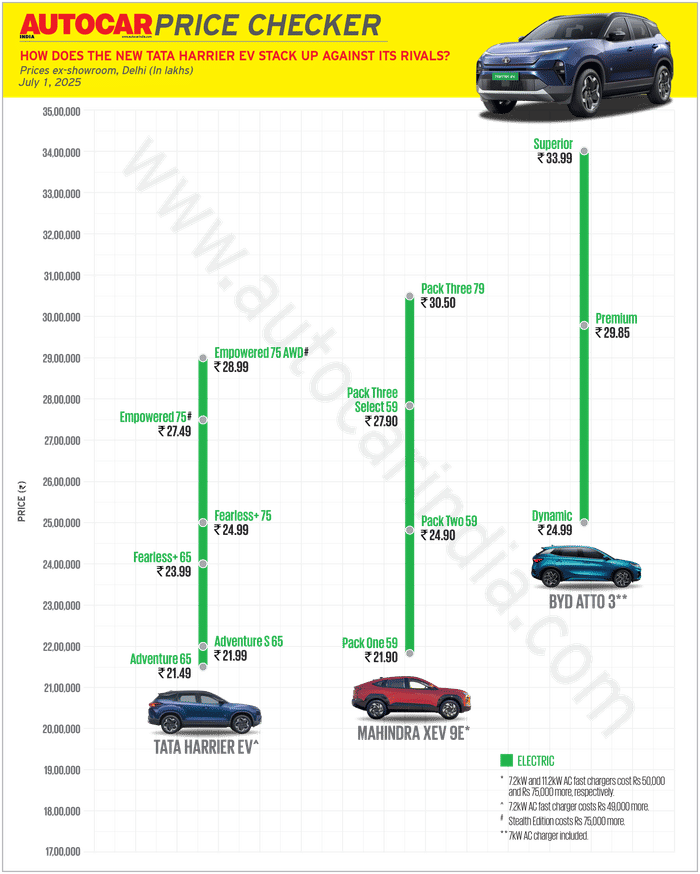
With an introductory starting price of Rs 21.49 lakh, the Harrier EV is the most affordable SUV here, undercutting the XEV 9e by Rs 41,000 and the Atto 3 by a whopping Rs 3.50 lakh. It’s worth mentioning that the Atto 3 is a fully imported CBU (completely built unit), so it attracts higher taxes. Notably, the Harrier EV and XEV 9e are offered with lifetime battery warranties, while Atto 3 buyers get an 8-year/1,60,000km warranty.
Top-end Harrier EV is Rs 5 lakh cheaper than the Atto 3.
The Harrier EV’s price advantage extends throughout the range, with the top-spec AWD variant coming in at Rs 28.99 lakh – Rs 1.51 lakh below the XEV 9e and Rs 5 lakh more affordable than the Atto 3. Considering the Harrier EV’s numerous advantages in the dimensions and powertrain departments, Tata has priced the SUV very competitively for its introductory period.
All prices ex-showroom, India.
Also see:

 Uday Singh
 Glenn Noronha
 Dipan Sur