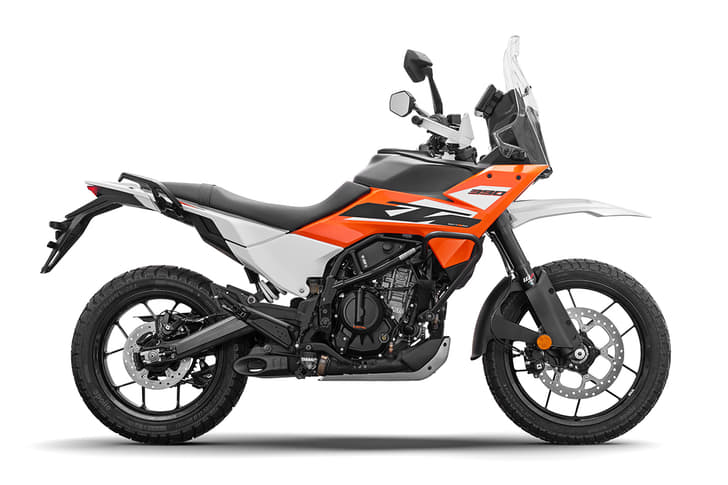
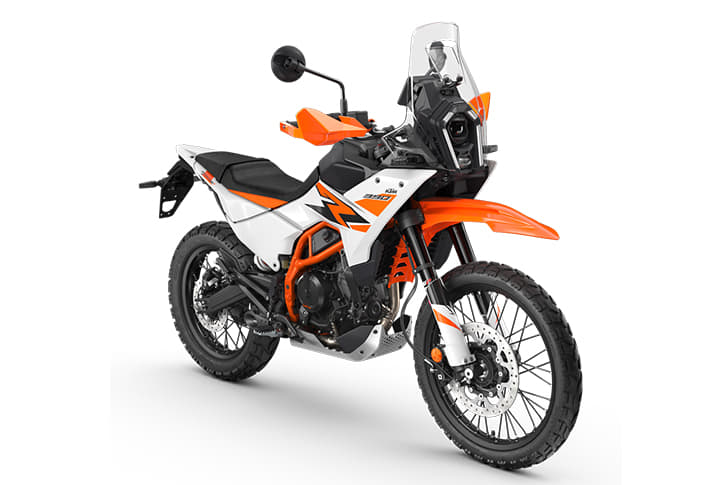
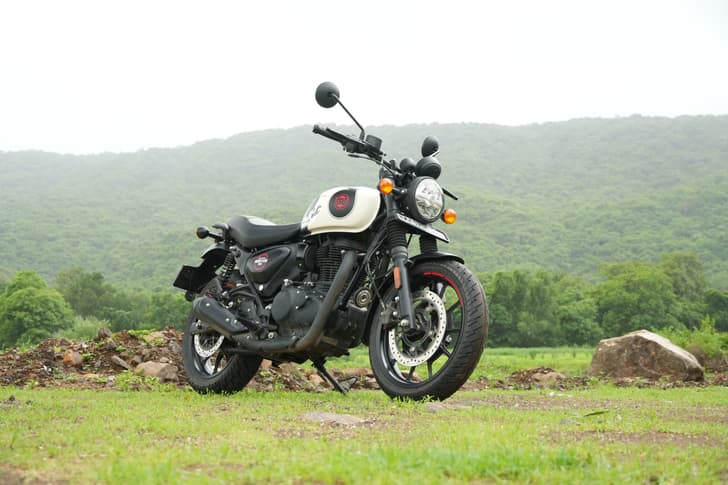
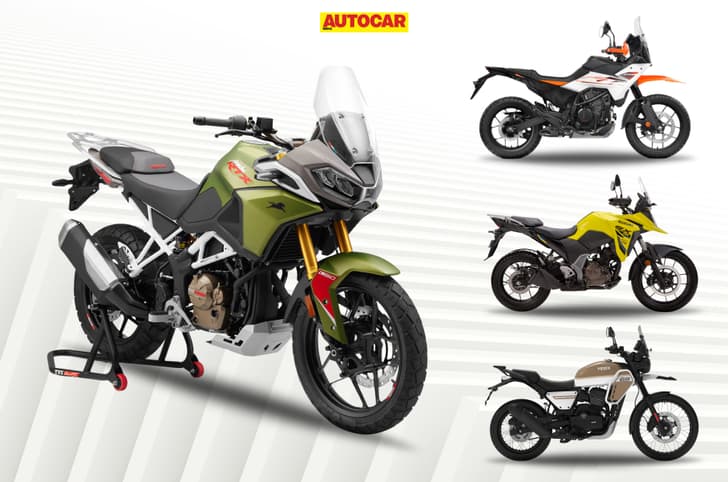
The Apache RTX debuts the new 300cc engine from TVS that was unveiled last year at Motosoul. It sits in a rather competitive segment, joining the likes of the KTM 250 Duke, Suzuki V-Strom SX and Yezdi Adventure. Here’s how the latest homegrown ADV stacks up on paper against its competition.
TVS Apache RTX vs rivals: Engine and output
The Apache RTX produces the most power
Engine and output
TVS Apache RTX
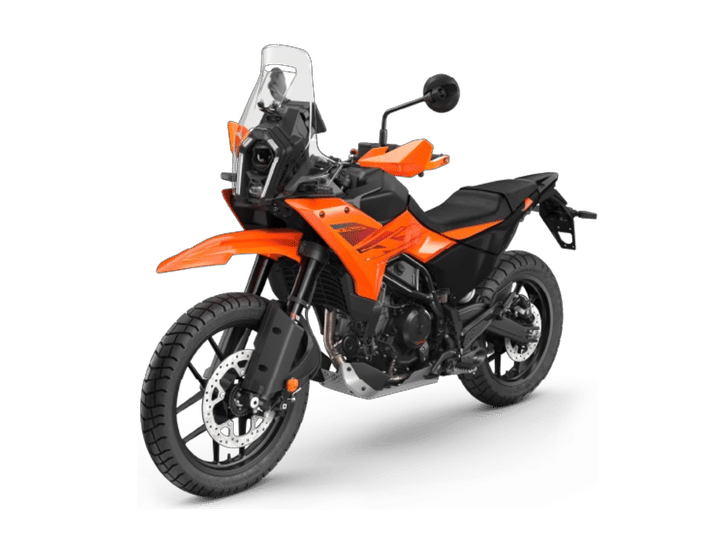
KTM 250 Adventure
Suzuki V-Strom SX
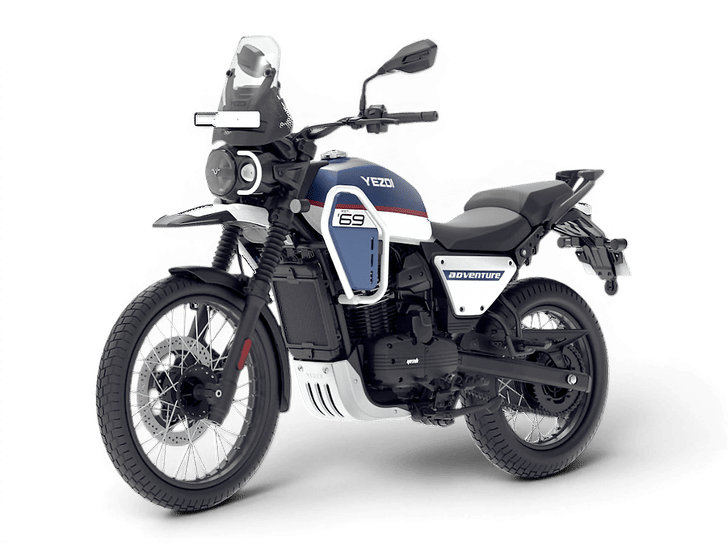
Yezdi Adventure
Engine
299, single-cylinder, liquid/oil-cooled
249cc, single cylinder, liquid-cooled
249cc, single cylinder, oil-cooled
334cc, single-cylinder, liquid-cooled
Power
35hp at 9,000rpm
31hp at 9,250rpm
26.5hp at 9,300rpm
29.6hp at 8,000rpm
Torque
28.5Nm at 7,000rpm
25Nm at 7,250rpm
22.2Nm at 7,300rpm
29.6Nm at 5,750rpm
Gearbox
6-speed
6-speed
6-speed
6-speed
The TVS Apache RTX debuts the new RTX-D4 engine that was unveiled last year, lending it the RTX moniker. TVS’ latest engine is both liquid-cooled (for the head) and air/oil-cooled (for the crank cases). It produces the most peak power compared to its peers here, followed by the KTM 250 Adventure and the Yezdi Adventure. The V-Strom produces the least amount of power and torque, which could be due to its simpler oil-cooled engine. Despite the Yezdi having the largest engine, it still manages to squeeze out less power out of it; however, it does produce the most amount of torque. Just like the 250 Adventure that shares its engine with the 250 Duke, the Suzuki too is powered by a familiar engine, shared with the Gixxer. All 4 motorcycles come equipped with a slipper clutch.
TVS Apache RTX vs rivals: Weight and dimensions
The V-Strom SX is the lightest here
Weight and dimensions
TVS Apache RTX
KTM 250 Adventure
Suzuki V-Strom SX
Yezdi Adventure
Seat height
835mm
825mm
835mm
815mm
Kerb weight
180kg
176kg
167kg
187kg (dry)
Ground clearance
200mm
228mm
205mm
NA
Fuel tank capacity
12.5 litres
14.5 liters
12L
15.5L
Wheelbase
1430mm
NA
1440mm
1465mm
Both the RTX and the V-Strom feature similarly tall seat heights. In comparison, the Yezdi is the most accessible, while the KTM 250 Adventure strikes a balanced middle ground. However, what’s not inviting about the Yezdi is its kerb weight, which is significantly higher than its rivals. With a declared dry weight of 187kg, its kerb weight could exceed the 200kg mark, making it the heaviest in this comparison. On the other hand, the V-Strom is the lightest of the lot but also offers the smallest fuel tank capacity, followed by the RTX.
TVS Apache RTX vs rivals: Suspension, tyres and brakes
The Yezdi is the only one to feature a 21-inch front wheel
Suspension, tyres and brakes
TVS Apache RTX
KTM 250 Adventure
Suzuki V-Strom SX
Yezdi Adventure
Suspension (F/R)
USD fork / Monoshock
USD fork / Monoshock
Telescopic fork / Monoshock
Telescopic fork / Monoshock
Tyre/wheel sizes (F/R)
110/80-19 / 150/70-17
19-inch / 17-inch
100/90-19 / 140/70-17
90/90-21 / 130/80-17
Brakes (F/R)
320mm disc / 240mm disc
320mm disc / 240mm disc
Disc / disc
320mm disc / 240mm disc
Two of the motorcycles here come equipped with USD forks and a monoshock setup. However, it’s the RTX that takes things a step further by offering adjustable suspension – though this feature is exclusive to the top-spec BTO variant. In contrast, the Suzuki and Yezdi rely on simpler telescopic forks. All the motorcycles, except the Yezdi, share a 19-inch front and 17-inch rear setup with alloy wheels. The Yezdi gets a 21-inch front wheel that should add to its off-roading prowess. Notably, the Yezdi also comes with the thinnest tyres of the group, while the RTX boasts the widest tyres at both ends.
TVS Apache RTX vs rivals: Features
The Apache RTX offers the most amount of features
In typical TVS fashion, the RTX comes loaded with several segment-first features such as TPMS and adjustable suspension—although the latter is reserved for the top-spec BTO variant. It even gets traction control and cruise control as standard, right from the base variant. Moving up the variant ladder unlocks the 5-inch TFT display, shared with the RTR 310 and Ntorq 150. This screen supports Google Maps mirroring, and TVS claims the user interface has been specifically designed for the RTX. Additionally, the TFT is capable of smartphone connectivity, offering access to vehicle data, ride statistics, last parked location, and more. The RTX also features a ride-by-wire throttle system, enabling a bi-directional quickshifter, cruise control and rider modes (Urban, Rain, Tour, Rally).
Following the RTX in terms of features is the KTM 250 Adventure, which gets the same TFT display as the 390 Adventure. However, it misses out on a few features compared to its elder sibling, such as traction control and cruise control, though it retains the ride-by-wire throttle with a bidirectional quickshifter.
The Suzuki V-Strom SX and Yezdi Adventure cover the essentials, offering an LCD dash with Bluetooth connectivity. The Yezdi goes a step further than the Suzuki by offering traction control and three ABS modes. All four motorcycles come equipped with LED headlights.
TVS Apache RTX vs rivals: Price
The KTM 250 Adventure is the most expensive proposition here
Price
TVS Apache RTX
KTM 250 Adventure
Suzuki V-Strom SX
Yezdi Adventure
Price (ex-showroom)
Rs 1.99 lakh - 2.29 lakh (introductory)
Rs 2.40 lakh
Rs 1.98 lakh
Rs 1.98 lakh
The Suzuki and Yezdi have a slightly lower starting price, but it’s the RTX that seems to offer the most value on paper. The RTX is available in three variants – Base, Top and BTO – priced at Rs 1.99 lakh, Rs 2.14 lakh and Rs 2.29 lakh, respectively. However, it is worth noting that these prices are introductory and they are slated to rise soon. The KTM 250 Adventure occupies the pricier end of the spectrum and is currently more expensive than the top-spec Apache RTX BTO variant.




 Vishal Venugopal
 Stephen Raj Antony