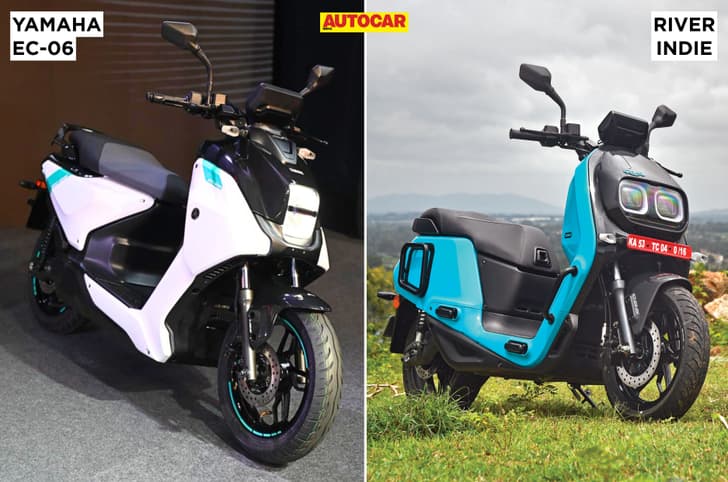
It’s no surprise that the recently unveiled Yamaha EC-06 is based on the River Indie. In fact, we were the first to report that Yamaha was working with the Bengaluru-based River to develop and produce its first global electric scooter. That said, it’s clear that the EC-06 ought to have a lot in common with the Indie. However, it isn’t merely a badge-engineered product, and there are several design differences.
Yamaha EC-06 vs River Indie: Design
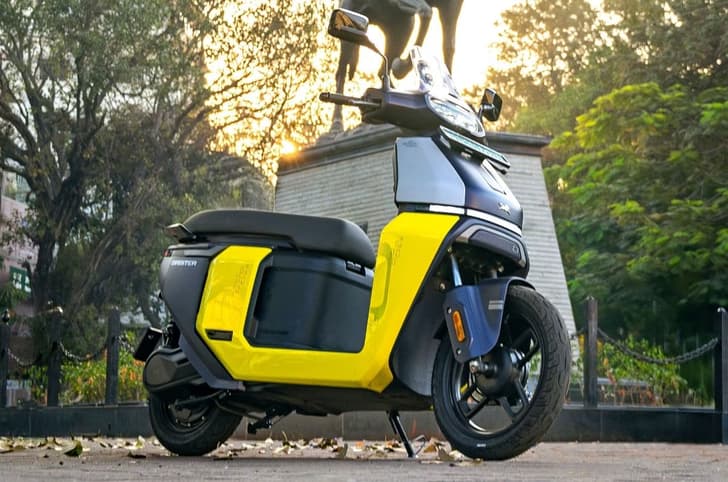
The Indie has a more utilitarian design with pannier stays and tether points.
.jpg?w=700&c=0)
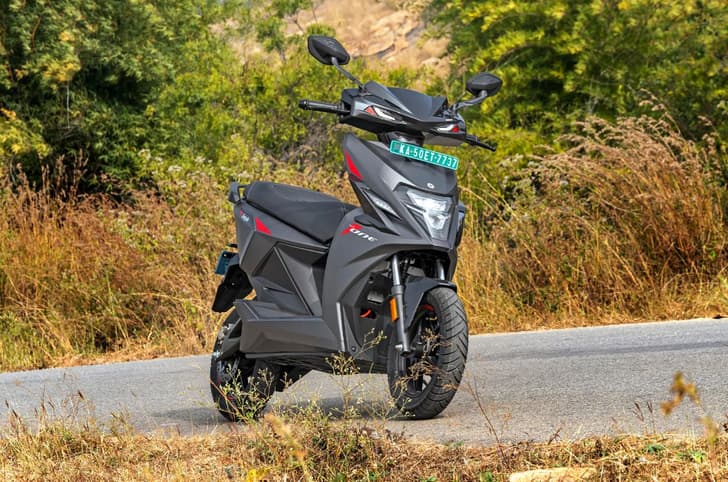
For starters, out goes the Indie’s twin-headlight setup, and in comes Yamaha’s relatively conventional vertically stacked headlight arrangement. Even the tail-light differs from the Indie’s rectangular unit. The LED indicators are also positioned above the headlight on the EC-06, unlike on the Indie, where they sit much lower and are prone to breaking – especially considering the hustle and bustle typical of our streets.
.jpg?w=700&c=0)
The Indie takes a utilitarian approach to its design, with ‘function over form’ likely being the focal point. This is evident in features such as pannier stays on both sides and a bag hanger for tethering luggage. The Yamaha counterpart, on the other hand, does away with these entirely and opts for a cleaner look that the brand says has been designed with a younger audience in mind.
Yamaha EC-06 vs River Indie: Storage
The Indie boasts a spacious 43 litres of boot space, whereas the EC-06 has only 24.5 litres.
.jpg?w=700&c=0)
With a clean design comes a lack of storage. One might argue that this isn’t always the case, but in this instance, it certainly is. The River Indie boasts a cavernous 43 litres of under-seat storage and an additional 12 litres of covered storage in the front apron. In contrast, the EC-06 offers a relatively modest 24.5 litres of storage, which Yamaha attributes to the restyling. The EC-06 also misses out on the covered front-apron storage; instead, it houses the charging port and key slot there. This redesign has also resulted in weight savings of 3kg, with the EC-06 tipping the scales at 132kg.
.jpg?w=700&c=0)
Yamaha EC-06 vs River Indie: Range, top speed and charging time
Yamaha claims a lower top speed of 79kph.
While the River claims a top speed of 90kph, the Yamaha’s is lower at 79kph. However, the EC-06 has a slight advantage in terms of the claimed IDC range, which is 169km as compared to the Indie’s 163km. The charging times are similar, with both River and Yamaha claiming that a 0-80 percent top-up takes 8 hours with a 480W charger. However, the Indie also gets an option of a faster 750W charger that the EC-06 misses out on. When this fast charger is used, the Indie can complete the 0-80 percent charging in just 5 hours. As mentioned earlier, the charging port on the EC-06 is located at a different and rather conventional spot; it has the port on the apron, whereas the Indie gets it on the side panel.
Yamaha EC-06 vs River Indie: Price
The EC-06 costs Rs 22,000 more than the Indie.
Yamaha had earlier only unveiled the EC-06, and now, the company has launched it at Rs 1.68 lakh (ex-showroom, Maharashtra). The EC-06 is currently only available in three states: Maharashtra, Karnataka and Tamil Nadu. At its current price, the EC-06 costs Rs 22,000 more than the River Indie while offering a lower top speed and less practicality but a marginally higher claimed range. While the EC-06 wears a Yamaha badge, it will be manufactured entirely at River’s factory in Hoskote, Karnataka.
 Vishal Venugopal
 Stephen Raj Antony