

Skoda has recently updated its mid-size SUV, the Kushaq. The 1.5 TSI now gets additional features, and crucially, the air-conditioning system has also been upgraded. We put the 1.5 TSI automatic to the test to find out its real-world fuel efficiency.
- Includes an auto engine stop-start feature
- Gets active cylinder deactivation tech
- Weighs 1,322kg
2026 Skoda Kushaq 1.5 TSI DSG real world mileage test
Uniquely features active cylinder deactivation
The Skoda Kushaq continues with the same 150hp/250Nm, 1.5-litre TSI direct-injection turbo-petrol engine mated to a 7-speed dual-clutch transmission. It also features an automatic engine stop-start system and active cylinder deactivation technology to help curb fuel consumption.
Gets a new variable-geometry AC compressor
Interestingly, despite the addition of rear disc brakes, a panoramic sunroof and powered front seats (among other updates) over the 2021 version, kerb weight has increased by just 17kg, from 1,305kg to 1,322kg. Also new is a variable-displacement air-conditioning compressor, which improves cooling efficiency and operates with less effort compared to the outgoing model’s fixed-displacement unit.
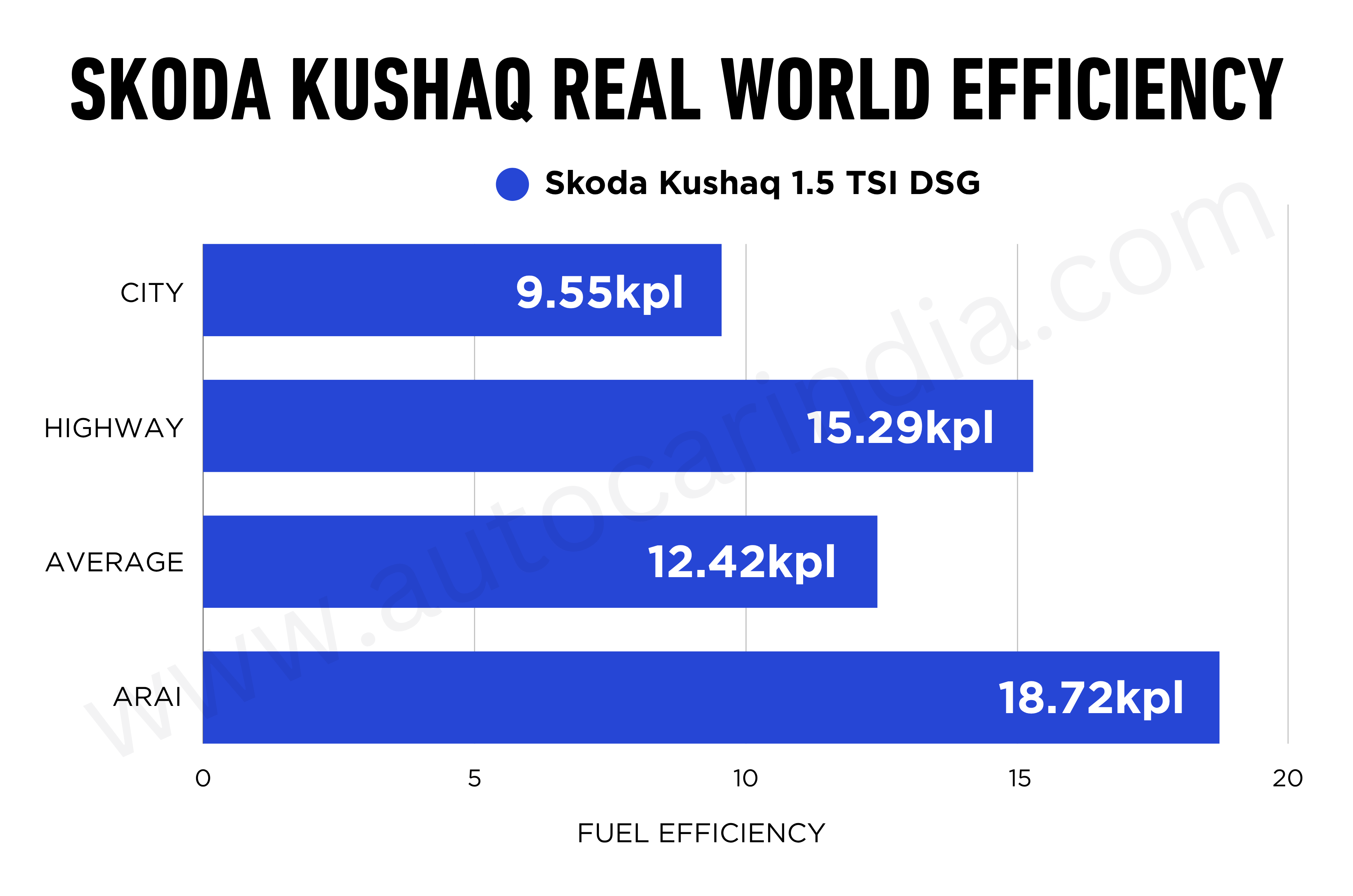
In our tests, the updated Kushaq returned 9.55kpl in the city and 15.29kpl on the highway. Compared to the 2021 version, its city efficiency has improved by 0.65kpl, while the highway figure remains largely similar to the earlier 15.40kpl.
Autocar India’s fuel efficiency testing
Before our real-world fuel efficiency tests, we fill our test cars’ tanks to the brim and maintain tyre pressures based on the manufacturer’s recommendation. These cars are driven in fixed city and highway loops in and around Navi Mumbai, and we maintain certain average speeds. Throughout the tests, there is only one person in each car, running the aircon at 22-degrees in full-auto mode, and other electricals, such as the audio system, indicators and wipers, when required, just like a regular user would. Periodic driver swaps further neutralise variations in driver patterns. At the end of each cycle, we calculate efficiency by filling the tanks to full again.




 Uday Singh

 Glenn Noronha
 Dipan Sur