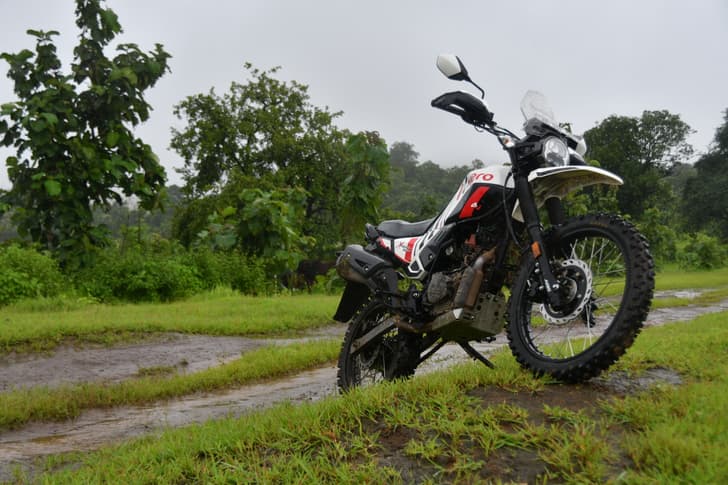
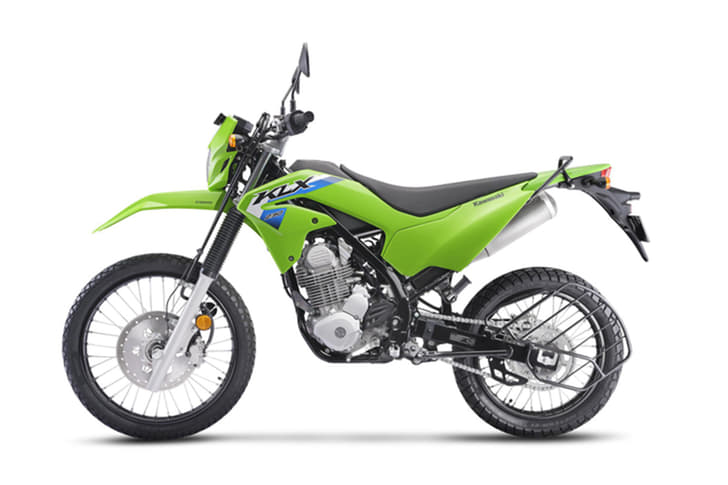
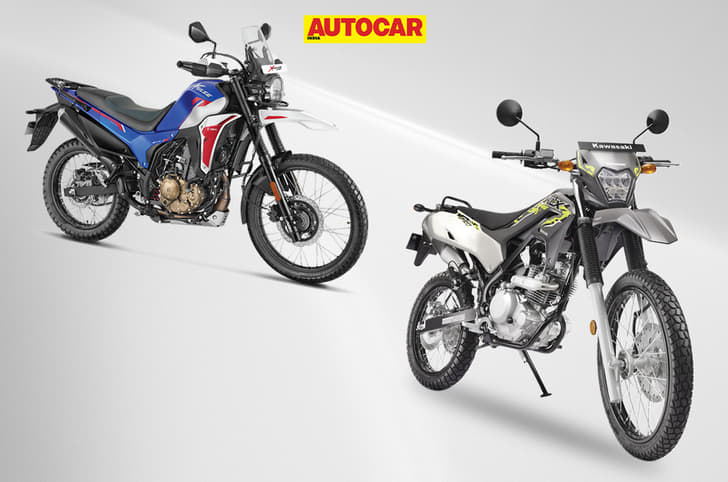
The Kawasaki KLX230 recently received a substantial price cut thanks to localisation, and both it and the Hero Xpulse 210 saw price reductions following the GST 2.0 reforms. With both models now priced much closer together, the localised KLX230 makes for an interesting comparison against what is perhaps the most popular made-in-India dual-sport. Here, we've stacked these two machines up on paper to see what's what.
Hero Xpulse 210 vs Kawasaki KLX230: Engine and output
Xpulse has a liquid-cooled motor and higher output
Engine and output
Hero Xpulse 210
Kawasaki KLX230
Engine
210cc, single-cyl, liquid-cooled
233cc, single-cyl, air-cooled
Power
24.6hp at 9,250rpm
19hp
Power-to-weight ratio
144.71hp per tonne
136.70hp per tonne
Torque
20.7Nm at 7,250 rpm
19Nm
Gearbox
6-speed
6-speed
With its liquid-cooled motor, the Xpulse has an immediately obvious advantage in terms of peak output compared to the KLX, which will be felt on the road and on fast, flowing gravel roads. However, the KLX’s motor is known for its tractable nature – especially important given these bikes’ intended usage.
Hero Xpulse 210 vs Kawasaki KLX230: Weight and dimensions
KLX is a big deal lighter but also significantly taller
Weight and dimensions
Hero Xpulse 210
Kawasaki KLX230
Seat height
830mm
880mm
Kerb weight
168-170kg
139kg
Fuel tank capacity
13 litres
7.5 litres
Ground clearance
220mm
255mm
Wheelbase
1446mm
1370mm
This area is one that sees a bit of give and take between these two accessible dual-sport bikes. On one hand, the Xpulse’s seat height is far lower, and it has nearly double the fuel capacity of the KLX. On the other hand, the KLX is 30 kilos lighter than the Hero, and while its seat height seems substantially taller on paper, the Kawasaki’s soft rear spring means the bike sags a lot once you get astride.
The KLX’s taller seat also liberates a bunch more ground clearance, and its wheelbase is also much shorter than that of the Xpulse, which should theoretically make it quicker to steer, more manoeuvrable, as well as agile.
Hero Xpulse 210 vs Kawasaki KLX230: Suspension, tyres and brakes
KLX uses a perimeter frame; both have similar cycle parts
Suspension, tyres and brakes
Hero Xpulse 210
Kawasaki KLX230
Suspension (F/R)
Telescopic fork / Monoshock
Telescopic fork / Monoshock
Wheel travel (F/R)
210mm / 205mm
220mm / 223mm
Tyres (F/R)
90/90-21 / 120/80-18
2.75-21 45P / 4.10-18 59P
Brakes (F/R)
276mm disc / 220mm disc
290mm disc / 230mm disc
With its move to heavy localisation, the KLX230 has lost some wheel travel; however, it is still a fair deal more than the Xpulse and, in general, this is unlikely to be a cause for concern for the majority of riders. Both bikes have similar cycle parts, but the KLX’s purpose-built perimeter frame is a more sophisticated component than the Xpulse’s simpler semi-double cradle design. Do bear in mind that this isn’t exactly a limitation on the Xpulse, just a point worth mentioning.
While these bikes may appear similar on paper, the KLX’s on-road manners are just about average, whereas the Xpulse doesn’t really feel as compromised. Only a proper comparison review will paint a proper picture of the differences between the two, and that’s a story we hope to bring you soon.
Hero Xpulse 210 vs Kawasaki KLX230: Features
Xpulse has more features than the KLX
Dual-sport bikes, by their very nature, are meant to be simple, rugged, and hardy machines that can take a proper bashing on the trails and still soldier on with minimal issues. By that very principle, they cannot be the most feature-rich or flashy machines, but rather straightforward and utilitarian.
Even so, the Xpulse 210, with its colour TFT display (on the top variant; the base model uses an LCD), adds a touch of premiumness to the equation. In comparison, the KLX uses a more basic and relatively smaller LCD screen.
Hero Xpulse 210 vs Kawasaki KLX230: Price
Both are priced quite closely after the KLX’s price drop and GST cuts
Price
Hero Xpulse 210
Kawasaki KLX230
Price (ex-showroom, India)
Rs 1.62 lakh - Rs 1.71 lakh
Rs 1.84 lakh
The Kawasaki KLX230 is now positioned quite close to the Hero Xpulse 210, and the factors working in its favour are its badge value and its image of being a true-blue on/off-road machine. In comparison, the Xpulse 210 promises more performance, potentially better on-road handling without compromising off-road ability, and, crucially, a significantly larger sales and service network.
Triumph Thruxton 400: FAQs on price, power, and features
The Triumph Thruxton 400 is a café racer and priced at a premium of Rs 25,000 over the Speed 400. Here are the answers to some frequently asked questions.






 Vishal Venugopal
 Ved Janve
 Stephen Raj Antony