The Ministry of Road Transport and Highways (MoRTH) has proposed making Vehicle-to-Vehicle (V2V) communication systems mandatory on all newly manufactured vehicles from October 1, 2028. According to the draft notification, the mandate will apply to L-, M- and N-category vehicles, which include two-wheelers, passenger vehicles and commercial vehicles. The proposal seeks to amend the Central Motor Vehicles Rules (CMVR), 1989.
- AIS-230 standard introduced for V2V systems
- Will use On-Board Units operating between 5.875GHz-5.925GHz
- Public consultation open for 30 days
MoRTH proposes phased rollout of Vehicle-to-Vehicle communication systems
MoRTH’s draft notification proposes a phased rollout of V2V communication systems. Manufacturers voluntarily offering the technology from October 1, 2027 will have to ensure they comply with AIS-230, the new Automotive Industry Standard for V2V communication systems. If approved in its current form, the fitment of V2V communication systems will become mandatory for all newly manufactured L-, M- and N-category vehicles from October 1, 2028.
The Automotive Industry Standard lays down the minimum technical, functional, performance, environmental and cybersecurity requirements for V2V communication systems. These include radio performance, receiver sensitivity and selectivity, Global Navigation Satellite System (GNSS) and positioning requirements, electrical and power-supply requirements, electromagnetic interference and compatibility, cybersecurity and communication security, and performance requirements for road safety applications.
Furthermore, the standard specifies the use of factory-fitted On-Board Units (OBUs) based on Cellular Vehicle-to-Everything (C-V2X) technology operating in the 5.875GHz to 5.925GHz frequency band. The Department of Telecommunications exempted the use of this spectrum from licensing requirements through a notification issued on June 10, 2026.
The standard also defines safety applications such as Emergency Brake Alert, Forward Collision Warning, Wrong-way Driving Alert and Emergency Vehicle Alert, enabling vehicles to exchange real-time information and warn drivers of potential hazards. The draft notification has been opened for public consultation for 30 days, following which the ministry will review the comments received before issuing the final notification.
What is Vehicle-to-Vehicle (V2V) communication?
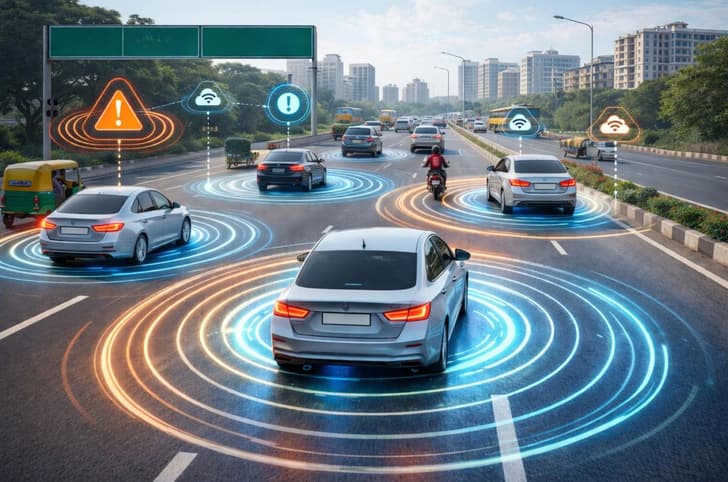
The technology enables vehicles equipped with V2V communication systems to wirelessly exchange real-time information such as speed, position, direction and acceleration. While conventional Advanced Driver Assistance Systems (ADAS) rely on cameras, radars, other onboard sensors and driver inputs, V2V allows vehicles to communicate directly with one another using Cellular Vehicle-to-Everything (C-V2X) technology.
This enables quicker detection of potential hazards that may not yet be visible to the driver and, according to the ministry, "is therefore expected to complement ADAS and support proactive accident prevention, connected mobility and future intelligent transport applications." The ministry also says the technology can provide warnings for situations involving sudden braking, forward-collision risks, unsafe lane changes and approaching emergency vehicles.
Challenges on the implementation of V2V communication systems
While the proposal marks a major step towards introducing V2V communication systems in India, it’s not without challenges. Automakers not only need to integrate and validate these systems across various models in their line-up, but also ensure they work as intended between vehicles made by different manufacturers.
In terms of costs, earlier estimates had suggested the On-Board Units (OBUs) could add around Rs 5,000 to Rs 7,000 to the cost of each vehicle, although the latest draft notification doesn’t explore the cost angle of integrating V2V technology. With connected-vehicle technologies, there will also be a need for robust cybersecurity measures, while importance must also be given to other factors such as data protection and user privacy.
When first announcing plans to introduce V2V technology earlier this year, Union Road Transport and Highways minister Nitin Gadkari said that it would allow drivers to "talk to each other like pilots". However, despite being under development globally for more than two decades, widespread adoption of the technology remains limited.
 Autocar India News Desk
 Dhruv Dhaka
 Dipan Sur