Pulsar 150, Apache 160 or Hunter?

TVS Motor Company is one of India’s largest two-wheeler manufacturers, with a 100-year legacy of trust and engineering. It is also the only two-wheeler company to have received the prestigious Deming Prize. With an annual production capacity of around 70 lakh two-wheelers, TVS offers a wide range of products in India. Its lineup includes mopeds, scooters, commuter motorcycles and racing-inspired bikes such as the TVS Apache series and Apache RR 310.
Technology / Feature | How It Supports TVS Bikes |
TVS Racing | TVS' motorsport experience influences the development of its performance motorcycles, particularly the Apache series, with a focus on handling, chassis balance and responsive performance. |
SmartXonnect | Adds connected features on compatible models, including Bluetooth connectivity, turn-by-turn navigation, call and message alerts, and riding information. |
Ride Modes | Lets riders change the motorcycle's response according to riding conditions. Depending on the model, modes such as Sport, Urban and Rain offer different performance characteristics. |
iGO Assist | Uses electronic torque assistance to support quicker acceleration while also helping improve efficiency during everyday riding. |
EcoThrust Technology | Used in commuter-focused motorcycles such as the TVS Sport and Radeon, with an emphasis on combustion efficiency and better fuel economy. |
Dura-Life Technology | Focuses on durability and dependable everyday operation, making it suited to TVS' commuter motorcycle range. |
310cc Motorcycle Platform | TVS developed the 310cc motorcycle platform with BMW Motorrad, demonstrating its engineering capabilities in the premium motorcycle segment. |
TVS has been involved in motorsport for more than four decades through TVS Racing. The experience gained from racing has also influenced its road-going motorcycles.
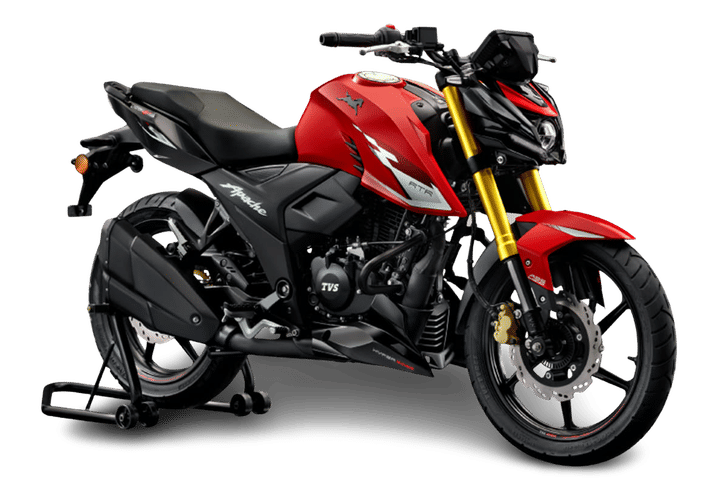
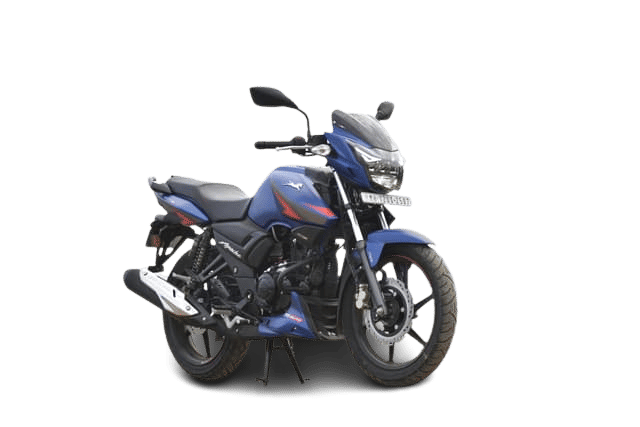
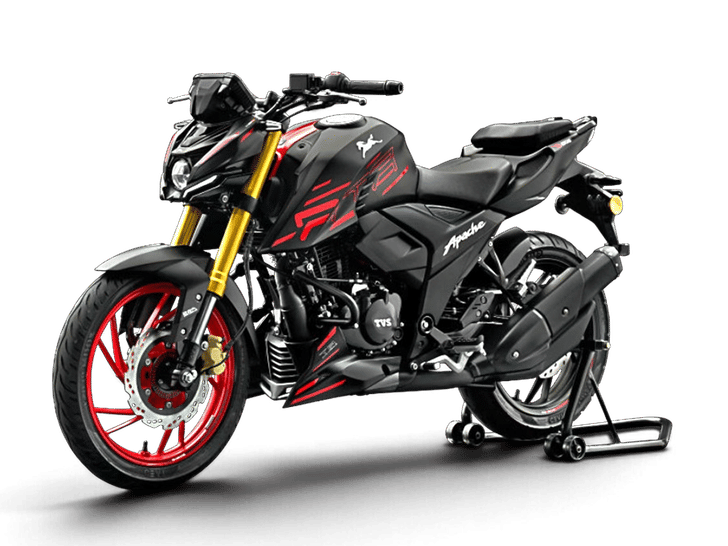
The Apache series is the clearest example. Models such as the Apache RTR 160 4V and Apache RTR 200 4V are built around a sporty riding experience, with an emphasis on handling, stability and engine response.
The approach is different with the TVS Ronin. It combines a modern-retro design with an engine tuned for usable performance in the low and mid-range, making it more suited to relaxed everyday riding.
TVS offers a range of bikes with different mileage figures, giving buyers options for everyday commuting and varied riding needs.
TVS commuter bike | Engine capacity | ARAI mileage | Real-world mileage |
TVS Star City Plus | 109.7cc | 83-86 kmpl | 70-80 kmpl |
TVS Sport | 109.7cc | 80 kmpl | 74-78 kmpl |
TVS Radeon | 109.7cc | 73.69 kmpl | 70-80 kmpl |
TVS Raider 125 | 124.8cc | 56.7 kmpl | 55-60 kmpl |
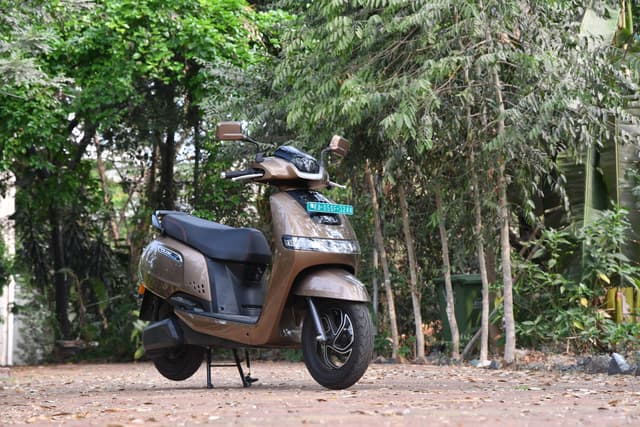
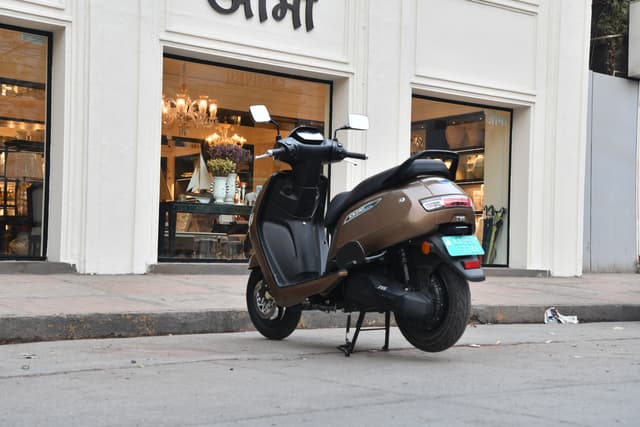
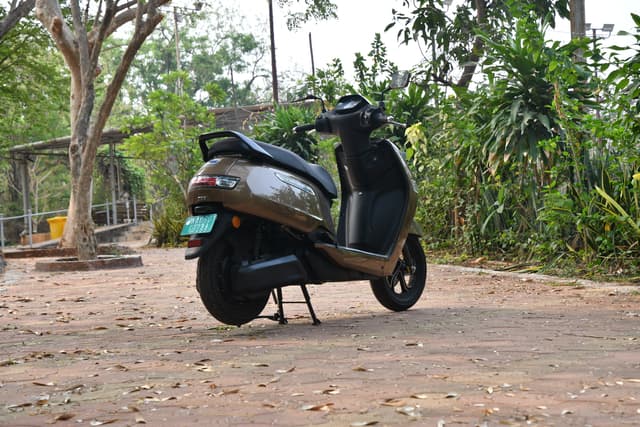
TVS currently offers three electric scooters in India: the TVS Orbiter, TVS iQube and TVS X. They cover different battery capacities, performance levels and claimed ranges.
This gives the TVS electric scooter range a broad spread, from the more affordable Orbiter to the larger-battery iQube and performance-focused TVS X.
TVS offers motorcycles and scooters across commuter, sporty, retro and performance segments. Its range includes small-capacity commuter bikes, performance-focused Apache motorcycles, electric scooters and practical petrol scooters.


Find bikes by budget


Find bikes by budget


Find bikes by fuel type
Filter your search
Filter your search
Hear from the
TVS does not currently sell any electric bikes in India.
Most commuter models, like the TVS Sport, Radeon, and Star City Plus offer strong mileage, generally between 65kmpl to 75 kmpl, depending on riding habits and terrain.
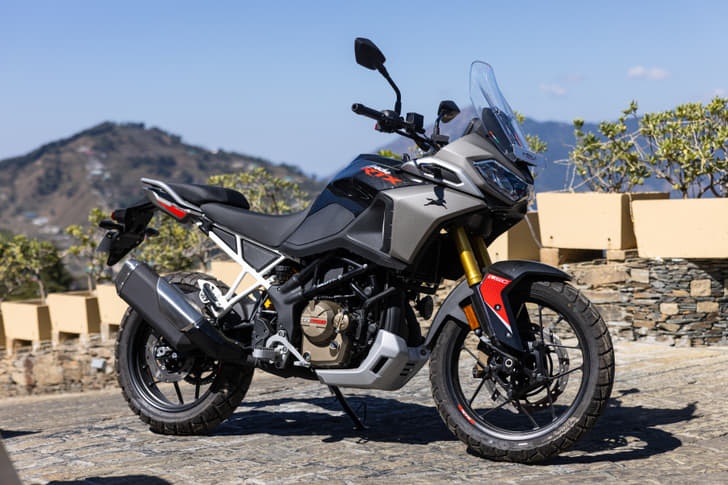
Yes. As of now, the only TVS adventure bike on sale is the TVS Apache RTX.
TVS Paddock is a new premium retail network that brand plans to use for Norton motorcycles, premium scooters, premium electric vehicles and other higher-end products.
TVS motorcycles are being developed and updated in line with India’s E20 fuel rollout.
Yes. TVS has a dedicated financing arm, called TVS Credit Services. It supports two-wheeler purchases through loan and finance options available across many dealerships.
No. TVS bikes are generally affordable to maintain, especially everyday commuters and scooters such as the TVS Sport and TVS Jupiter. Basic models typically cost around Rs 500-Rs 1,500 per service visit, making them inexpensive to run. However, performance-oriented Apache models and certain service centres may have slightly higher labour or spare-part costs.
TVS supports its customers with a wide after-sales service network across the country. Currently, TVS has 4,500+ authorised service centres operating across 3,800+ cities in India, supported by over 10,000 certified technicians. The company brings 30 years plus of customer care experience to ensure smooth service support for your TVS bikes and scooters.
Apart from all this, you also get these benefits when buying a TVS bike or scooter:
I want to buy a 2-wheeler under Rs. 1.5 lakh but I am confused between Yamaha FZ-Fi and TVS Apache RTR 160 2V. Please advise.
The Yamaha FZ-Fi is one of the most dependable, practical and fuel efficient commuters in its class but its not what you'd call cutting edge or exciting from a performance standpoint. Over the years, the FZ has transformed from one of the most powerful machines in its category to now making power akin to most sporty, new-age 125cc commuters like the Raider and Xtreme. Where that pays dividends is in terms of fuel economy and the FZ scores really high in this regard. In some ways the TVS Apache RTR 160 2V is similiar to the FZ in that it is a decades-old product that has been soldiering on with small updates sprinkled in over the course of its lifecycle. Where it differs from the FZ is that this is still a quick and peppy commuter and will 'feel' fun to ride. Its engine isn't the most refined and its design is now the better part of two decades old but the Apache 160 2V is nonetheless a sorted machine in its own right. These bikes have very different riding experiences so we'd recommend a test ride of both to figure out which one makes more sense for you.
Dear Autocar team, I am looking to purchase a two-wheeler for my daily office commute, roughly 95km per day (a mix of both highway (40%) and city traffic (60%) - Chennai). My height is 5.3 feet, and I am looking for a bike to suit my height; the preferred options are Pulsar 150, Apache 160 4V and Royal Enfield Hunter. Also, looking at the budget and features, the new Pulsar 150 make more sense to me. Need experts' suggestions on this. Thank you.
If your priority is fuel economy, you're better off with either the Bajaj Pulsar 150 or the TVS Apache RTR 160 4V. These bikes are proven workhorses which will last you a long time and deliver good fuel economy, which will be an important factor in your purchase decision given your near-100km daily commute. If, instead, you want a more premium and polished machine with better performance, build quality, design and ride quality, then the more expensive Royal Enfield Hunter 350 is surely a good option. It all boils down to whether or not you can manage the stretch and what sort of experience you are after.
Hi Autocar Team, I currently own a 2021 Hero Super Splendor. The most annoying aspect of my bike is its gearbox, which frequently experiences missed shifts and false neutrals. A few months ago, I decided to upgrade to a 160cc motorcycle. However, my neighbour recently bought a Hero Xtreme 125R, and it seems to have similar gearbox issues. Why has Hero been unable to provide a consistently smooth gearbox experience? If I upgrade to the Hero Xtreme 160R, am I likely to face the same issues? Please advise.
On most Hero motorcycles, as you've pointed out, the gearbox is quite notchy & lacks a snick, precise feel. While we can't comment on why the company has been unable to solve this issue, we can say that the latest Xtreme 160R 4V doesn't seem to suffer from this issue - at least our experience from the first ride event tells us that it doesn't. We'd recommend you get an extended test ride of the bike to properly try it out before going ahead with your purchase, or look at alternatives like the Bajaj Pulsar N160 or TVS Apache RTR 160 4V.
Is Bajaj Pulsar 220F a good choice for daily commute of 50km?
In isolation, the Bajaj Pulsar 220F is a proven workhorse with a punchy engine, comfortable rider's traingle position and good highway stability, which makes it well-suited for longer daily runs. It is also relatively affordable to maintain and has a wide service network, which is important for a high-mileage commuter.That said, the 220F is now nearly 2 decades old and has only seen regulatory and minor feature-related updates since. It does not offer the refinement or modern features of newer-generation bikes in the segment. If your commute is mostly highway and you don't mind the old-school feel of the 220F, it can make sense for you. However, if you are looking for a more modern package with better refinement, consider Bajaj's own Pulsar N250, the TVS Apache RTR 200 4V or Honda Hornet 2.0 as similiarly-priced and comparable alternatives. Try to take a test ride of all four before you make your decision to see where your preferences lie.
I am looking to buy a new scooter primarily for city commuting, with a typical daily riding distance of around 7 to 8 km. My pillion rider is a senior citizen, so ease of getting on and off, comfortable seating, and a stable ride are important considerations. Price is not an issue. Kindly suggest a suitable scooter that would meet these requirements.
Given your low daily run and emphasis on comfort and practicality, we'd advise you to choose between the Honda Activa 110 / 125, Suzuki Access 125 and TVS Jupiter 125. These are reliable, fuss-free, comfortable, fuel-efficient and practical machines - basically textbook family scooter options - which will all suit your needs very well. We'd recommend you take your pillion with you on your test ride and then gauge which one fits your needs best.
Last Updated on: 29 Oct 2026