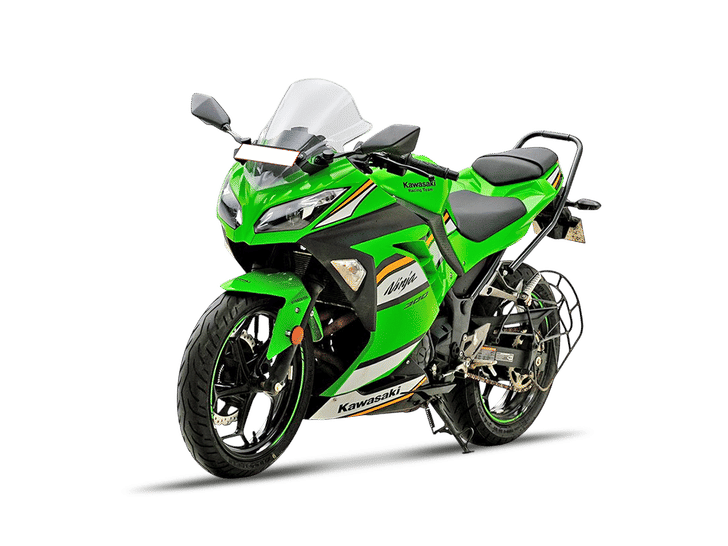

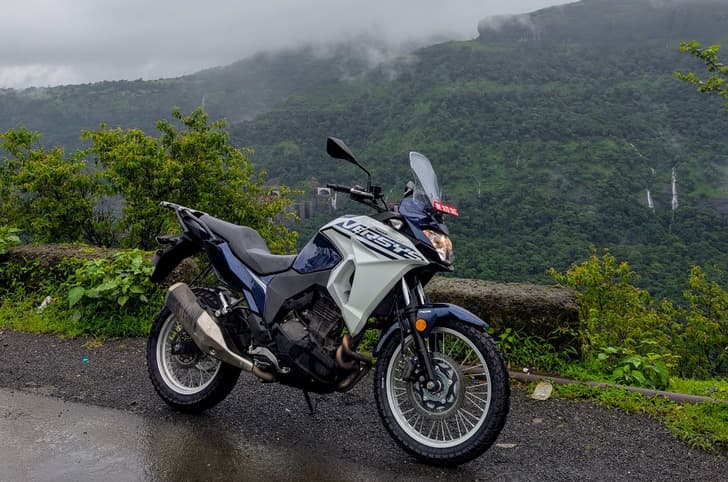
With its tall stance and twin-cylinder heart, the Kawasaki Versys-X 300 occupies a unique corner of the ADV world. It’s a motorcycle that appears adventure-ready, but underneath that touring silhouette is a high-revving 296cc parallel-twin that behaves very differently from most entry-level ADVs. Here’s how it stacks up when we dive into the numbers.
Kawasaki Versys-X 300: acceleration
Testing was conducted on a wet patch of road during the monsoon
40kph 1.9s | 60kph 3.2s | 80kph 4.99s |
100kph 7.54s |
The Versys-X 300 doesn’t launch off the line with an urgent shove, and that’s no surprise. With a peak power of 39hp arriving at a rather high 11,500rpm, the engine demands a healthy amount of revs before it gets going. The short-stroke twin is smooth and refined, but that high-rpm nature means it’s not going to wow you in drag races. However, keep the motor on the boil, and it rewards you with a clean, linear build of speed. Unlike many ADVs that rely on low-end grunt, the Kawasaki’s engine behaves more like a sportbike’s – it thrives on revs and enjoys being worked hard. In our tests, it managed a 0-60kph time of 3.2 seconds and a 0-100kph time of 7.54s.
Kawasaki Versys-X 300: roll-on acceleration
The Versys-X 300 doesn’t have the quickest roll-on acceleration figures
20–50kph (2nd gear) 2.45s | 30–70kph (3rd gear) 4.12s | 50–80kph (4th gear) 4.06s |
These figures further reinforce the engine’s high-revving character. There’s enough tractability to potter around at lower speeds, but to make quick overtakes or respond sharply to throttle inputs, the gearbox becomes your best friend. You’ll often find yourself dropping a gear or two to access the stronger part of the powerband. That said, the smooth throttle response and light clutch make this gear-hunting process effortless. It’s not lazy – just a motorcycle that prefers a more involved riding style.
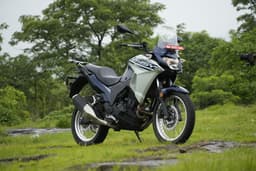
Kawasaki Versys-X 300: braking performance 60-0kph
Braking performance is average with early ABS intervention
60-0kph 17.20m |
Braking performance is adequate, and the 290mm front disc offers decent bite. The rear disc complements it well, though it’s not particularly standout. What does stand out, however, is the ABS, and not in a good way. It tends to intervene quite early and aggressively, especially at the front, which robs some confidence under hard braking. While this level of intrusion might be helpful on gravel or slippery roads, on tarmac, it can be frustrating for experienced riders trying to brake late or precisely. What doesn’t help is the fact that ABS cannot be turned off.
Kawasaki Versys-X 300: specifications and price
This motorcycle is one of the slowest in its class
Engine 296cc, parallel twin, liquid-cooled | Power 39hp at 11,500rpm | Torque 26Nm at 10,000rpm |
Gearbox 6-speed | Fuel capacity 17 litres | Kurb weight 181kg |
Brakes (F/R) 290mm disc / 220mm disc | Tyres (F/R) 100/90-19 / 130/80-17 | Price Rs 3.80 lakh |
While it doesn’t win on straight-line speed or aggressive roll-on sprints, its performance numbers tell the story of a machine that rewards commitment. Ride it like a mellow ADV, and you’ll miss the point. Ride it like a small sport-tourer, and it comes alive. It may not match the punch of a Himalayan 450 or the outright speed of a KTM 390 Adventure, but if you’re after a smooth, rev-happy twin that will cruise all day and ask for more, the Versys-X 300 is well worth a look.
Autocar India’s testing standards
Before conducting our performance tests, we check and maintain tyre pressures based on the manufacturer’s recommendation and ensure the motorcycle has a full tank of fuel. The motorcycle is then tested in a controlled environment, and the data is collected via highly accurate GPS-based timing equipment.
 Autocar India Team
 Stephen Raj Antony
 Vishal Venugopal