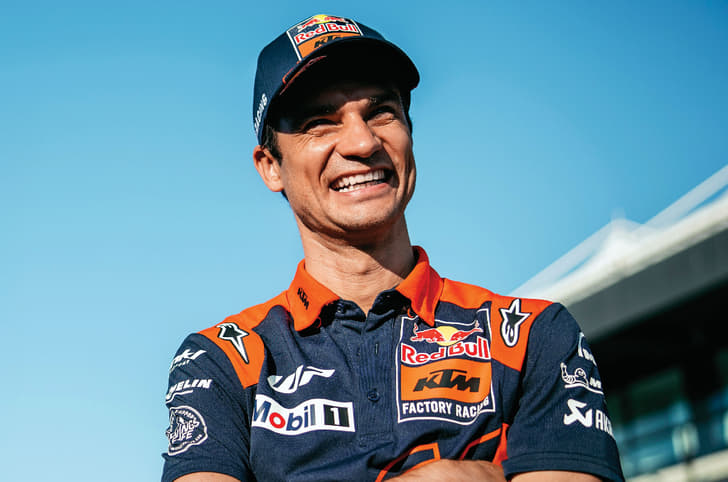
With 31 wins and 112 podiums to his name, Dani Pedrosa has cemented his status as a MotoGP legend. Throughout his MotoGP career, he raced shoulder-to-shoulder with some of the sport’s greatest riders like Valentino Rossi, Casey Stoner, Marc Marquez and Jorge Lorenzo. Since hanging up his leathers in 2018, the Spaniard has played a crucial role in KTM Racing’s progress as the team’s development and test rider.
We got the chance to sit down with Pedrosa to discuss his incredible MotoGP career, how the upcoming rule changes will impact racing, why consistency is key to the Indian GP’s success, and a lot more.
Note: This interview was conducted before MotoGP’s recent ban on wildcard entries from 2027 onwards.
Q: You’re here for the KTM Cup. How important are initiatives like this when it comes to building a robust racing ecosystem in India? You’ve often spoken about the Activa Cup and how it played such an important role in your junior career.
Exactly. So you know where I come from, and that’s why I support a lot of these ideas – especially in India, where they still know only a little about MotoGP. But there are some kids who are willing to one day be riders, and that’s why I like to interact with them, see how they train, how they ride, and hopefully give hope to their dreams.
Q: There is renewed interest in bringing MotoGP back to India. What really needs to happen to make the Indian GP a successful long-term part of the MotoGP calendar?
One key would be to have an Indian GP for some years in a row because that would be important for the new generation to settle in, to watch this sport, to see it live, to see it up close and [to] start enjoying [it]. If you only do a one-time or two-time thing, it doesn’t have time to set in the culture.
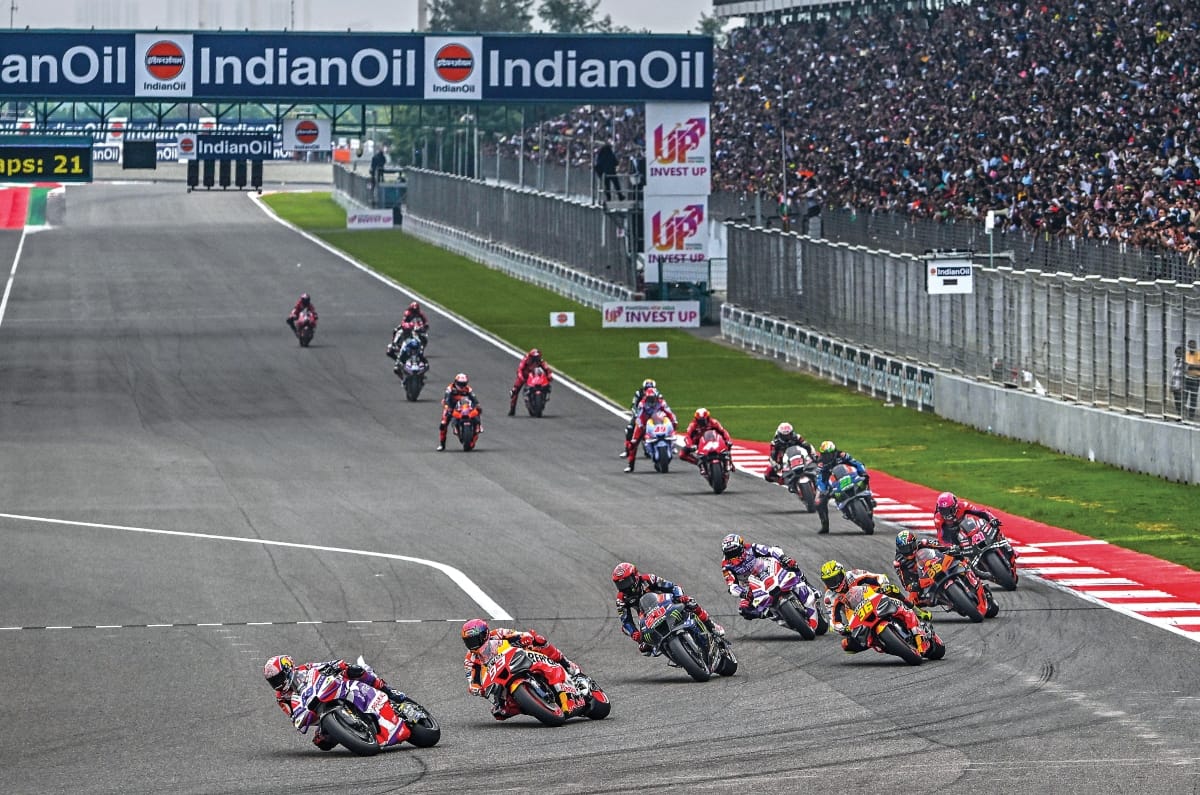
Q: What would you say separates the circuits that survive on the calendar from the ones that don’t?
One is the business, and the second thing is the public attendance. When a track is packed, I think it’s hard to take it off the calendar. And to make a good event, it’s not only about racing. For instance, I say this because I know that Spanish fans are in love with MotoGP. For them, it’s [not just] about following their favourite rider, or favourite bike, or team but also [about] having a good weekend with friends, having good food and doing some kind of escape event.
Q: Coming to your incredible MotoGP career – over 100 podium finishes, 31 wins. Looking back, what are you most proud of?
I would say I’m proud of being able to be fast on a MotoGP bike because, initially, I wasn’t sure I could ride these types of big bikes because I’m built small. But then I was offered the opportunity, and I think I did quite well in an area where other legends were also racing.
Q: Is there any season where you look back and think, “Yes, that was me at my peak as a rider”?
I think 2012, 2013 – these were some of my best moments because I didn’t have too many injuries, and I was performing quite well. The bike also – at the time – was performing well. Prior to that, I did amazing as well, but I was a bit too young and had injuries. And after that period I had too many injuries.
Q: You’ve raced shoulder-to-shoulder with some legends of the sport – Rossi, Lorenzo, Marquez, Stoner. What unique strengths would you say each of them has as a racer?
I liked Casey Stoner a lot because he made difficult situations look unbelievably successful. So, when we had very rough days on the bike – because of weather conditions or the track being almost unrideable – he was able to win easily. This was something I missed.
For Rossi, what I would have had from him was how he handled the media and the fans. I think this was one of his greatest strengths.
From Lorenzo, I think he was a very determined guy; this was one of his strong points.
Marc [Marquez], I would say that he was very competitive; he would fight every centimetre. It doesn’t matter if it was for the win or for second, but if it was fighting against your teammates – in this case, me – he would always fight every little centimetre.
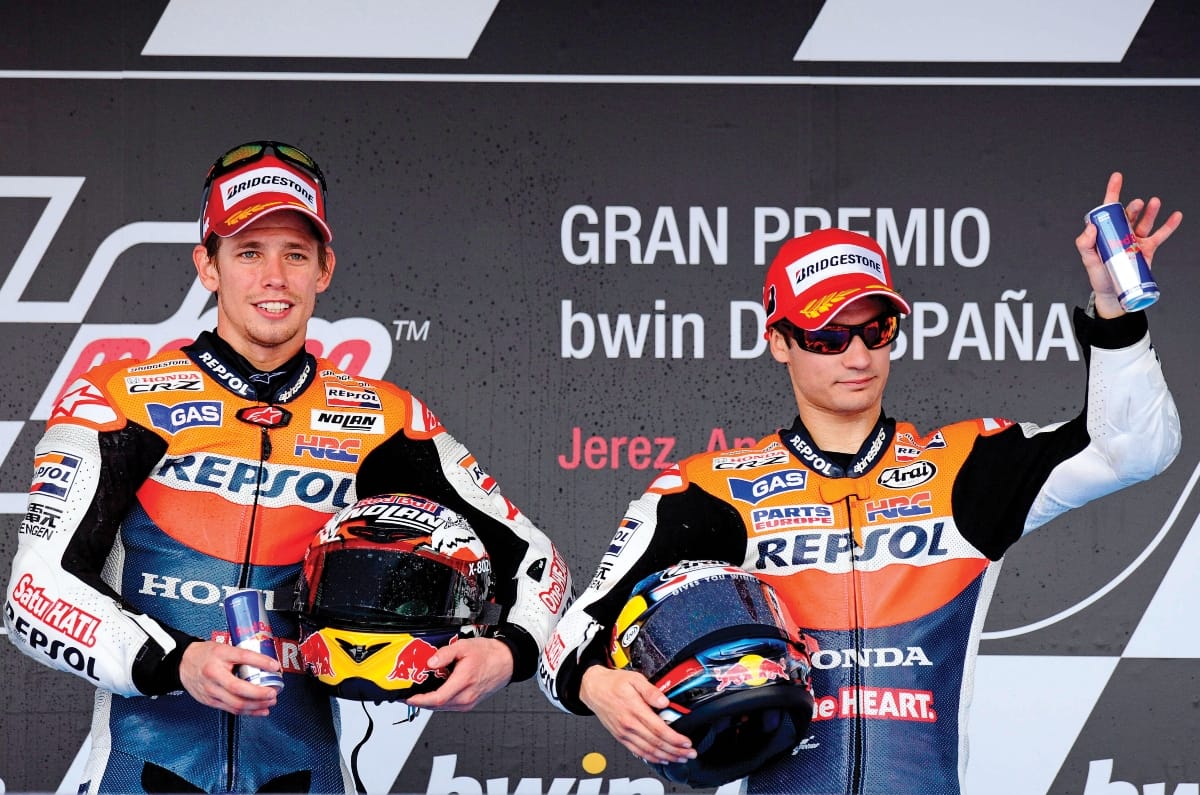
Q: And whom did you enjoy competing against the most?
I did enjoy competing against Casey because he was always a very clean rider. He always tried to be fast but not dirty, without playing tricks. One of my biggest rivals has always been Lorenzo since we were small because of the Spanish rivalry. I enjoy all of them because they all made me grow in a way. Because, as I said, I miss what Rossi had, I miss what Casey had, but in a certain way, when I realise those things, I always try to improve in these areas. And they made me realise my weakness and work on that.
Q: Since then, you’ve taken on a test and development role with KTM. How different is the mindset of a test rider compared to a full-time GP racer?
The mindset is totally different. Because in racing mode, you are very picky. You don’t accept things that are not working, and you just work for the result. You have high pressure on you to deliver results. You have to be super focused on your mission and then try not to be disturbed by the noise, by what everyone wants. You have to be selfish in this regard.
So when you take on a testing rider role, it’s almost the opposite. You have to open your vision a lot and try not to be selfish. Be picky, because you have to choose what parts are working and what aren’t, but you also have to be super patient. You have to understand the timings of production, analysing the data, etc., and then try to understand that maybe the first try is not going to work. You have to word things positively in order to promote people to keep working on the idea.
Q: Do you have any examples of feedback you’ve given that’s translated into performance gains on the bike?
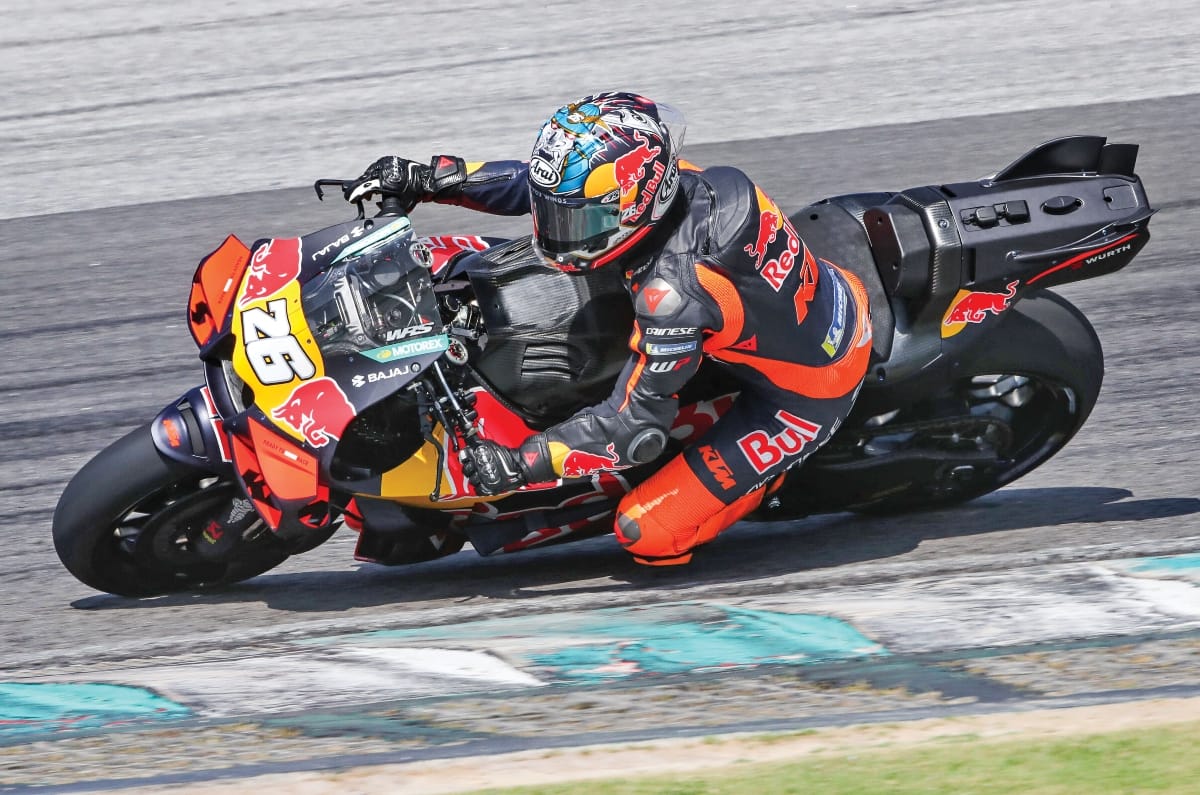
Plenty. For instance, we are now developing a lot of aerodynamics. It’s a new topic in MotoGP, but we don’t have a lot of experience. We have experience with what Formula 1 did but didn’t apply it to MotoGP. When we introduced aerodynamics, the amount of power that you needed to handle the bike was much more.
So the technicians start to look at the aerodynamics and say, “Okay, these are the perfect numbers that we are looking for to gain speed”. But when we try on track, it’s not as the computer is saying – because you get tired, and your arms cannot make the force needed to achieve these numbers. Additionally, at certain speeds, you need to make quick decisions, and with these aerodynamics, you have to anticipate a lot of the decisions. So you cannot make quick changes. We are now learning that we have to listen to the riders more. So, it’s not only a one-sided discussion; it’s about complementing.
Q: You’ve spent your entire racing career without ride-height devices. Since then, you’ve played a key role in developing these devices for the KTM RC16. What is it like to ride with them versus without them?
The ride-height device is basically a tool that allows you to have fewer wheelies at the exit of the corner. This allows you to make every lap the same. Sometimes, without it, you will have a lot of wheelies on some laps and much less on others.
Personally, I like riding without it because then you have more difficulty making every lap the same. And actually, one of my strong points was that I was able to more or less do every lap the same. Other riders struggle more: on some laps, they will have a perfect exit, and on some laps, a disastrous exit. And that’s where I think it’s interesting – for the public to see this difference and to create windows for overtakes in racing.
Q: Next year, we are going to see some big changes in MotoGP. How do you see this impacting the racing?
I think it’s going to be a good change because it’s now been a long time with the same rules. So it’s going to be interesting to have a shift, and at the same time, we have a tyre manufacturer change. I think that’s going to be the biggest change.
Of course, less power on the bike, less aerodynamics, the ride-height device, and so on, is going to be implemented, and that’s going to change the championship a bit. But the biggest change is the tyres because some riders have a softer riding style and some others are more aggressive. So, depending on how these tyres are, some riding styles will suit these tyres immediately, and some others won’t. These riders will need time to understand and reshape their riding style to match the tyres, and that’s going to be a bit more bumpy in the first two years, I think.
Q: Toprak Razgatlioglu is quite used to Pirelli tyres due to years spent racing in WSBK. With Pirelli coming to MotoGP, would you say that gives him a slight advantage in any way?
In the case of Toprak, this year, he’s going to be learning the tyre, the class and most of the tracks. So it’s going to be a bit of a struggle in terms of results. And probably next year, it’s going to turn over because he will be the one with the most experience with the new tyres. He will regain the confidence that he got when he was winning in WSBK. So I think it will be, at the beginning, a big help for him because he knows how much to push, when to push and where the limit of the new tyres is.
Q: Can we expect any wildcard outings from you next year?
We don’t have any plans at the moment. To be honest, I have 299 races. So, I am one race off 300, which is a good record. But I am also turning older, so I don’t know if it’s going to happen or not at the moment.
Q: When you have wildcard outings like Misano and Spain with such impressive results, is there any temptation at all to reconsider full-time racing?
No, actually, you know when it’s your time. I had my great years, and I did this amazing result with the team, and it was a great moment. But to come back full-time, you have to be there mentally. And for that, you need to be exposed to the good and the bad things because you can crash, and you have to attend [to] the media all the time, and there is a lot of pressure to deal with. So for this, you need to be very, very sharp.
Q: And lastly, it looks like it’s shaping up to be Aprilia vs Ducati for MotoGP 2026. Who do you think has the upper hand?
At the moment, Marco Bezzecchi has the upper hand. It’s clearly showing.
It seems like, at the moment, Marc [Marquez] is struggling with his condition or his setup on the bike, and he’s not able to be as strong as he was last year so far. I’m thinking that he will [bounce back]. But the start of the season has been a bit more complicated for him.