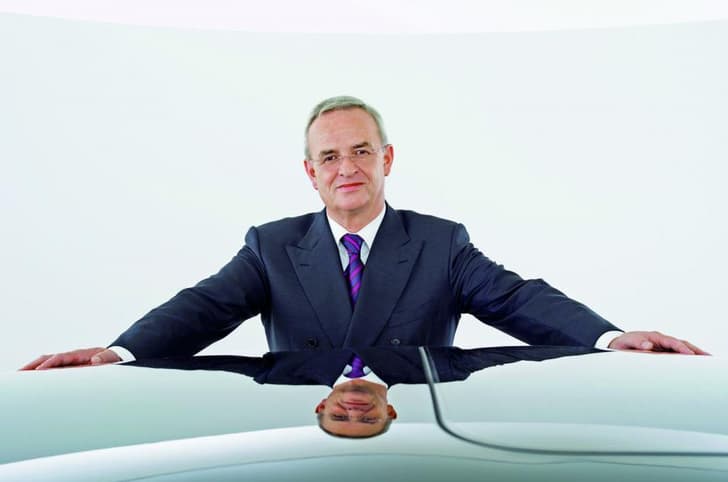
Volkswagen has admitted that then CEO Martin Winterkorn was first aware of the NOx emissions irregularities with its EA189 diesel engine in 2014 - but has denied that it misled shareholders by withholding the information until September 2015.
The revelation came in an official statement by VW outlining the timeline of events, as part of its defence against legal action by shareholders who say the company illegally withheld information regarding the scandal.
The chief purpose of VW’s carefully worded statement is to explain its defence of legal action, but it also offers a fascinating timeline of events that unfolded in the build-up to the scandal for the first time.
VW traces the scandal back to 2005, when it decided to launch diesel engines in the US. It would do so with the EA189 engine. But US regulations were far stricter than Europe, the 31 mg/km of nitrogen oxides (NOx) emissions limit six times less than that allowed under EU5 law at the time. VW says that reducing the NOx emissions would impact on CO2 emissions.
During development of the EA189 for the US, VW says that “a group of persons – whose identity is still being determined – at levels below the group's management board in the powertrain development division, decided to modify the engine management software”.
This act, VW says, produced emissions values in bench testing that “differed substantially from those under real driving conditions”.
VW says that this was done by a “significant modification of the existing engine management software” and was done so with “relatively small changes and within the budget that was available for the development of the engine management software and without the need to involve superior levels”.
This software manipulation first came to light in May 2014 when the Californian environmental agency California Air Resources Board (CARB) heard of the irregularities in a study published by the International Council on Clean Transportation (ICCT).
This study looked at NOx values for two VW models and the fact they “deviated significantly between bench testing and road operation than would be expected under normal circumstances”. CARB requested an explanation from the Volkswagen Group of America, who investigated over several months, and offered to recalibrate first and second generation EA189 engines as part of planned service work from December 2014.
It was after the ICCT report that the VW CEO Winterkon was first informed, on 23 May 2014 as part of his “extensive weekend mail”. The statement reads: “Whether and to which extent Mr. Winterkorn took notice of this memo at that time is not documented.”
A second memo to Winterkorn followed on 14 November 2014 that said that the issue would cost €20 million to fix in North America.
VW admits that the issue was “treated as one of many product issues facing the company” and “did not initially receive particular attention at the management levels of Volkswagen”. At this time, it was the responsibility of a division of VW called ‘Committee for Product Safety’ (APS).
VW notes that deficiencies between test and real-world figures are common in the industry, as are recalls, but the company “expressly regrets that, looking back, the situation is different”.
Subsequent tests from CARB found VW’s fixes proposed from December 2014 as insufficient. The APS set up its own diesel task force in summer 2015, and as such VW retained US law firm Kirkland & Ellis to advise it on US emissions law.
The issue was then discussed by VW employees on 27 July 2015 on the periphery of a meeting that included Winterkorn and VW brand chief Herbert Diess on damage and product issues, although the exact meeting contents are still being reconstructed.
On this meeting, VW adds: “It is not clear whether there participants understood already at this point in time that the change in the software violated US environmental regulations. Mr Winterkorn asked for further clarification of the issue.”
A month later, VW technicians “gave a full explanation of the technical causes for the irregularities discovered regarding the emission of nitrogen oxides in the US to lawyers from the Volkswagen Legal Department as well as to the US attorneys from Kirkland & Ellis”.
 Dipan Sur
 Viraaj Bhatnagar