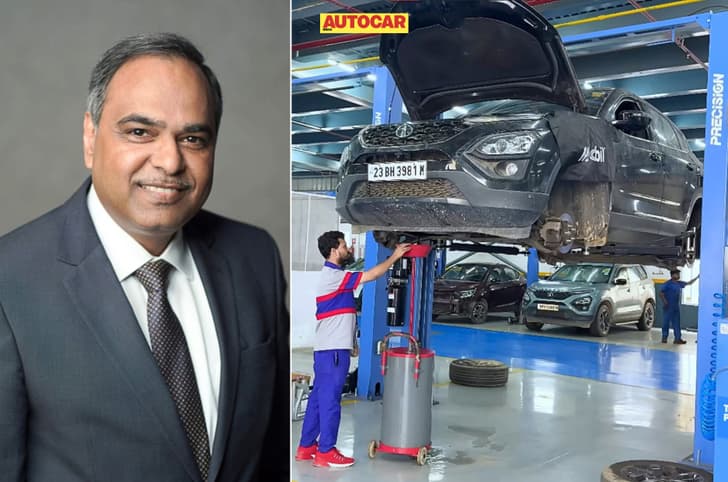
After spending the past few years expanding its product portfolio and nearly quintupling passenger vehicle volumes, Tata Motors is shifting its focus to an area where it has faced criticism in the past – product quality. “We have to prepare the system proactively rather than reactively,” managing director and CEO Shailesh Chandra said, outlining the company’s strategy to strengthen quality through AI, digital engineering, predictive diagnostics and total quality management (TQM).
- Early-life vehicle issues are down by nearly 60 percent
- AI-based diagnostics to reduce repair times and repeat failures
- Digital twins and virtual testing to strengthen product validation
Quality processes being strengthened
Tata Motors acknowledged that rapid growth and increasing vehicle complexity were among the reasons why its after-sales services and product quality came under stress. The company claims it has already reduced early-life vehicle issues by nearly 60 percent through tighter factory quality gates, improved logistics processes and electronic proof-of-delivery systems.
“There are two stress points as far as [product] quality is concerned. One is steep growth, which leads to the system coming under stress, and the second is new technology,” said Chandra.
Predicting outcomes through AI and digital engineering
The company will expand the use of hardware-in-loop testing, software-in-loop validation and digital twins to validate systems virtually before physical testing. It also plans to use AI and telematics data to identify potential defects earlier and improve manufacturing processes.
Chandra noted that state-of-the-art quality infrastructure across the company’s plants will “enable precision manufacturing” and “leverage data and AI”, especially for early defect identification, outcome prediction and continuous learning.
“We are building the capability to detect early signals, predict outcomes and prevent issues before they manifest,” said Tata Motors PV chief product officer and chief corporate quality officer Mohan Savarkar, adding that digital engineering, diagnostics and software-defined vehicles would enable continuous improvement throughout a vehicle’s lifecycle.
AI to support after-sales operations
The company said TQM will be extended across its engineering, manufacturing, supplier and after-sales operations. It will also introduce AI-based diagnostic tools across its service network to improve fault detection, reduce repair times and minimise repeat failures.
“Going forward, you will have diagnostic tools which are AI-based, which completely map the fault tree and are able to immediately identify the real problem. Therefore, turnaround times become faster and repeat failures reduce,” stated Chandra.
 Dipan Sur
 Viraaj Bhatnagar

 Uday Singh

 Suraj Viswanathan
 Hormazd Sorabjee
 Kiran Murali