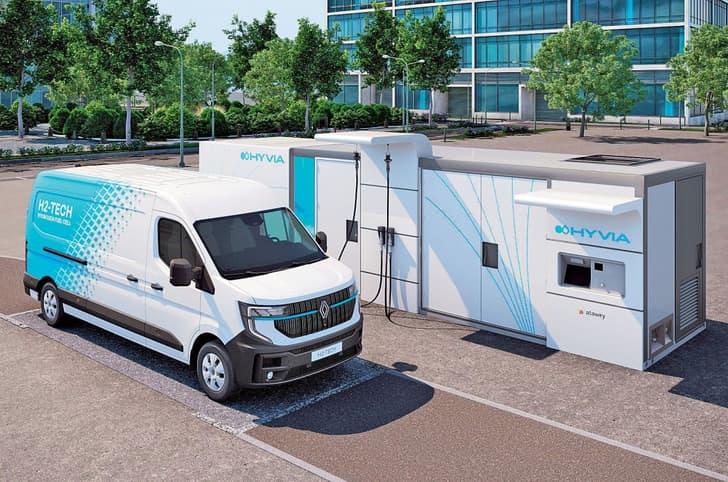
Hydrogen fuel cell projects continue to grow, along with interest in using them to power commercial vehicles and, particularly, heavy trucks. One such is the new Renault Master H2-Tech Prototype shown at the recent IAA Transportation show in Hanover. The Master has been developed by the Hyvia joint venture between Renault and US fuel cell specialist Plug. As part of the project, Hyvia has also developed hydrogen fuel cell stations that are being rolled out across Europe.
The significance of the project to car drivers is that commercial hydrogen fuel cell fleets have long been seen as the way to grow a hydrogen refuelling network. Hyvia’s ‘Hywell’ filling stations are clever because they are “containerised and relocatable”, making them relatively easy to set up, with minimum engineering involved. One station can supply 100kg of hydrogen a day, which is enough for more than 20 vehicles.
The Master H2-Tech Prototype has a WLTP range of 700km and can be refuelled as quickly as a petrol or diesel car. It uses a “dual-power” architecture: a combination of a 47kW fuel cell and a 20kWh battery pack. The fuel cell is a new-generation system based on a Plug fuel cell and is produced at the Hyviaplant at Flins in France.
Fuel cells have an anode and a cathode in the same way as a battery and split hydrogen molecules into protons and electrons at the anode. The protons travel through an ultra-thin membrane to combine with oxygen from air fed into the fuel cell, and it forms water as a by-product along with heat. The electrons flow into a circuit to power the electric traction motor, so the combination of fuel cell and small battery replaces what would be a large high-voltage battery in a BEV.
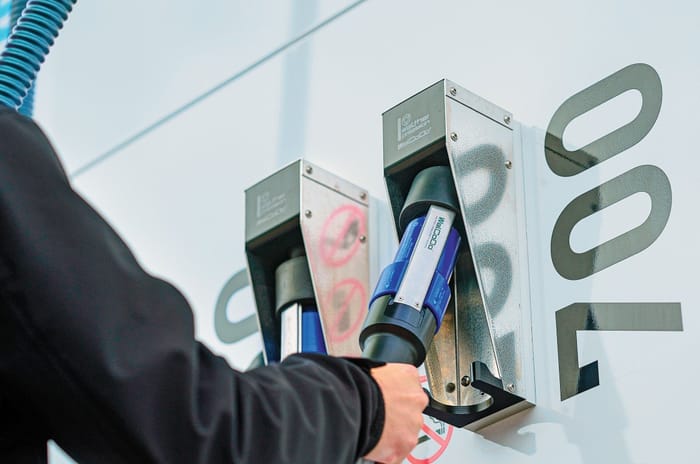
The advantage over a BEV is a much longer range and quick refuelling, but the driving experience is the same as that of a BEV. Fuel cells for vehicles are usually combined with batteries to create a reservoir of energy for the transient boost needed for acceleration, while the fuel cell generates a steady flow of power to top up the battery.
The heat generated by Hyvia’s system is used for cabin heating, and the fuel cell uses compressed hydrogen stored in tanks under the floor. There’s a choice of tanks available, depending on the range requirement, holding either 7.5kg or 9kg of hydrogen. Power comes from an AC traction motor, and, like a BEV or conventional hybrid, regenerative braking allows energy to be captured when the vehicle slows.
From the end of next year, the Master H2-Tech will be manufactured entirely at the Renault Group plant in Batilly, France, and marketed by Renault.