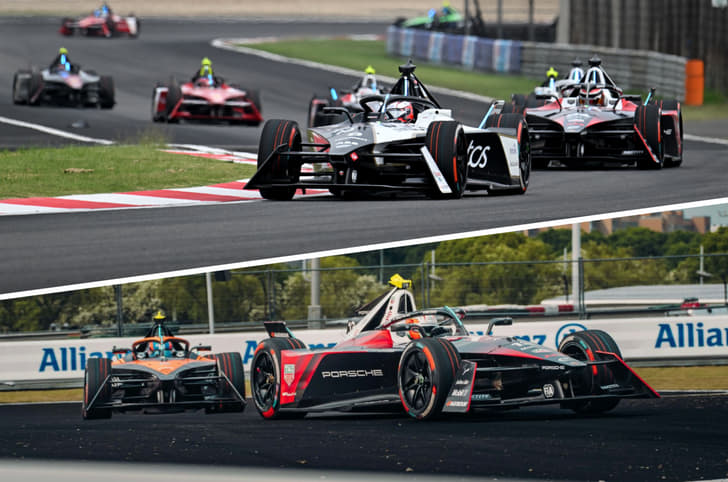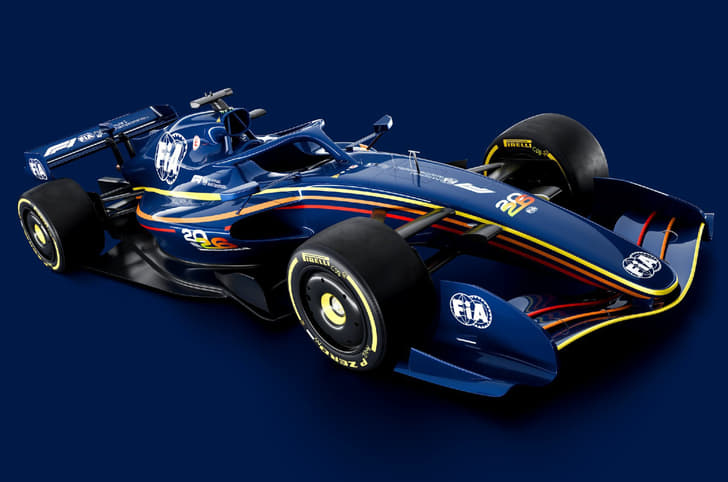
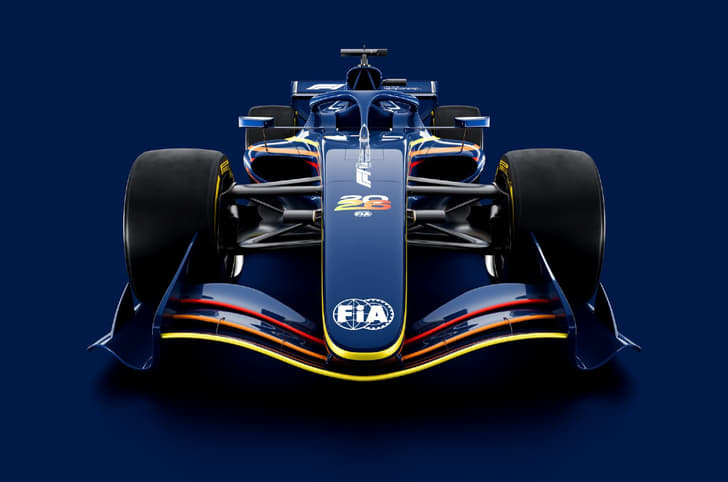
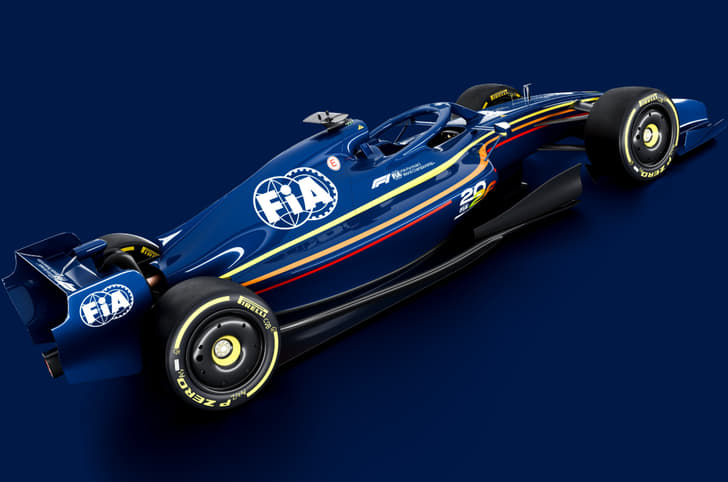
We’ve been given a first look at the next generation of F1 cars, with the FIA (Federation Internationale de l’Automobile) revealing the new chassis rules that will come into effect from 2026 onwards. Some of the key changes include smaller and “more nimble” cars and the introduction of active aerodynamics, which will replace the current DRS (Drag Reduction System).
- New cars will be 30kg lighter
- No Drag Reduction System
- Manual Override mode will provide on-demand power boost
2026 F1: Smaller cars
FIA Single Seater Technical Director Nikolas Tombazis has described the new cars as being “lighter, more powerful and more focused on driver skill”. He added that the new rules have been designed to “provide closer racing among drivers, increase the competition between teams and to improve the spectacle”.
In line with this, the new cars will be smaller. The wheelbase has been reduced to 3,400mm from 3,600mm and the width to 1900mm from 2,000mm. The maximum floor width has also been cut by 150mm.
These new cars will be 30kg lighter than the 2022 cars, with a minimum weight of 768kg. The FIA said downforce will be lowered by 30 percent and drag by 55 percent.
2026 F1: Active aerodynamics
The introduction of active aerodynamics will bring moveable front and rear wings to allow for closer racing. The new cars will be switchable between two configurations: Z-Mode and X-Mode.
Z-Mode will alter the front and rear wings for drivers to enjoy greater cornering speed. The lower-drag X-Mode can be used on straights to maximise top speed. F1 said this new system “can be used in zones like those used for the current DRS overtaking aid.”
Furthermore, a three-element active rear wing will be used, while the lower beam wing has been removed and the end plates have been simplified. The front wing will also be 100mm narrower and feature a two-element active flap. The front wheel arches will be removed.
Other changes include partially flat floors and a lower-powered diffuser. In theory, this should reduce the ground effect and reliance of the cars on ultra-stiff and low set-ups.
2026 F1: More safety
The new rules will introduce a two-stage nose design to mitigate the risk of detachments in initial impacts, which would then leave the car unprotected from a subsequent impact.
Side-intrusion protection has been increased as well. Roll hoop loads have been upped to 20G from 16G. Finally, lateral safety lights will be introduced to identify the Energy Recovery System (ERS) status of a car stopped across the track.
2026 F1: New power unit
F1’s new engine rules had already been revealed in 2022, featuring more electric power and the introduction of 100 percent sustainable fuel.
The new power units will carry on with the current 1.6-litre V6 internal combustion engine but do away with the complex MGU-H (Motor Generator Unit-Heat) system. Instead, the MGU-K (Motor Generator Unit-Kinetic), which recaptures energy under braking, will generate three times more power.
So, while the power from the hybrid unit would drop to 400kW (544hp) from 550–560kW (748–761hp), the battery element would increase massively to 350kW (476hp) from 120kW (163hp). A new Manual Override mode will also be introduced, giving drivers an on-demand boost of battery power when they’re close enough to the car ahead of them.
Along with existing engine suppliers—Ferrari, Mercedes and Renault—the new rules have attracted Audi and Ford and even enticed Honda to return to F1.
The new 2026 F1 rules will now be ratified by the World Motor Sport Council on June 28.
 Dinshaw Magol


 Stephen Raj Antony