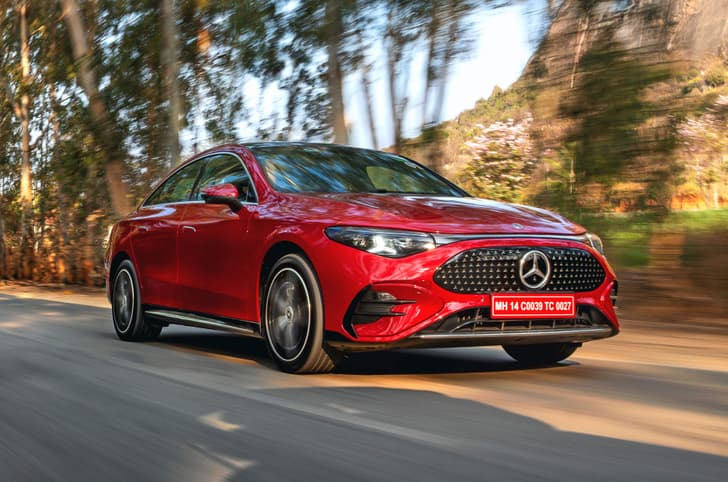

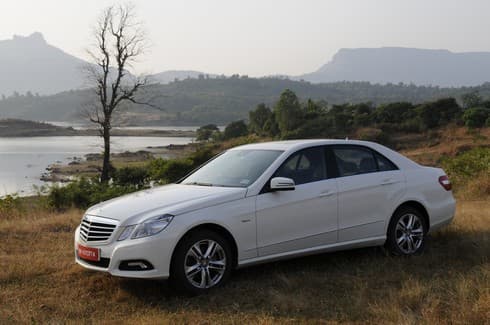
Blue Efficiency is a term coined by Mercedes to encompass a number of small steps that improve overall efficiency. Aerodynamic drag, weight and rolling resistance are reduced, the car’s underbody is closed and power steering pump works only on demand. It’s also the world’s slipperiest saloon with a drag coefficient of just 0.25. The largest impact however is made by the new electro-pneumatically controlled shutters behind the grille. They close when direct airflow-based cooling is not required, reducing the car’s total drag by as much as 10 percent.
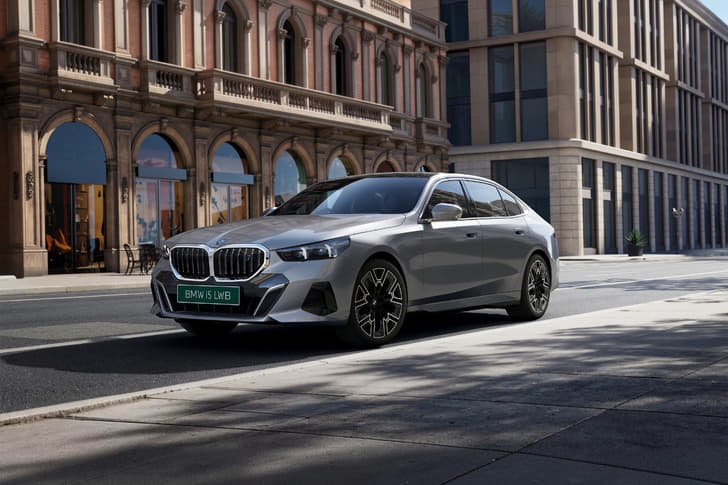
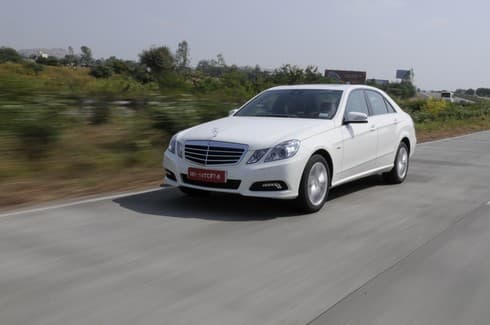
The overall build of the new E reminds us of the way Mercs were built a decade ago, with no compromise when it comes to build strength or solid engineering. The fresh styling with those crystal-cut headlamps and the sharp cuts along the body are fresh and modern and the new E sets new standards for refinement in this class. Even more impressive is the manner in which you step into the car, thunk the doors shut and leave the noisy world behind. It’s like you’ve put on a set of ear muffs.
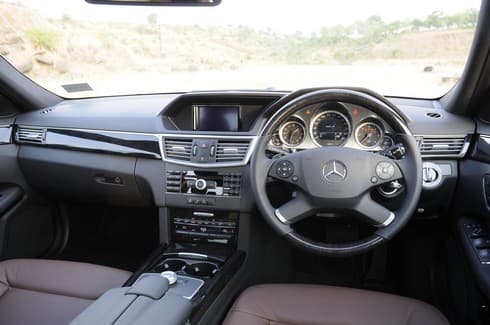
Step inside the new E-class and the immediate impression is of understated quality. It has precise switchgear and lots of soft-touch plastics although some materials and textures like on the steering boss don’t feel very special. The beige interiors have a shade of brown which is not to our liking; we feel the E-class looks best and classiest with black interiors, which is also an option. The interior however comes into its own at night. The ‘waterfall’ lighting effect which splits the dashboard and the downlighting on the door switchgear looks simply fantastic.
The interior design mirrors the exterior theme. The dashboard is upright with angles and straight lines instead of the flowing shape of the previous E-class. Although there is nothing really exciting to draw your attention, all the major controls are well located and simple to use. Taking pride of place is the high-mounted screen housed in its own binnacle. A single knob lets you scroll through the on-screen menus to operate most functions. This arrangement, which Mercedes calls COMAND, dramatically reduces clutter. However, the stereo and climate control systems get conventional controls and the mass of tiny buttons that surround them can be quite confusing. Also, important functions like the Parktronic and trip computer have separate displays and are not integrated into the screen.
What is beyond reproach is the quality feel of the buttons and switches. Even the metal-finish air vents have a solidity that tells you it will last forever. The insides are more practical than before, thanks in part to the column-mounted gear shifter which frees up space in the centre console for large cupholders (which the previous E-class never had). There are three power sockets to charge all your gadgets and the door pockets are generous as ever.
The best news is that Mercedes has finally agreed to give the E-class fully-powered seats. Gone is the manual fore-aft adjuster and instead you get Merc’s traditional seat pictogram on the door which means you’re guaranteed to find a good driving position.
The seats themselves are fantastic, taking comfort to a new level thanks to a new combination of foam, a longer backrest and added length in the cushion. The rear seats too are even more comfortable, if that can be possible. Firstly, access to the rear has been improved by raising the roofline and providing a larger door aperture. The backrest angle at the rear is slightly more reclined which adds to comfort. However, the taller front seat and the higher window line (taller by 18mm) give rear occupants more of a cocooned feeling. It’s something you only notice when you jump from the old E-class into the new one.
Equipment levels are higher than before. The sound system is beefed up, parking sensors are standard and so are cornering lights. And, of course, safety too is enhanced with more airbags than before and a unique Attention Assist system which detects drowsiness and gives a warning!
Despite a few niggles in the Merc’s cabin, there is no doubt that it’s the most comfortable in its class and reeks of attention to detail that’s a step beyond. However, we still can’t understand why Mercedes persists with the old-fashioned mechanical footbrake. A Merc probably wouldn’t be a Merc without one!
The new diesel E350 CDI is just so smooth and sweet-sounding even from the outside that anyone could easily mistake it for a petrol-powered car.As most of you are aware, diesel motors have been gaining in popularity because they have been getting more powerful as well as more silent and refined. But the Merc’s updated 3.0-litre V6 takes this even further. There’s no hint of diesel motor rattle, there’s very little vibration and even when you rev it, it’s as smooth as honey mixed with syrup.
As ever, Mercedes engineers have taken what was already a very good motor and improved on it significantly. While much of the OM 624 (OM stands for Oil Motor or diesel) remains common with the previous-generation E280 CDI, Mercedes has both upped the power and also improved fuel economy. In an effort to make it even more refined and silent, the motor’s compression ratio has been reduced significantly from 17.7 to 15.8. And there are new, more responsive injectors for better control as well as improved air flow and ducting in the engine, all of which translate to even greater refinement. This engine develops torque in a more linear manner and has a flatter torque curve too, which can be felt in the effortless manner the car drives.
This all-aluminum 72-degree V6 also makes a commercial vehicle-embarrassing 55kgm of torque from 1600rpm, just off idle, and this allows this otherwise heavy 1825kg car to be blown forward like it’s an ultra-light skiff. It lacks the surge in power you get in the earlier 280 CDI and you miss that spike to a certain extent, but the overall performance is even stronger.
Normal driving conditions need only a gentle dab on the throttle and even that is good enough to have you scooting forward in that effortless, well insulated, typically Mercedes manner. The greater flexibility of the motor also means that the gearbox in ‘Comfort’ setting can shift up gears much earlier, so progress is both rapid and relaxed. However, with 231bhp, the sharp new E can play performance saloon easily as well.
As you take off from rest with full throttle, the E-class’s seven-speed automatic gearbox takes you through the gears in rapid succession, with the passengers pinned back in the seats. Zero to 100kph comes up in a very rapid 7.63sec. The extra gear on the gearbox is put to good use here. Performance continues unabated further up the power band as well, with 0-200kph coming up in 30.47sec. It also helps that you are given paddle shifts, that in both Sport and Comfort settings, are really nice to use, the gearbox responding swiftly enough to requests for a downshift.
The Blue Efficiency badge you see on the wings of the car is the other new feature. Not a single system, but a collection of optimisation measures that together make a significant impact on fuel economy. Our tests show the new E350 CDI is as efficient in the city and much more efficient than the E280 CDI on the highway. The new E BlueEfficiency returned 7.8 kpl in the city and 13.15 kpl in the highway cycle.
The new E-class’s ride is as flat as Dal Lake at any speed, no big vertical movement even when poor roads are driven over at speed. This new car is also a whole lot nicer to drive when you want to press on. The steering is quicker, the car feels much more agile and willing to take corners hard and after that initial bit of body roll, the frequency selective dampers firm up automatically when you drive harder. And once you are pressing on, there’s a nice cohesiveness to the manner in which this car drives, making it shrink around you.
However, there remain areas where the new E has not taken a big step forward. The earlier E had a more absorbent and silent ride at low speeds, rear seat comfort is not nearly as good and some of the plastics you don’t come into direct contact with feel quite flimsy. But the ride improves dramatically as speeds increase and there is additional room for rear seat passengers, which compensates to some extent.
 Lenny D'sa
 Sergius Barretto
 Saumil Shah
 Soham Thakur
 Nikhil Bhatia