Volvo has given its all-new XC90 a safety package that it claims will reduce the number of serious spinal injuries and fatalities in case of an impact or if the car goes off the tarmac. The 'run-off road protection package', as it's called, will take Volvo, the company says, a step ahead in fulfilling its vision of having zero casualty cars by 2020.
“Studying our own extensive accident data, we discovered that the occupant’s posture during the load transfer through the spine is an important factor," Lotta Jakobsson, senior technical specialist safety at Volvo Cars Safety Centre, said. "However, there's minimal research and development done to reduce these injuries."
To rectify this, Volvo's 'run-off road protection package' will use input provided by the car's advanced sensor system, which will be able to detect a scenario where the car is going to swerve off the tarmac. If so, the front safety belts will be electrically tightened to the maximum extent to retract and keep the passengers in position.
To reduce, and eventually, prevent the number of spine injuries, the new Volvo XC90 has also given an energy-absorbing function between the seat and the seat frame. On impact, the seat will be able to deform, thus cushioning the vertical forces that are created when the car is impacted hard. “By keeping the occupant in an upright posture while cushioning the impact, the vertical forces he or she is exposed to can be reduced by up to one-third. This helps to considerably lower the risk of the most serious and frequent spine injuries in these situations,” Jakobsson said.
Crash testing the new safety technology
Despite the frequency of spinal injuries in the case of an accident, Volvo Cars says that there are no regulatory or rating tests that quantify a car's ability to handle such situations.
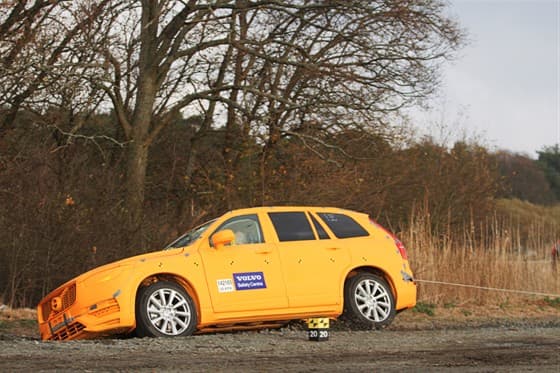
For this, Volvo has developed three new crash test methods – Ditch, Airborne and Rough terrain, and put the new XC90 through them all. The new XC90, filled with adult and child dummies was run through an 80cm deep ditch, sent through rough terrain and was launched into the air at about 80kph only to hit the ground again. In addition to this, the company also developed a method to evaluate the position of the occupant and retention after the crash.
Volvo has also provided technologies to aid the driver. This includes Land Keeping Aid and Land Alert Control. Lane Keeping Aid will help the driver stay on track if the car seems to be moving out of its intended path. Driver Alert Control, on the other hand, will warn tired or inattentive drivers. The XC90 also gets a Rest Stop Guidance system, which will direct the driver to the closest rest area.

 Viraaj Bhatnagar
 Dipan Sur
 Dhruv Dhaka

 Saptarshi Mondal