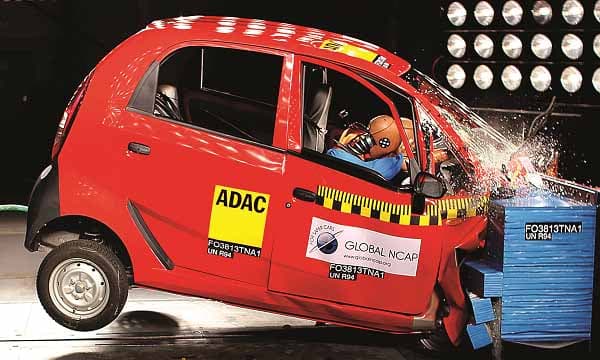
With no government-approved crash-testing facility in India, there are no proper crash safety regulations. And so, the crashworthiness of our homegrown cars was always unknown. Until now. Euro New Car Assessment Program’s (NCAP) independent tests on some of the best-selling hatchbacks in India confirm what we’ve always suspected – that they come off terribly in crashes.
A 2012 survey conducted by the National Crime Records Bureau tallied the total number of reported road accident fatalities at exactly 1,39,091, thereby earning India the distinction of holding the worst road safety record in the world. Only 10 percent of those fatalities happened in cars while 23.2 percent happened on motorcycles, but that’s still a good enough reason to prompt people to buy cars. The fact is, it’s the opposite.
Price, fuel economy and cost of ownership take precedence over ABS, airbags and crumple zones. Though car buyers are becoming increasingly aware of the latest safety features, they still don’t want to pay for them. This situation is one of the factors that forces manufacturers to cut back on safety features and offer cheaper variants to attract buyers.
Take, for example, the Tata Aria 2WD. When it was launched a few years ago, an engineer admitted that a few body reinforcements had been removed; there were no plans to sell the Aria 2WD in Europe and hence, it wouldn’t have to meet Euro NCAP norms. The resultant 45kg weight loss no doubt improved fuel economy and the fewer materials used in construction helped lower ◊ ∆ the cost of the Aria. There are other carmakers who have done this too and, let’s face it, we, as consumers, like the sound of better economy and lower costs.
But this means, we are getting cars that are less crashworthy than their counterparts abroad.
When the Nano was first sent to the Motor Industry Research Association (MIRA, UK) for crash testing in 2009, it passed the 56kph offset test thanks to additional reinforcements at the front. It was designed to meet European crash regulations and was equipped with airbags. So it’s not that we don’t have the know-how; it’s just that safety is not a priority in India – cost is. The Nano would possibly never have been a Rupee-one-lakh car if it was engineered with a four-star rating. Even if manufacturers did raise safety standards, it would, in many cases, push the prices of cars up to uncompetitive levels.
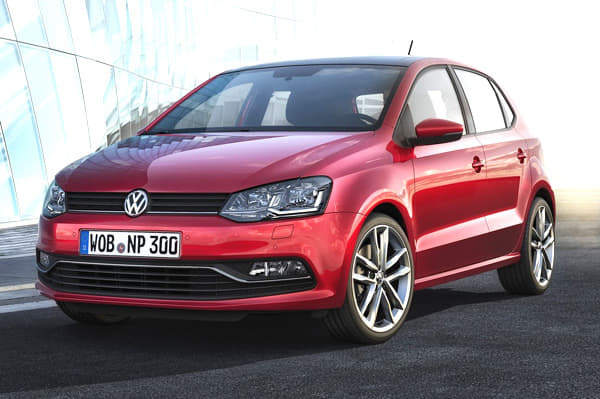
Sure, as demonstrated by NCAP, some cars like the VW Polo can, with the fitment of airbags, pass the test with flying colours. Others, like the Maruti Alto 800, were never designed to meet Euro NCAP; doing so would require Maruti to make a new Alto 800 altogether which, in itself, may not be economically viable.
Alternatively, we could come up with crash regulations specifically for India as our conditions are vastly different from the situations in the western world. But to get to that, we need a crash-test facility. NATRiP’s plan to build crash test centres has been delayed and will take at least a couple of years to be fully operational.
Till then, we could look at other options. The government could probably, like the US does, link it to car insurance, where you pay premiums depending on the car’s safety rating. Another solution could be the VW way – they turned the crash test results to their advantage by offering airbags as standard on all variants of the Polo. This, unfortunately, won’t work on the cars that don’t have strong enough crash structures but it will, at the least, encourage manufacturers to design the next generation of cars to be stronger.
The best thing about the NCAP results is that it leaves no place for the carmakers to hide, and lays bare the cars that are safe and those that aren’t. It can be a huge marketing tool for carmakers like VW, which has emerged as India’s NCAP hero. A spotlight on crash safety will hopefully change the way we think, to make us pay more for airbags than for sunroofs. Until now, we could feign ignorance as to how safe the cars we buy are, but that’s no longer an excuse.
 Viraaj Bhatnagar
 Dipan Sur
 Dhruv Dhaka
 Saptarshi Mondal