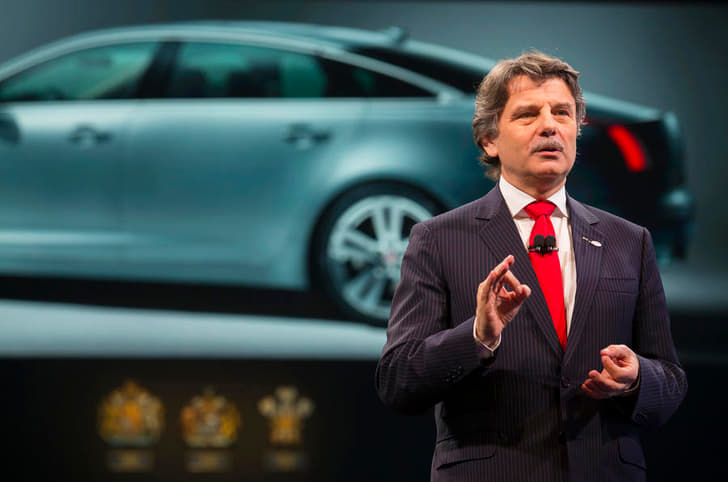
Jaguar Land Rover (JLR) CEO Ralf Speth has launched a fierce defence for diesel cars and attacked the demonisation of modern diesel engines.
Speth told Autocar UK that his company would do more to promote modern diesel technology, and said that its continued adoption would be crucial if the industry was to meet the ever stricter emissions legislation imposed upon it.
“The latest diesel technology is really such a step in emissions, performance, particulates; it’s better for the environment when compared to [an equivalent] petrol. Diesel has to – needs to – have a future.”
Speth believes that the issue of diesel emissions is one for the entire transport and automotive industry, not just one related to cars, as diesel is effectively the sole power source used for commercial vehicles, lorries, buses and taxis, all of which are big contributors to air pollution, particularly in major cities, saying: "the complete automotive industry needs diesel to fulfil legislative requirements”.
Modern diesels are cleaner, meet current norms
Speth highlighted the distinction between older diesels and newer ones, with modern diesels being much cleaner and meeting current legislation. Reporting on diesel has lumped the technology – old and new – together as a whole, Speth believes, and has led to the demonisation of the technology, which he said is incorrect.
“Anyone can see the black smoke coming out of old diesels is bad. We need to replace them with newer ones.”
Speth said that the cleaner emission of modern diesels is the important bridging technology in ensuring emissions continue to fall before hybrids and electric cars really hit the mainstream. Widespread adoption of hybrid and electric cars is needed for the industry to meet stricter legislative emissions targets, but the industry is instead seeing a shift back towards petrol.
“It’s bad for the industry, bad for Jaguar Land Rover, and bad for Europe,” he said. The last point is key, as Speth said that the European car industry more than anywhere else in the world is reliant on diesel cars, and moving away from them would impact the continent’s ability to meet targets.
Speth hinted that he believed the start of the demonisation against diesel could be traced back to the Volkswagen Dieselgate emissions scandal, on which he said: “This kind of manipulation software is not acceptable. Unfortunately, the whole automotive industry suffers, not just Volkswagen.”
Education is now needed on modern diesel technology and to promote its benefits, feels Speth. “Nobody believes the automotive industry anymore,” he said. “They see us as offenders and not giving the right information. We have to show our technology is the best you can buy, to reduce the damage to health and the environment.”
Speth said there would be no specific date when diesel-powered cars would disappear. “ICE to ACE – internal combustion engine cars to autonomous, connected, electrified ones – will happen in parallel. There’s no switch. You can’t say diesel will go in 2020. We need to develop both, internal combustion diesel and petrol engines, in addition to battery electric vehicles.”
JLR and electrification
Speth believes that battery electric vehicles will prove to be the key future powertrain technology, with 25-30 percent of JLR’s sales planned to be of electric cars by 2025. By 2020, half of the company's models will offer some form of electrification, ranging from mild hybrids to fully electric, such as the Jaguar I-Pace. Speth doesn’t see a future for fuel cells, however, believing them to be “poor from an environmental point of view”.
“The future is pure battery electric vehicles,” he said. “No other technology will bring that freedom.”
He called on the British government to do more to support the development of battery technology, and bring together academia to help achieve it. At the moment, Speth said, JLR will be buying in all of its battery technology from Asia, as there simply is no provider in the UK.
“It’s not for JLR to lead; the UK should do a lot better. Academia should be working on the challenges of modern mobility. We’re on an island, and the technology is too big to transport.
“The UK needs a manufacturer. It has missed an opportunity to be ahead in modern mobility. We have the best universities, we know the future is battery electric vehicles, why not use their skills? We’d buy batteries from here tomorrow," he said.
Mark Tisshaw
Autocar UK
 Viraaj Bhatnagar
 Dipan Sur
 Dhruv Dhaka
 Saptarshi Mondal