.jpg?w=728&q=75&fm=auto)
Triumph has launched the new Thruxton 400 in India at Rs 2.74 lakh (ex-showroom, Delhi). While it’s no secret that the bike shares its underpinnings with the Speed 400, Triumph has made several tweaks to bring it in line with the cafe racer aesthetic the Thruxton name is known for. Now that it’s officially here, let’s take a closer look at how it differs from the Speed 400.
Triumph Thruxton 400 vs Speed 400: Design and styling
The Thruxton 400 gets a half fairing, bar-end mirrors, and a rear seat cowl, among other cafe racer-themed elements
.jpg?w=700&c=0)
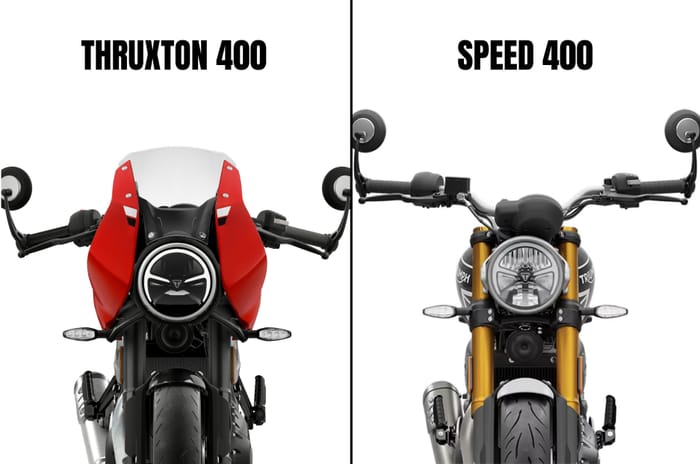
The most obvious differences between the Triumph Thruxton 400 and the Speed 400 are in their styling. Staying true to the Thruxton line, the former features classic cafe racer elements such as a distinctive half fairing, clip-on handlebars, bar-end mirrors, and a single-seat setup with a rear cowl. The fuel tank design (capacity is unchanged at 13 liters) has also been subtly revised.
Other changes include a redesigned tail-light and a blacked-out USD fork on the Thruxton, compared to the gold-colored unit on the Speed 400.
Triumph Thruxton 400 vs Speed 400: Chassis and Ergonomics
The Thruxton 400 puts the rider in a more committed riding position
The styling changes go beyond just visual appeal. The Thruxton's lower-set clip-on handlebars will position the rider in a more committed, forward-leaning stance. In contrast, the Speed 400’s more conventionally placed handlebars enable a relaxed, upright riding posture. The manufacturer has also made adjustments to the steering geometry on the Thruxton and this has resulted in a 10mm shorter wheelbase at 1376mm.
.jpg?w=700&c=0)
The Thruxton and Speed 400 share the same mainframe, but the former features a redesigned subframe. And while suspension hardware is similar with a USD front fork and rear monoshock, Triumph tells us that the units on the Thruxton offer 10mm more suspension travel.
Both motorcycles ride on 17-inch alloy wheels and are equipped with disc brakes paired with dual-channel ABS. However, there seems to be a difference in tyre choice. While the Speed 400 now ships with Vredestein rubber, the Thruxton 400 will come with the option of either Apollo Alpha H1 or MRF tyres.
Triumph Thruxton 400 vs Speed 400: Engine
While the engine is the same, a different state of tune means it produces slightly more power higher up in the rev band on the Thruxton
The new Thruxton 400 is powered by the same 398cc, single-cylinder seen on the rest of the brand’s 400cc range, but in a different state of tune. On the Thruxton, this engine now produces 42hp at a higher 9,000 rpm compared to the peak 40hp at 8,000 rpm on the Speed. While peak torque is unchanged at 37.5Nm, it arrives 1,000 rpm later in the rev range at 7,500 rpm.
Another notable change is that Triumph has equipped the Thruxton with a rear sprocket that has 2 less teeth than the one on the Speed. A smaller rear sprocket typically increases top speed but comes at the expense of acceleration. However, the Thruxton 400 does produce more power with a better power-to-weight ratio, so it will be interesting to see how its real-world performance compares when we have the opportunity to test both bikes back-to-back.
Triumph Thruxton 400 vs Speed 400: Price
The Thruxton 400 is the second most expensive model in the brand’s 400cc lineup
.jpg?w=700&c=0)
With a price tag of Rs 2.74 lakhs, the Thruxton 400 is Rs 24,000 more expensive than the Speed 400, and is the second most expensive motorcycle in the brand’s 400cc lineup, below the Scrambler 400 XC. For the premium, you’re getting a motorcycle built on an impressive, proven platform, and with slightly higher performance figures and a distinctive cafe racer style. The closest rival in terms of genre is the Royal Enfield Continental GT 650, which is priced notably higher, starting at around Rs 3.25 lakh (ex-showroom, Chennai).
 Ved Janve
 Stephen Raj Antony