Wheels falling off vehicles may not be the first thing that springs to mind when it comes to road safety, but it does happen, and it’s well-documented. A two-phase project carried out by The Transport Road Laboratory between 2006 and 2010 established that during that period, every year, there were 7,500-10,000 cases of loose wheel nuts reported on heavy vehicles in the UK and 150-400 wheel detachments. As a result, there were between 10 and 27 injury accidents and three to seven fatal accidents.
Part of the problem in some markets is thought to be the higher frequency of wheel changes due to drivers switching between winter and summer tyres, which increases the possibility of an inadequately tightened wheel nut.
In Japan, it has become a newsworthy subject and something the government takes very seriously. As a result, Sumitomo Rubber Industries (SRI), which owns the Falken Tyres brand, came up with an idea for detecting loose wheels on cars and trucks, and it doesn’t involve special hardware. Called Sensing Core, the technology is entirely software-based and has the added advantage that it can be installed in the software of the vehicle’s ECU.
When ABS was invented, it introduced the accurate measurement of individual wheel rotation speeds, enabling software to detect when a wheel was locking up. Sensing of lateral acceleration and other factors grew with the advent of stability control, and tyre pressure monitoring systems (TPMS) are now mandatory on new cars and light commercial vehicles in the UK.
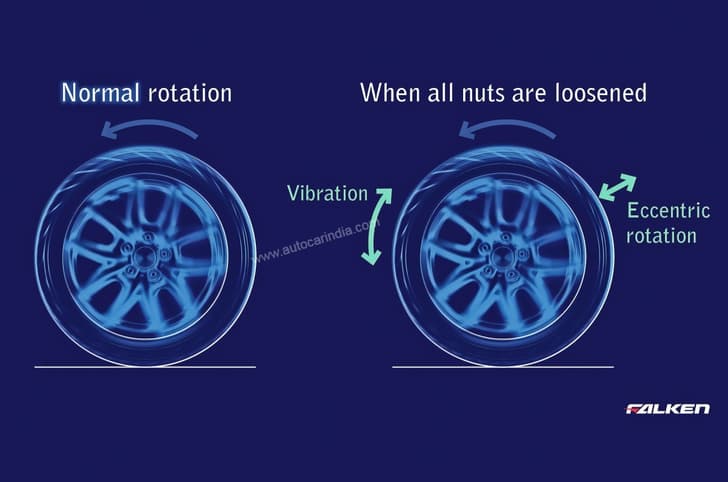
SRI says its Sensing Core software grew out of its original deflation warning system (DWS), which is an indirect form of TPMS and works on the basis of tyre rotation speed. DWS is used by 15 OEMs across Europe, Japan, China and India. So, that information is already available and flying around the CAN data bus of modern vehicles. It also gives an indication of tyre slip on the road surface. SRI’s engineers found wheel vibration produces variations in that data when any wheel nut becomes loose by a millimetre or more and flags it to the driver in the same way as low tyre pressure.
The new technology is part of SRI’s overall Smart Tyre Concept, aimed at collecting a variety of information, such as road and weather conditions, and sharing it across the wider vehicle fleet via the cloud. The company is also planning to use Sensing Core for cloud-based tyre-wear monitoring. The idea is that details of vehicle use are passed to software in the cloud, which uses it to predict tyre wear and warn drivers or fleet managers when a tyre replacement is likely.
Other tyre makers, including Continental and Pirelli, are also investing heavily in smart tyre research, and the technology is likely to have a significant role to play in improving safety in the future.
Sensing Core is being adopted as standard equipment by a car manufacturer this year, and though SRI isn’t revealing the name yet, it seems likely that the technology will appear first in Japan.