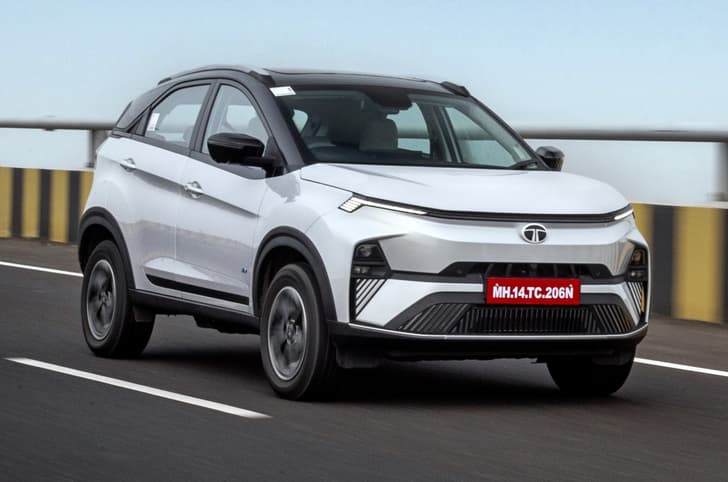
Recently, Tata Motors updated its popular Nexon EV with a larger battery, more power and more features. We’ve now subjected the new Nexon EV 45 through our instrumented real-world tests to see just how much more range you get over the Nexon EV 40.5kWh variants.
As the name suggests, the range-topping Nexon now has a 45kWh battery compared to the earlier 40.5kWh. The company says the new battery pack is 15 percent more energy-dense, so it takes the same amount of space as the 40.5kWh unit, but it weighs slightly more. As such, it has an ARAI-claimed range of 489km, which is 24km more than the 40.5kWh unit’s. Tata says the real-world C75 cycle range for the Nexon EV 45 is around 350-370km. The brand’s C75 cycle is said to represent a near-real-world driving range, and 75 percent of owners can expect to achieve this.
In terms of real-world range, we achieved an average city efficiency of 7.9km/kWh and an average highway efficiency of 7.67km/kWh, resulting in a mixed (city and highway) range of 350 km on a full charge. In comparison, we got a range of 273km from the 40.5kWh version.
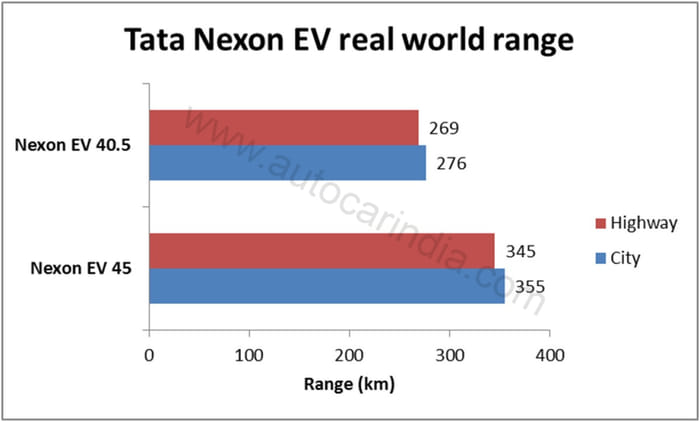
Our tests were conducted in Eco mode, where torque is limited to around 70 percent of the total output and top speed is capped. The regen braking was set to Level 2 in the city and Level 1 (least aggressive) on the highway.
Along with the larger battery, the updated Nexon EV also makes 5hp more, and it features a new panoramic sunroof. The charging time from 10-80 percent, too, is down to 48 minutes instead of the 56 minutes it takes the 40.5kWh unit.
Autocar India’s range testing
Before our real-world range test, the battery of our test car was fully charged, and we maintained tyre pressures in accordance with the manufacturer’s recommendation. The car was driven in Mumbai city and the adjoining state highway on a fixed loop and on a weekday, and we maintained set average speeds. This test was conducted with two people in the car, and we changed the driver after each loop to further neutralise variations in driver patterns. At the end of each cycle, we calculated the range based on the percentage charge consumed. Throughout our test, the climate control was set to 22 degrees Celsius in a full-auto ‘Economy’ setting, and other electrical such as the audio system, indicators and ventilated front seats were used when required, just like a regular user would. We take pride in our testing data, which isn’t merely consistent but also gives users an accurate indication of what they can expect in the real world.

 Uday Singh
 Glenn Noronha
 Dipan Sur
 Dhruv Dhaka