

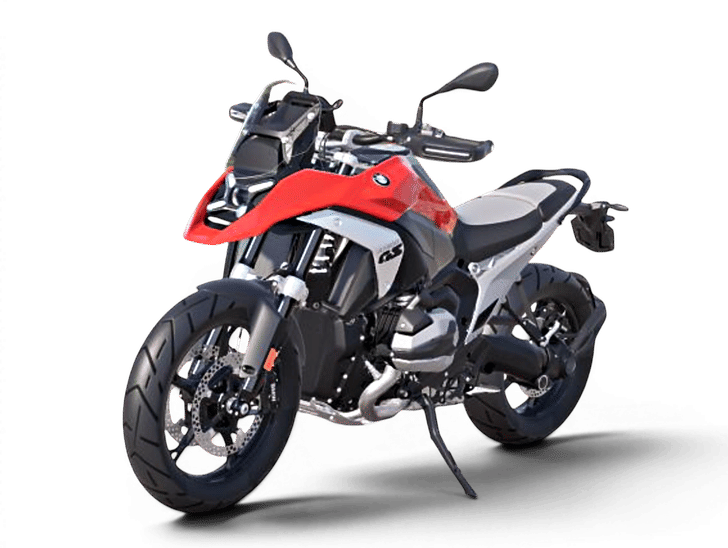
Somewhere on the approach to Passo Falzarego, I kept the throttle open well beyond the sensible braking point, then feathered the brakes far too late and tipped the fully loaded 250kg BMW R 1300 GS into a corner. The horizon tilted at what felt like 49 degrees. The motorcycle took it all in its stride. The suspension swallowed the bend; when I rolled back onto the throttle, the Akrapovič exhaust cleared its throat, the traction control moderated the conversation between the drive shaft and the rear wheel, and the front wheel lifted in a little wheelie of triumph. I carried on to the next hairpin with a smile plastered across my face, as it had been so many times that week.
Around me, the Dolomites were having the best week of their year, in the middle of October. The larches had turned gold and rust, the pale rock towers stood bathed in sunshine, and the tarmac was dry and, for long stretches, entirely ours. Every so often another rider came the other way, two fingers held out in the wordless handshake motorcyclists everywhere seem to have agreed on. And there, around the next hairpin, a thought arrived, uninvited and slightly absurd: all of this had begun with an innocent phone call from Abhijit, my brother-in-law.
HOW IT STARTED
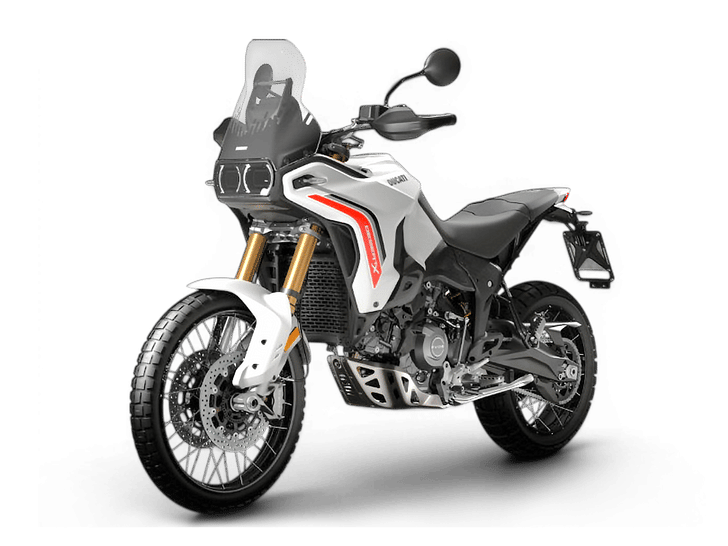
Abhijit was twiddling thumbs between jobs, with time on his hands and a recently purchased Ducati Multistrada V4S standing in his parking bay. He called me for advice on where to take it for a road trip. The conversation wandered from Goa to Rajasthan, and to Kerala, but none of that caught his fancy. Then he said, “What about riding to Ladakh?”


I told him that riding in Ladakh is wonderful, but getting there from Mumbai is tiresome. “It’s not like Europe,” I said rather offhandedly, “where riding from Munich to the Alps is almost as enjoyable as riding in them.”
That was the tipping point. The Alps stuck to the conversation like a rash, and the mere mention of them infused my voice with a whole new level of excitement and elation. By the end of the call, what had started as Abhijit’s search for a week-long ride had turned into a plot in which I had committed to planning a 12-day loop out of Munich through Germany, Switzerland, Italy and Austria, with me becoming a party to the plan. Those eight minutes on the phone ultimately ended up costing me Rs 2.5 lakh – money very well spent!

Then I started looking for a motorcycle. My first instinct was to find something in the 600cc to 800cc category. But my former Autocar India colleague, Ouseph Chacko, now a BMW-certified GS instructor, and Rishaad Mody, this magazine’s motorcycle editor, were unanimous in their advice: “Take the BMW R 1300 GS. It’s a sweet, sweet motorcycle.” That was all the convincing I needed. I asked BMW for one, and they said yes. Abhijit also chose the GS and rented one for the trip.
To plan our ride, I hopped, skipped and jumped between Google Maps, Auntie Claude and Booking.com, checking distances, looking for route advice and good food, and finding mostly affordable two-bedroom apartments with free cancellation as close to the day of stay as possible.
Now, on a bend near Passo Falzarego, with the larches blazing, the great limestone walls of the Dolomites bathed in warm, slanting sunlight, and the road empty beneath a motorcycle that was mine for twelve days, I smiled wistfully at the phone call that had started it all.
FROM PORK KNUCKLE TO PASSO PORDOI
Nine days earlier, I had stepped off an Etihad flight in Munich after an intentional 24-hour break in Abu Dhabi, so I met the GS without a trace of jet lag. The comfortable cabin, attentive service and warm hospitality onboard meant I swung a leg over the saddle well rested and energetic.
We left Munich and rode south, deeper into Bavaria, the Alps growing larger in my visor until Wallgau, a village of timbered balconies and painted house fronts, appeared at their foot. For dinner that evening at the Gasthof Zur Post, I did what any traveller in Bavaria is duty-bound to do and ordered the pork knuckle. It arrived beneath a cap of crackling the size of a small cushion and left as bare bones.
The next day, Austria’s Fernpass and Reschenpass unspooled in long, flowing curves, easy miles in which to settle into the GS before the real work began. Then we dropped into the Italian part of Tyrol and spent two nights in Laces, in the Vinschgau Valley, among apple orchards so laden that the branches were propped up on crutches. This also meant delicious apple strudel at most places we ate at.

Carrying on, we crossed into Switzerland, over the Ofenpass and through the Swiss National Park, on a road lined with pine forest and almost no traffic, before dropping down to Poschiavo, with the Bernina Pass on its doorstep. I had set the mode button to toggle between Dynamic for the long, easy stretches, Dynamic Pro for the passes, and Rain for wet-weather days. By then, my thumb knew which one to reach for before my head did.
Crossing back into Italy, we spent a night near Bormio, and the next morning we came face to face with the mighty Passo Stelvio sitting at 2,757 metres (9,045 feet).

We rode the famed 48 hairpins of the north face. At the Tibet Hütte, the café at the summit, I ate apple strudel with fresh cream and watched cyclists grind up the last bends under their own power, grunting at the effort. I prayed to the Almighty to cure them of this affliction that makes them torture themselves and took another bite of my delicious dessert.
At the bottom of the Stelvio, we turned east through the Vinschgau, past Merano and Bolzano, and powered on to Villandro and the Dolomites.
Rumpelehof stands in the hamlet of Stofls, on the outskirts of Villandro. It is a working farm with self-catering apartments, where Alexandra and Raimund Gasser raise cattle and sheep. Mornings began with bleats and bull bellows rather than an alarm. Our two-bedroom apartment looked straight across at the Dolomites, a spectacular view, especially at sunrise. There were apple trees on the farm, and Raimund told me I could eat the apples without washing them because no pesticide had been sprayed on them. The only thing to watch for was worms. They were delicious, the apples, not the worms.
For dinner on both evenings, we rode down to Gasthof Pizzeria Rustica in Villandro, a sprawling, warmly lit place that unfolds room after room, each one fuller and louder than the last. We came across two lads from Punjab working in its kitchen and had a hearty conversation with them.

It was hunting season, so game crowded the menu. One night I ate a pizza with local salami and fiery peppers, the heat sneaking up like a rumour. The next, I had tagliatelle with a deer ragù – rich, slow-cooked, laced with pepper and finished with Parmigiano Reggiano – that I would happily have crossed a mountain pass for. Fortunately, I only had to ride down a hill.
On our first day there, we rode a loop from the farm through Ponte Gardena, Ortisei and Selva, then up Passo Sella to Canazei, over the Pordoi and back the same way. The Alps had been wonderful, but it was the Dolomites that took my heart, perhaps because we arrived just as the autumn colours peaked.
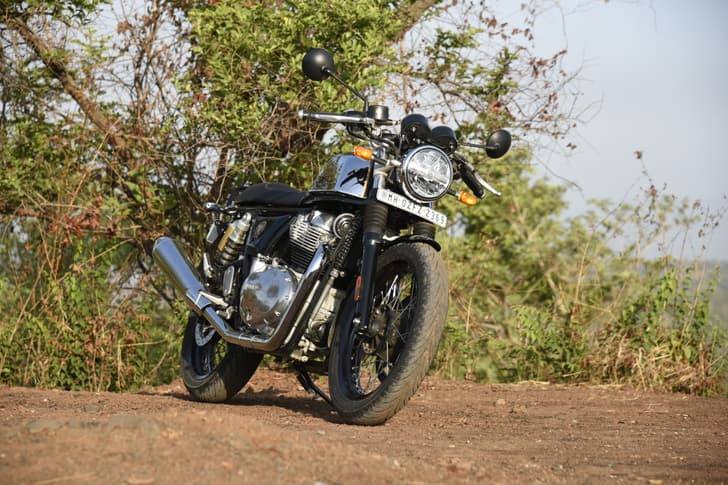
Near Canazei, through my helmet, I heard a familiar thump. My heart told me what it was before I turned my head. Sure enough, a Royal Enfield was chugging up towards Passo Pordoi. I excitedly flagged it down. The rider, from Lake Garda, said he loved everything about India and Royal Enfield. Around us were Multistradas, GSs and Africa Twins, while this humble Bullet chugged up the slope, holding its own, its rider in no hurry at all.

The two engines could hardly have been more different. His Bullet, a single cylinder that thumps. Mine, a boxer, with two cylinders poking out either side like elbows at a crowded table, a layout BMW has been refining since 1923. Blip the throttle at a standstill and the GS rocks sideways, like a large dog shifting its weight. Both are unmistakable, and both certainly have character.
It was the kind of day that leaves you a little melancholic and nostalgic, quietly happy at the way things have turned out. So, the next morning, when I leaned the GS into the hairpin on the road to Falzarego that opened this story, my mind went back to Abhijit’s phone call and how a casual conversation about Ladakh had brought me here.
HOT GRIPS AND WARM HOSPITALITY
Mornings at that altitude start with a nip in the air, which is where the GS earns some of its keep. Thumb the heated grips and seat into life, and within two minutes you are sitting on a warm bench with warm hands, wondering why anyone ever thought bravery had anything to do with riding Alpine passes in mid-October.
The other quiet hero was the BMW Motorrad ConnectedRide Navigator, the GPS unit above the dash, which I came to treat as a third member of the expedition. It is controlled by the rotary dial just ahead of the left grip, so I never had to take a glove off or a hand off the bars. I had loaded the daily routes I’d planned at home. Twelve GPX files, one for each day, went in through the BMW Motorrad Connected app, and every morning, the unit simply knew where we were going. Better still, it let me tell the motorcycle what kind of road I wanted: very twisty, moderately twisty or sensibly straight. I could ask it to avoid motorways and toll roads altogether. Where an ordinary satnav would have hustled us down the fastest road, this one, with a little encouragement from my thumb, kept finding the road worth riding. Over twelve days, it took us on a string of roads I would never have found on my own.

That was how we found the road to Passo Falzarego and a procession of bends I’d happily call unreasonable, in the best way. Auntie Claude had warned me of the possibility of closed passes and snow. The passes, evidently, had not got her memo. Falzarego led to Passo Giau, which, as many riders will agree, is the most beautiful pass in the Dolomites. The road climbs through hairpin after hairpin into a wide, bare bowl ringed by rock, and the GS went up it as if it had been waiting all week for the invitation. Part of the secret is the boxer’s low, wide cylinders, which pull the centre of gravity down, so a motorcycle this heavy turns in like something much lighter.
I braked late, leaned into corners at angles that would make Newton neurotic and got back on the throttle early, delighted by the feel of the front wheel lifting. We stopped at the top for coffee and cake, the two BMWs parked in the sun and preening. From there, we descended through Val di Zoldo, stopping at Rifugio San Sebastiano for a hearty salami and cheese sandwich and indulgent hot chocolate on Passo Duran, then continued to Venas di Cadore.
We were meant to stay the night in the town of San Vito di Cadore, but our booking was cancelled because my credit card payment hadn’t gone through. It turned out to be the best thing my card did all year. A last-minute scramble found us a room at Dolomiti Lodge Villa Gaia, in a village ten kilometres away, and it became the best stay of the trip.

We walked in expecting a bed and a plate of pasta. We walked out feeling like regulars at a village wedding. Dinner that evening at the lodge’s restaurant felt like one long communal table. Everyone talked to everyone, even to us, though we knew no Italian, rounds of drinks were bought for us, and people drifted over to say hello. Most of the diners were locals who knew the staff, but nobody treated us as outsiders.
The staff came from Albania, Italy, Pakistan and Bangladesh, and they worked the room like a well-rehearsed dance. Music played, feet skipped between tables, and now and then a waitress broke into a small pirouette on her way to the kitchen. It was joyful, noisy and entirely unpretentious. The food kept pace. I opted for the wild pigeon, a bird I was trying for the first time. Where I come from, pigeons are treated as a civic nuisance, so there was a certain poetic justice in the exercise. It was really very good.
Villa Gaia was the southernmost point and the happiest evening of our trip, and without anyone saying so, it became the hinge. From there, every road pointed north and back towards Munich. We still rode some glorious ones: from Cortina into East Tyrol, a night at Bergmanns Ferienapartment in Debant, a day on the Grossglockner High Alpine Road in Austria, then Kitzbühel and St. Johann in Tirol. The colours stayed blazing, the roads stayed dry, and the GS kept doling out delight.
But the mood of the trip had undergone a subtle change. The days that had begun with a hunger to reach the next pass now began with the gentle awareness that this was the home run, and that real life, with its emails and credit card bills, was waiting somewhere beyond the Bavarian border. It is an odd feeling, fully enjoying something and mourning it at the same time.
And then we rolled back into Munich, and I hauled the BMW R 1300 GS onto the main stand for the final time. Twelve days earlier, I had been apprehensive about handling this big motorcycle. Now I unloaded my luggage with the sort of reluctance people usually reserve for goodbyes at airports. I gave the tank one last pat, fondly, and walked away.

 Vishal Venugopal