One of the biggest downsides of ethanol-blended petrol is its impact on fuel efficiency. While the Automotive Research Association of India (ARAI) estimates a 1-6 percent drop when running on E20, carmakers admit to a slightly higher 7-8 percent. On social media, however, the perception is far more pessimistic, with claims of mileage losses as steep as 20 percent.
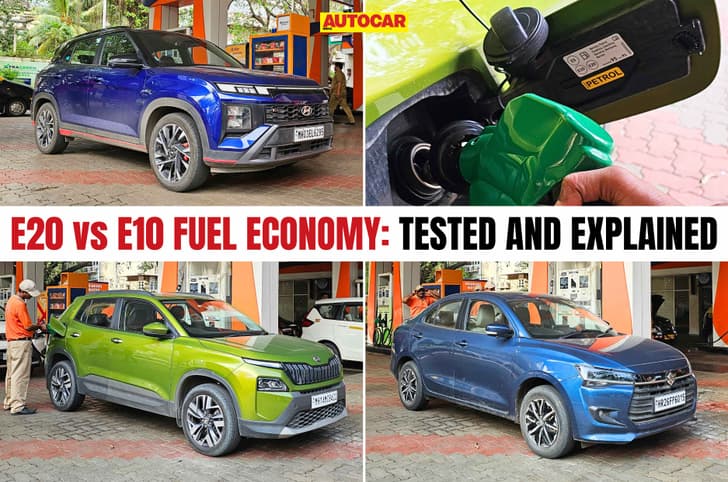
To separate fact from speculation, Autocar India conducted a controlled real-world test with four cars. Representing naturally aspirated engines were the Tata Punch and Maruti Suzuki Dzire, both powered by 1.2-litre 3-cylinder petrol motors. The Punch was paired with an AMT, while the Dzire used a 5-speed manual.
To gauge how turbocharged engines respond to ethanol blends, we added the Hyundai Creta N Line and the Skoda Kylaq. The Creta featured a 1.5-litre turbo with a 7-speed DCT, while the Kylaq carried a 1.0-litre turbo mated to a 6-speed torque-converter automatic. Between them, this quartet covered a broad spectrum – naturally aspirated and turbo-petrol, manual and automatic, sedan and SUV – while also being among the most popular models in their respective categories.
It is important to note that these cars, produced between 2024 and 2025, have all been recalibrated to run on E20 fuel and are fully E20-compliant.
Autocar India’s testing methodology
All cars were first filled with standard E20 fuel, tyre pressures set to manufacturer specifications, climate control fixed at 22deg C and drive modes kept in Eco, with auto start-stop enabled where available. Each car was then driven on the same 230km South Mumbai loop over twelve hours at an average speed of 18-20kph, with drivers swapping halfway to eliminate differences in driving style. The test was conducted during the middle of the week to have the most consistent traffic conditions. The fuel was measured from the same set of dispensers, and a brim-to-brim filling method was used.
In other words, using a higher-octane substitute makes the recreated E10 look better than the original 91-octane E10 would have, and hence exaggerates the difference in efficiency or the size of the drop.
On E20, the Tata Punch delivered 9.43kpl, the Creta N Line 10.59kpl, the Dzire 14.24kpl, and the Kylaq 8.66kpl. When run on the E10 mix, efficiency improved across the board: the Punch climbed to 10.28kpl, the Creta to 12.12kpl, the Dzire to 14.81kpl, and the Kylaq to 9.16kpl.
In percentage terms, the Creta saw the sharpest drop, at 12.6 percent. The Punch and Kylaq suffered smaller but still significant declines, at 8.3 and 5.5 percent, respectively. The Dzire fared the best, with only a 3.8 percent fall in efficiency when switching from E10 to E20.
Why did some cars fare better than others?
By contrast, the Maruti Dzire’s performance stood out for a different reason. Despite its modest compression ratio, it recorded the smallest decline in fuel economy. The explanation lies in calibration. Maruti Suzuki has long been regarded as an industry leader in fine-tuning engine maps – carefully balancing ignition timing, fuel delivery and air-fuel ratios to extract maximum efficiency in real-world conditions. This superior calibration appears to have allowed the Dzire to cope better with the lower energy density of ethanol.
The key takeaway for motorists is twofold. Ethanol blends will inevitably reduce mileage, but the losses are closer to carmakers’ estimates than to the alarmist figures circulating online. And while hardware – compression ratio, turbocharging – sets the stage, it is software calibration that ultimately decides how gracefully a car adapts to ethanol-blended fuel.