Ethanol blending has fundamentally changed India’s petrol landscape. On the downside, ethanol has about 30 percent less energy per litre than petrol. This reduces fuel efficiency by 5–10 percent in real-world driving. Ethanol is also hygroscopic – it absorbs water – and can accelerate wear in rubber hoses, gaskets, seals and plastic components, particularly in older vehicles not designed for E20. For modern post-2020 cars, these effects are mostly tolerable, but there remain unavoidable trade-offs.
Despite these negatives, ethanol has one major advantage: it significantly boosts octane. With an octane rating of around 108 RON, ethanol raises the Research Octane Number (RON) of petrol when blended up to 20 percent (E20).
Oil companies say that E20 (20 percent ethanol blend) increases octane by about 6 RON compared to the base petrol. That means regular E20 petrol, which once hovered around 91-92 RON, should now be closer to 97-98 RON.
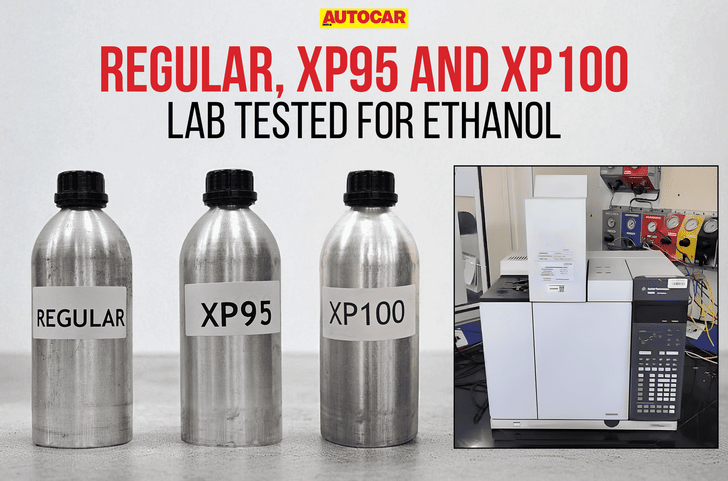
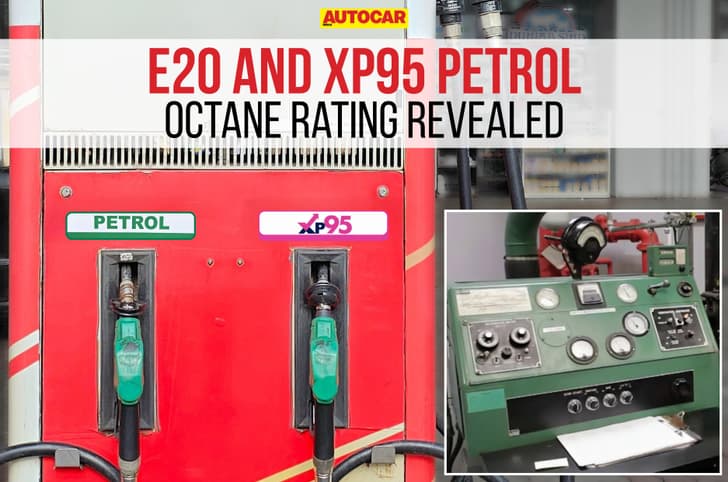
This raises an important question: if regular petrol is already in the high-90s, what is the point of buying branded fuels or premium fuels like HPCL’s Power95 and IOCL’s XP95, which promises a 95-octane minimum? To answer this, we commissioned an ASTM D2699 test – the global standard for determining Research Octane Number (RON) – on samples of regular petrol and XP95 acquired in Mumbai.
How the octane rating test works
The ASTM D2699 procedure uses a single-cylinder CFR (Cooperative Fuel Research) engine under controlled lab conditions. The test, sometimes called the “engine knock test”, measures a fuel’s resistance to knock by gradually increasing the engine’s compression ratio until detonation occurs. The knock resistance is then benchmarked against reference fuels of known octane levels, giving an objective RON value.
Fuel type RON result | Regular E20 petrol 98.2 RON | XP95 98.8 RON |
What the results tell us
Both fuels tested at virtually the same level: just under 99 RON. This means that ethanol blending has effectively levelled the playing field between regular and premium 95 octane fuels. In practical terms, today’s ‘regular’ petrol in India is already higher octane than the advertised 95 of Power95 and XP95, leaving no meaningful performance advantage to justify the premium. The Oil Marketing Companies claim that Premium fuels offers added detergents and “special cleansers” that keep the fuel system clean. That may be true, but ethanol itself is a powerful solvent and already helps dissolve deposits.
High-octane fuel does matter in specific contexts. Modern turbocharged and high-compression engines are calibrated to exploit higher RON, allowing for more ignition advance and reduced knocking. On paper, this should give better performance and sometimes better efficiency. But with E20, there’s a trade-off: ethanol’s lower energy density reduces the total energy content per litre, and this efficiency loss outweighs any gains from higher octane. In short, you may have fuel that resists knock brilliantly, but you will still see a dip in mileage.
Octane booster
The jump in octane rating with E20 petrol changes the way changes the way enthusiasts, tuners and even manufacturers should think about calibration and performance. What was once a 91-92 RON baseline for regular petrol is now nearly 98 RON across the board. Oil companies certify a baseline of 95 octane for E20 at the pump because the actual ethanol blend can fluctuate. While laboratory samples like ours confirmed a full 20 percent ethanol blend – and thus a nearly 98 RON rating – real-world variations can sometimes drop ethanol content (and octane) lower, so a 95 RON guarantee ensures that carmakers can safely tune engines for this baseline while customers often get even higher octane in practice.
The unavoidable downside is the efficiency penalty – a reminder that higher octane doesn’t automatically mean better mileage.