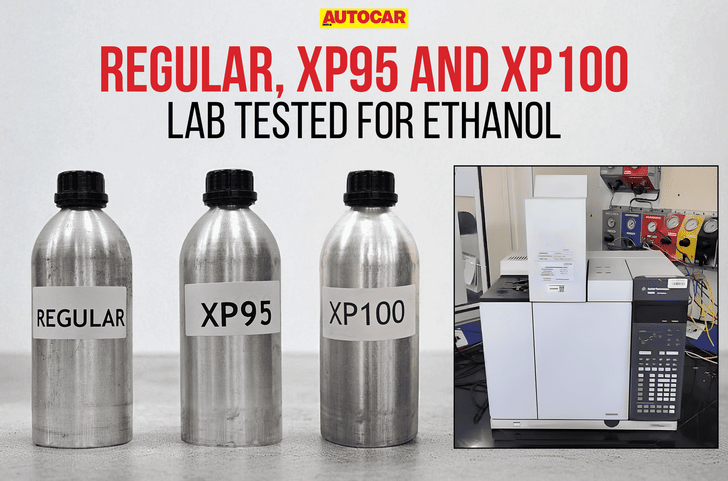
To clear the confusion around ethanol content in petrol, Autocar India tested regular, 95-octane and 100-octane petrol in a certified laboratory.
Why we did this test
With the nationwide rollout of E20 petrol – a blend of 20 percent ethanol with petrol – there has been a lot of speculation about what exactly goes into the fuel we buy. Government notifications and oil companies have confirmed that both regular petrol and premium fuels like IOCL’s XP95 contain 20 percent ethanol, but online debates have only added to the confusion.
Much of this uncertainty came from inaccurate “water separation” tests and aftermarket ethanol sensors, both of which enthusiasts and tuning houses often use to check fuel quality. These tests frequently produced misleading results, with some even claiming ethanol content in fuels where none existed.
Another grey area was premium 100-octane fuels like XP100 and Power100. Both IOCL and HPCL at one point incorrectly stated on their official X handles that these contained 10 percent ethanol, which Autocar India challenged and got corrected. Yet, the belief persisted – partly because influencers, tuning garages and social media chatter kept repeating these claims.
To put this speculation to rest, Autocar India conducted a proper laboratory test using gas chromatography (GC) as per the ASTM D4815 standard. Unlike crude water-separation methods, GC accurately identifies and quantifies oxygenates – a category that includes ethanol as well as other additives like MTBE (Methyl Tertiary Butyl Ether) used to boost octane.
Why sensors and water separation tests get it wrong
Aftermarket “ethanol content” sensors are usually dielectric constant sensors. These measure the change in a fuel’s electrical permittivity, which indeed correlates with ethanol concentration in standard petrol-ethanol blends. But here’s the catch – other oxygenated compounds, such as MTBE or ETBE, alter permittivity in a similar way. So the sensor might register “ethanol” when in fact it’s detecting a different oxygen-rich additive.
Water separation tests are even less reliable. Ethanol is hygroscopic and mixes with water, which is why adding water to E10 or E20 fuel will cause a distinct layer to form. But additives like MTBE also have partial solubility in water, and some co-solvents can mimic ethanol-like behaviour. This means a test tube separation could suggest 10 percent ethanol even when the fuel is ethanol-free.
That’s why only a certified GC test, like the one we conducted, can give an authoritative reading of what’s really in your tank.
Oxygenates composition
What do the results mean
The results are unambiguous. Regular and XP95 petrol contained close to 20 percent ethanol, confirming the government’s E20 mandate. In fact, regular petrol tested at 20.86 percent – slightly above the stated figure, though still within blending tolerances. XP95 was bang on 19.88 percent.
Most significantly, IOCL’s XP100 showed less than 0.2 percent ethanol – effectively zero. Instead, its oxygenate load came from MTBE, which accounted for 12.38 percent of the blend. This not only makes XP100 ethanol-free but also explains why crude ethanol sensors or separation tests mistakenly detect “ethanol” in it.
It’s worth noting that our samples were sourced in Mumbai, and ethanol percentages may vary slightly across the country due to blending practices at different depots.
Why 100-octane has zero ethanol
XP100 (IOCL) and Power100 (HPCL) are the only fuels in India that are ethanol-free. There are two reasons for this. First, these fuels are niche products, sold in small volumes through select pumps. Ethanol blending typically happens at large storage depots, and it’s impractical to manage small-scale E20 blending for limited batches of 100-octane.
Second, ethanol is hygroscopic – it attracts moisture. Since 100-octane fuel is a slow seller compared to regular petrol, it often remains in underground tanks for longer periods. If blended with ethanol, this could increase the risk of water absorption and eventual fuel degradation. By keeping XP100 ethanol-free, oil companies avoid these storage-related issues.
Should you use 100-octane (E0) in your car?
For most owners, the answer is no. At about Rs 60 per litre more than regular petrol, XP100 is an expensive option. Modern mass-market cars built after 2020 are designed to run on E20 and pose little cause for concern when it comes to reliability. Owners will have to accept a drop in fuel efficiency, but that’s part of the trade-off with ethanol blending. For cars produced before 2020, any ethanol-related wear usually appears only after years of use and is generally manageable with routine replacement of rubber hoses, seals and plastic parts.
Where XP100 does make sense is in more specialised cases:
Classic and vintage cars
Older fuel systems are far more vulnerable to ethanol’s corrosive effects. For rare or valuable vehicles, ethanol-free petrol can significantly reduce the risk of long-term damage to parts that are difficult to procure
Supercars and high-performance imports
Many of these were engineered for E10 fuels in Europe and its only after April 2025 that they are certified for E20 Ethanol-free 100-octane not only protects engines but also provides the high knock resistance they need to deliver full performance.
In short, XP100 is worth the premium only if you own a supercar or a cherished classic. For everyone else, it’s unnecessary overkill.
Nothing in-between E0 and E20
Our tests tell you that regular and XP95 petrol in India are E20 fuels, while 100-octane premium fuels like XP100 are ethanol-free and rely on MTBE as the oxygenate. It’s also important to understand why there is no middle ground between E0 and E20. Once the government mandated E20, oil companies standardised on this single blend. Running parallel supplies of E5, E10 and E20 would have made logistics unmanageable and distribution prone to errors. As a result, motorists today have just two real choices – ethanol-free 100-octane and all other fuels which are E20.
With inputs from Lenny D'sa